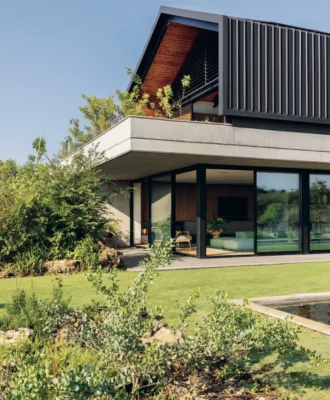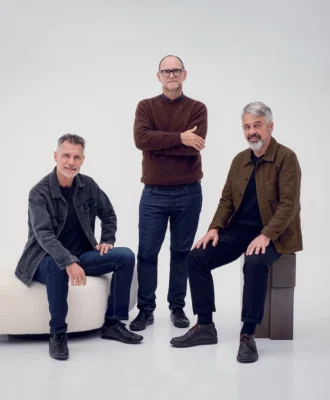
With 2026 around the corner, we’ve decided to round up this year’s most-read features on VISI. From luxe retreats to ultra-modern beach houses, here’s a look at your 15 favourite spaces of 2025 (and checkout our faves from 2024, 2023, 2022 and 2021, too).
COMPILED BY Gina Dionisio PHOTOS Paris Brummer; Jan Ras; Dook; Warren Heath/Bureaux; Greg Cox/Bureaux; Marsél Roothman; Ossip Van Duivenbode; Greg Cox & Emma Jude Jackson
Brutalist Waterkloof House
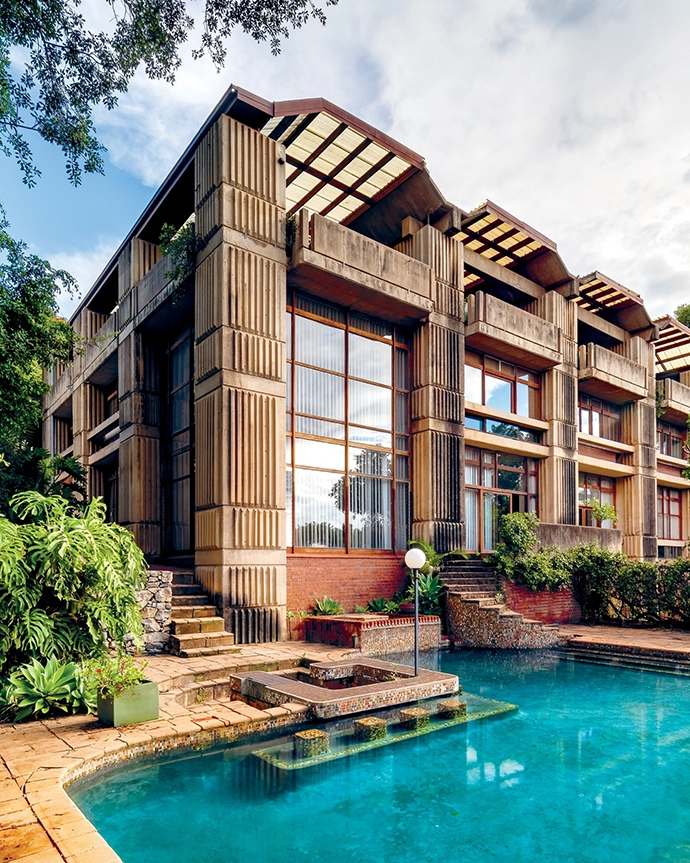
Afew years ago, when a handful of curious architects made a pilgrimage to this spectacular 1970s house in Waterkloof in Pretoria, one described it as a “time capsule”. “We’ve lived here for 48 years,” says its owner. As a result, the architecture and the furniture are perfectly preserved, looking just as she envisioned them nearly five decades ago. Everything has been meticulously maintained, and the house has an almost otherworldly, hallucinogenic quality that leaves you feeling transported in time.
It was designed by architect Petrus Paulus (Piet) van den Berg, a Pretoria architect who, while prolific, hugely versatile and tirelessly experimental over his 50-year career, seems little known outside of local architectural circles. “Piet was a great friend of ours,” says the owner. She and her husband simply wanted “something different” when they engaged him to do the design.
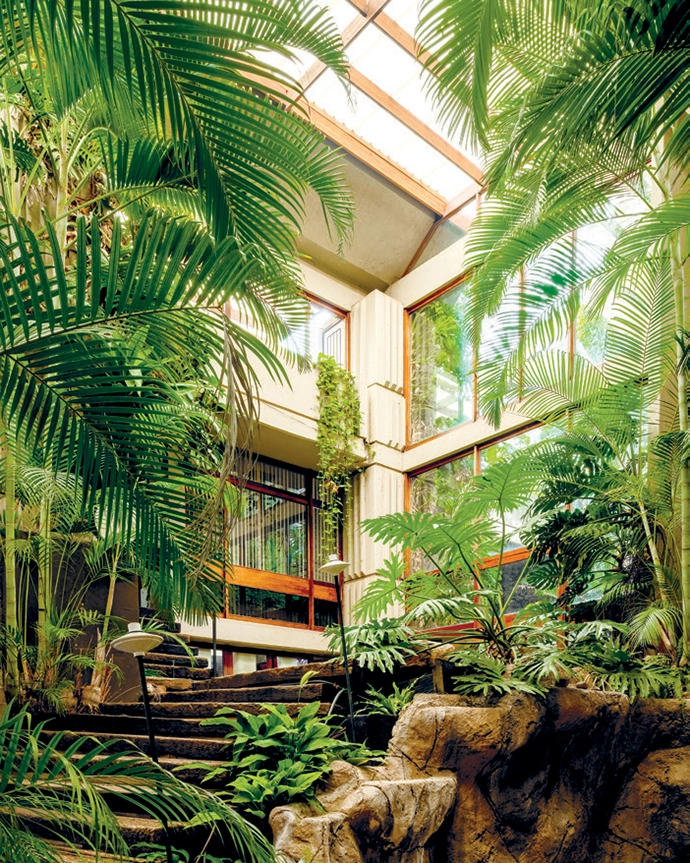
And they certainly got it. Unassuming from the street, the house is on a steep slope. On arrival, visitors drive onto a concrete slab – essentially a rooftop motor court – which wraps around the building, leading to a separate exit. Distinctively shaped fibreglass canopies draw the eye to sweeping views of the city. Brutalist-style columns and heavy wooden doors with ceramic handles hint at the wonders beyond. A concrete spiral staircase descends through a triple-volume atrium filled with a waterfall, a koi pond and a tropical indoor jungle, where palm trees tickle the roof. The ground level features a small aviary built into the columns, and coffered ceilings are a reminder of the raw materiality of the structure. “As you go down, it gets cooler and cooler,” the owner notes.
Read the full story on this Brutalist home in Waterkloof Ridge.
De Rust Cabin
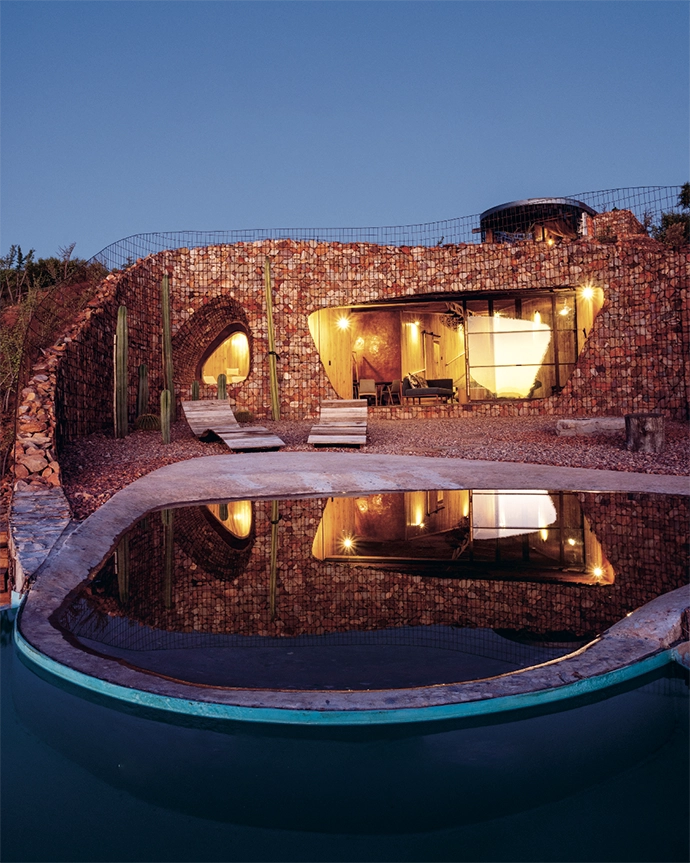
You need game-spotter eyes to see Aardts Cabin – the kind that can spot a motionless mountain zebra cloaked in a Karoo landscape. If you possess this model of eyeball, you’ll see both on a koppie outside the Klein Karoo village of De Rust – although you’re more likely to spot the zebra first, such is the way Abrie von Wielligh’s design appears to have emerged from its rocky, scrubby surrounds. It’s a design that caught Airbnb’s eye in 2022 – the concept was one of 100 global winners of their $10-million “OMG!” competition. The rental disruptor chose 100 designs, each receiving $100 000 to facilitate the build, with the proviso it be rented out on Airbnb’s platform for a year.
“Ag, but ja,” says Abrie dryly. “We ended up a bit short, and had to spend a little more on the construction. You know how it is when you’re building – you think, ‘Why don’t we add this and that…’” And Abrie knows dry well: although he currently lives in George, he’s originally from Namibia. “George is a bit busy and wet for us, so we started looking around for a place to get away. It didn’t make sense to have a beach house, as it’s the same climate as George.” The “we” he’s referring to are his wife Jorika and their two daughters. The family bought the piece of land near De Rust five years ago and, after walking around the property a lot, decided on a location that was hidden from the farmlands in the valley below and allowed them to burrow into the land.
Read the full story on Aardts Cabin.
Skaam Cabin
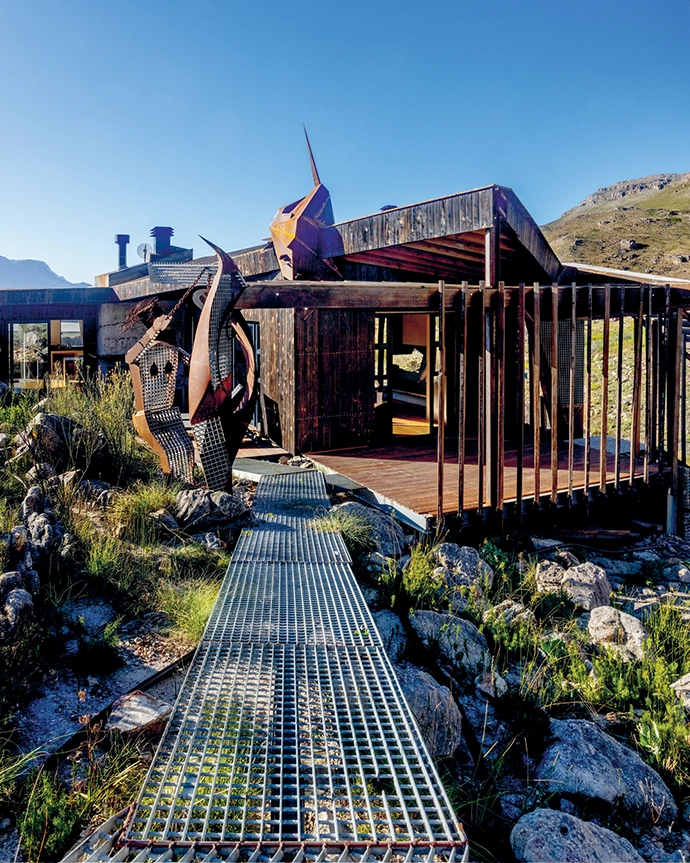
Architectural salvage – the practice of sourcing materials from demolitions and repurposing them for new builds – can be many things. Sustainable? Certainly: it diverts waste from landfill and contributes to a circular economy. Trendy? Indubitably: adaptive reuse is front and centre in a host of recent award-winning builds. Aff ordable? Not necessarily – at least not in the case of Skaam Cabin, a little sandstone-and-timber bungalow situated on a rocky ledge on the Limietberg mountain.
Requiring about three kilometres of off-roading after turning off the meandering Bainskloof Pass, the rocky site couldn’t be more off-the-grid if it tried. This remoteness was both a blessing and a curse for its designer and owner, Wynand Goosen, whose pursuit of a secluded eco-cabin was not without challenges. “Nobody delivers anything here,” he says. “We had to bring everything up ourselves. During the project, I think I drove about 90 000km, and spent about half-a-million rand on diesel – just to get stuff.”
From the outset, he wanted to use reclaimed materials as far as possible. What this meant was near-constant adaptation of his original plans. “The one thing I’ll never be is a quantity surveyor,” says Wynand, who designed and built the cabin through a process of trial, YouTube and error. “We learnt many expensive lessons – stuff nobody tells you about beforehand.”
Read the full story on Skaam Cabin.
Dzombo Lodge
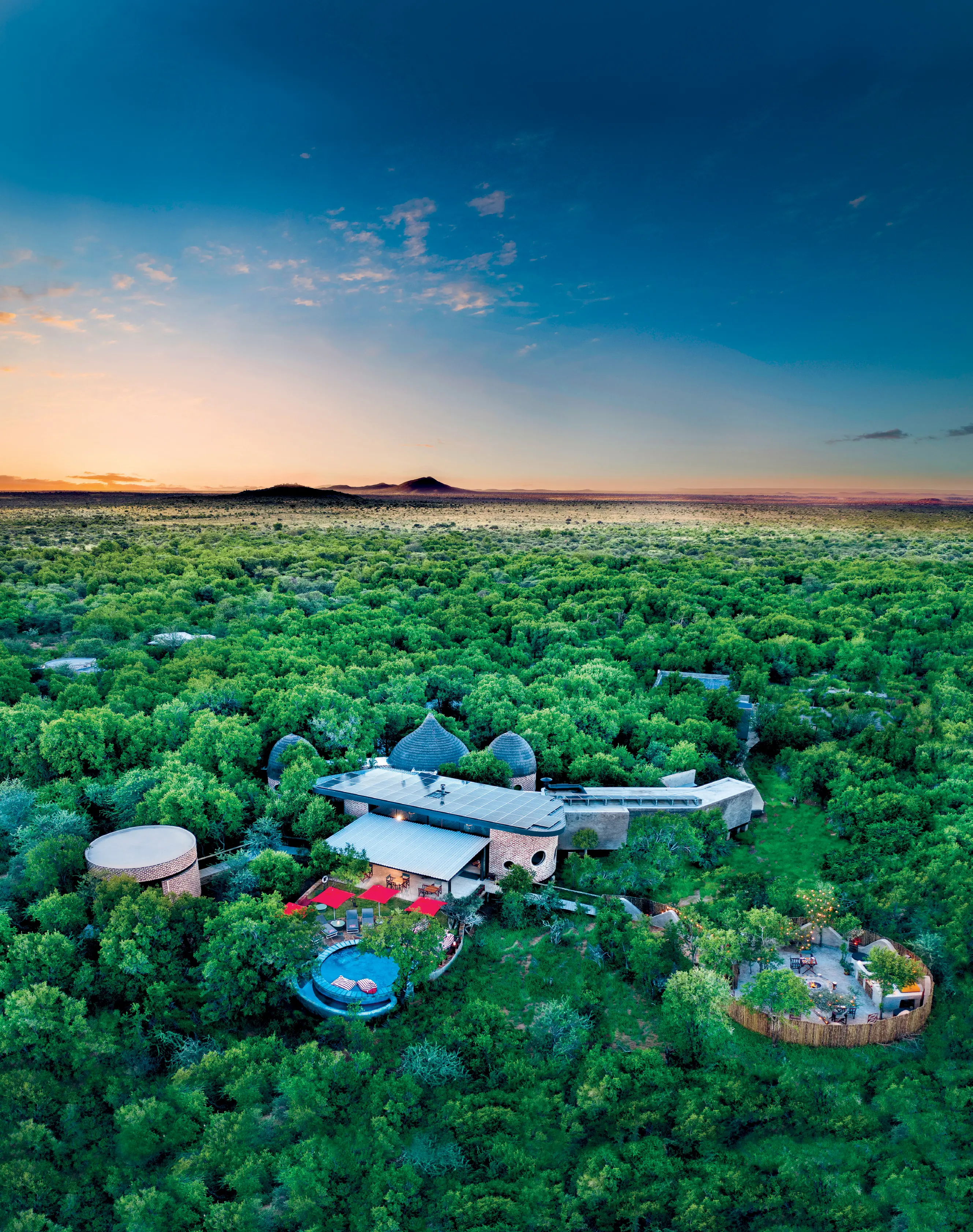
“Vibrant” would best describe Dzombo Lodge. In this wildlife sanctuary – the Black Rhino Game Reserve at the Pilanesberg National Park – you’ll find a yellow giraffe amid green leaves under a blue sky, with an orange sun as a backdrop. The giraffe is a life-sized metal sculpture at the lodge’s entrance, painted so brightly that it’s guaranteed to put a smile on your face.
It’s a testament to the whimsical approach of owners Hendri and Liezel Van Dyk. He is an urbanite brought up around bustling kitchens; she’s a third-generation bushvelder, who grew up with the Kruger National Park as her backyard. Also driving Dzombo’s design approach is the fact that it’s not the couple’s primary source of income – so their goal here is not to fill lots beds or boast a healthy bottom line, but to share their love of the bush with as many people as possible, and to do it creatively. The smaller lodge provides a more intimate experience for couples, but can also be block-booked by family and friends.
They rejected the easy build of bland, thatched, cookie-cutter dwellings, choosing rather to express themselves while keeping their African roots front of mind. They wanted something that would be fun, an unforgettable visual bite, with added vitamins of local design to perk up the energy. Plus there was a budget to keep to – and it wasn’t a big one.
Read the full story Dzombo Lodge.
Reverie Desert Pod
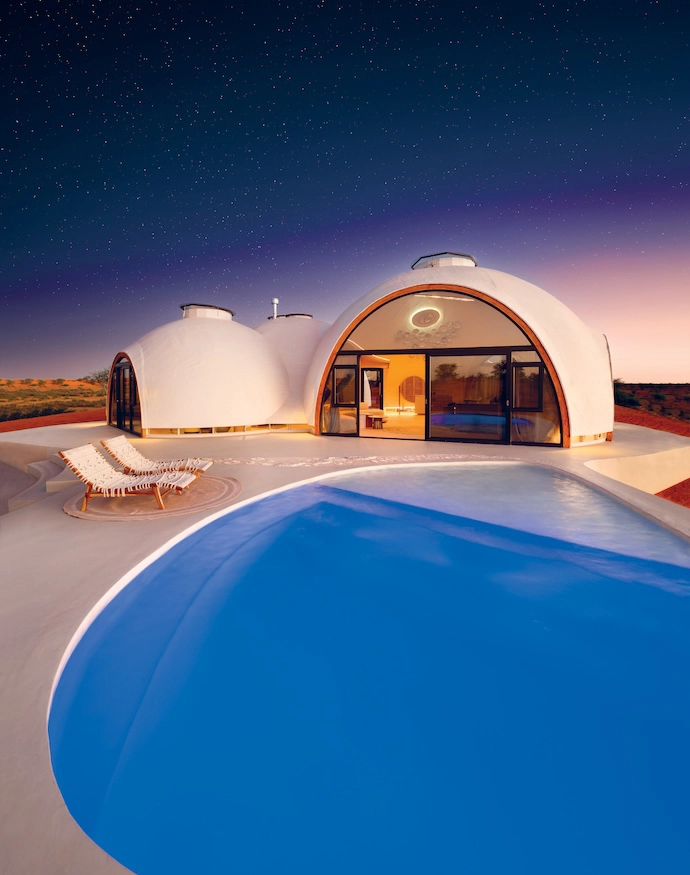
Your first view of Reverie’s white domes emerging from the red Kalahari sands will almost certainly result in one of two impressions. You might get Sven Staby’s original vision. When the Namibian architect considered the Kalahari shapes, forms and elements that could inspire a structural design, on his list were termite hills, weavers’ nests, camelthorn trees… and ostrich eggs. Their hard protective shells inspired an organic structure with domed ceilings and interconnected interior spaces that honours the unique geography of this starkly beautiful environment.
That, or you’re going geek out on Star Wars. Because it really does look like Reverie could be the swankier property next door to Luke’s homestead on Tatooine. Suddenly, your Toyota Fortuner is a landspeeder hovering above the desert – and in front of you, a white wonder shimmers in the late-afternoon heat. You can practically hear the rumble of an approaching Jawa Sandcrawler and the thrum of Obi-Wan’s lightsabre.
Whichever option these images evoke for you, one thing is shared: the force is strong here. There’s a unique and powerful perception of being part of the desert when you’re at Reverie; an overwhelming sense of peace that’s as much about where you are as it is about the very special structure that Sven and the team at Gondwana Collection have designed and built.
Read the full story on Reverie.
Desert Whisper
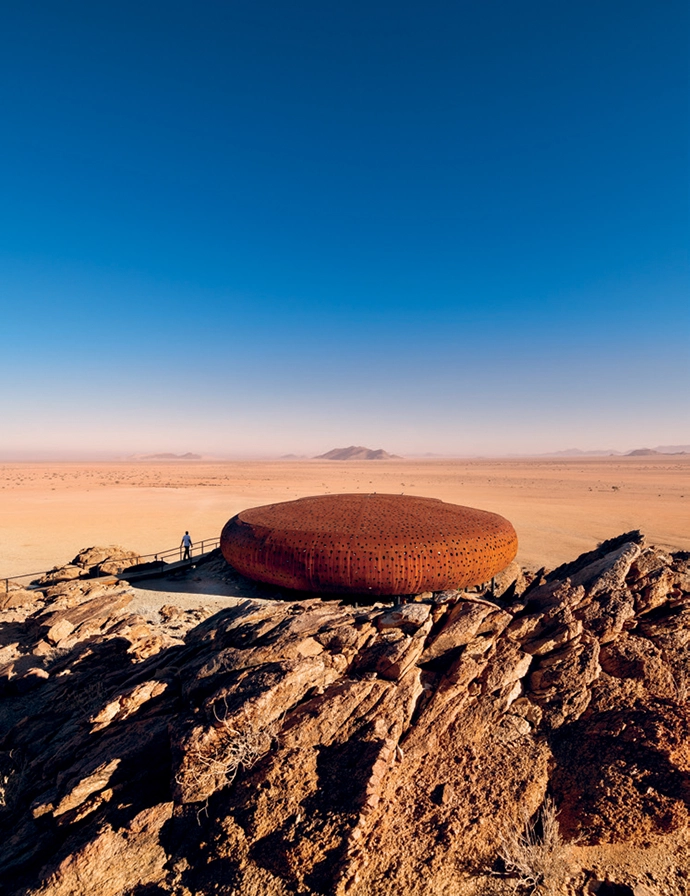
The aliens, it seems, love Namibia. If you picked up a copy of our Feb/March issue, you would’ve read about Reverie – a desert pod in the Kalahari that’s straight out of Star Wars. But it seems that the space travellers from the Dune universe prefer Namibia’s western desert, because perched up on a rocky outcrop on the very edge of the Namib is another sci-fi -inspired pod. It’s called Desert Whisper, and given the topography of their home planet, it’s no surprise its occupants have chosen here to land their spacecraft. This is my preferred origin story.
Alain Noirfalise offers an alternative. As the operations director for the Gondwana Collection – Reverie and Desert Whisper’s owners – his backstory is more grounded in fact than cinematic fiction. “I never thought about it that way,” he says kindly, acknowledging the alien theory. “But now that you mention it, I see what you mean.”
Read the full story on Desert Whisper.
Pringle Bay Holiday Cabin
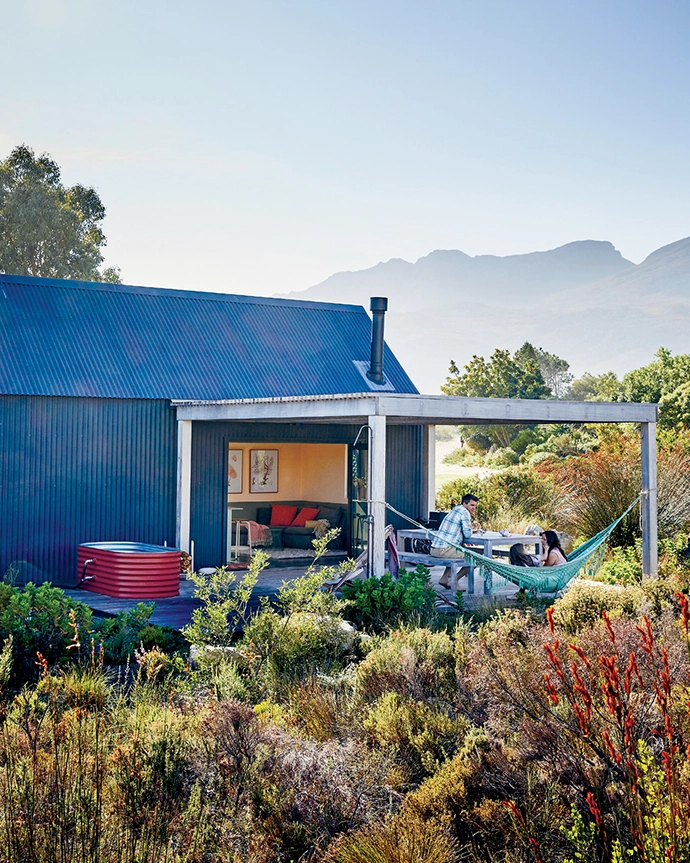
Having spent a large portion of their teenage years surfing along the overberg coastline, Nathalie Ammann and her husband John Blignaut know Pringle Bay very well. Just over an hour’s drive from Cape Town, in a pristine, protected natural area, this tiny coastal hamlet is where they chose to build their recently completed holiday cottage, dubbed the TinTin Cabin.
The couple have always enjoyed exploring the area on holidays away from their daily routine, where John is a fractional business developer and Nathalie manages her family’s farm, Rozendal, and makes an award-winning range of botanical vinegars. In 2018, after a weekend of hiking the nearby Kogelberg mountains, they decided to look at properties in Pringle Bay “on a bit of a whim”, says Nathalie. “It started with a list of must-haves and nice-to-haves – and a small budget.”
A property came on the market that met most of their criteria – budget, walking distance from the beach, a large plot filled with indigenous fynbos – and, says Nathalie, “The plan was always to build within five years of buying the land, while our daughter Amelia was still young enough to spend her childhood there making beautiful memories.” During the lockdowns in 2020, after deciding that a modular, prefabricated cabin was best suited to their budget and aesthetic preference, Nathalie and John decided to go with Cape Town-based company Mobile Maisonette, helmed by architect Jed Kritzinger. “We liked the simplicity of the Mobile Maisonette design, and the fact that their Farmhouse Cabin was bigger than many of the other modular cabins available,” says Nathalie. “It was within our budget, and we could make modifications to the interiors too.”
Read the full story on this Pringle Bay cabin.
Kommetjie Beach House
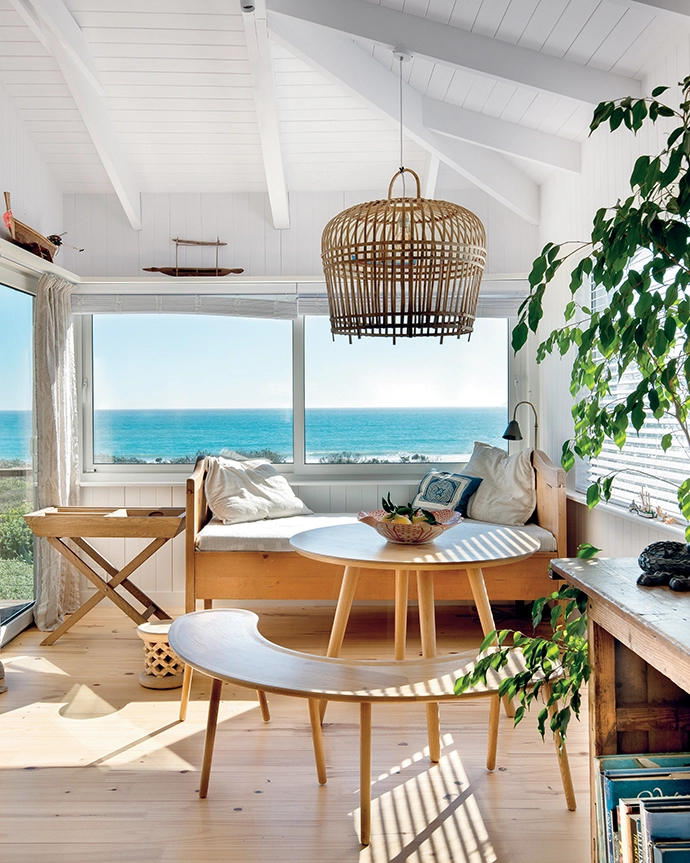
“We bought the house in early 2016, when our youngest son had just finished high school,” says homeowner Christine Daron of this beautiful beachfront abode on the Atlantic Ocean side of the Cape Peninsula. Contemplating the fact that they were about to become empty nesters, this enterprising couple – Louis had had a long career as a ship chandler, while Christine founded innovative textile-weaving company African Jacquard in 2014 – opted to make a move to a new home base. “We were looking for a house by the sea, as my husband is a sailor and a surfer,” says Christine. Finding this property by chance, “We fell in love instantly.”
The property combines the quirky village appeal of Kommetjie with a genuine beachfront location
– you simply walk a few steps along the dune pathway at the front of the house to emerge onto the
spectacular surfing and strolling pleasures of Long Beach. It was the ideal spot for the couple to enjoy a life without their four children, but one that was also “a place of holidays to which the kids could come back”. In 2023, Louis and Christine embarked on a substantial renovation, assisted by local architect Ian Macduff and his partner, interior architect Charrisse Johnston of studioSALT. “We knew just what we wanted, having lived here for six years,” says Christine. One of the priorities was extending the first floor of the house to maximise the ocean views, and creating an enviable master suite of rooms. These now include a large bedroom with en suite bathroom and dressing room, plus a home office for Louis, a lounge area with a bar and kitchenette, and a wide covered balcony furnished for outdoor dining. “It’s a self-sufficient ‘flat’ for our old days – in case we can’t go downstairs any more,” jokes Christine.
Read the full story on this beach house in Kommetjie.
Little Mowbray House
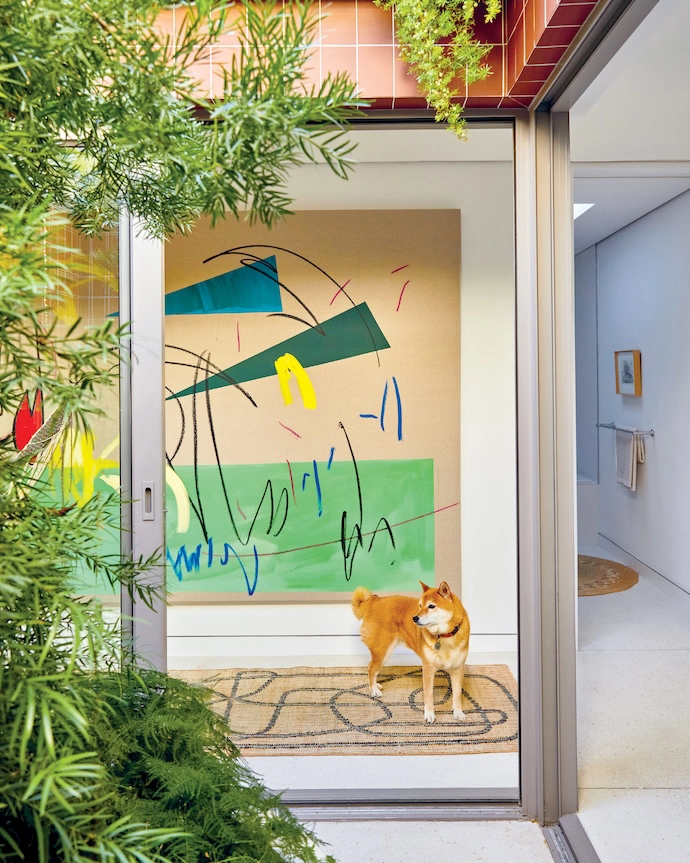
Almost 100 years ago, in his influential 1927 manifesto Vers Une Architecture (Towards An Architecture), architect Le Corbusier declared: “A house is a machine for living in.” Much discussed and critiqued since, the concept retains its explanatory usefulness. For modern designers, buildings should always balance functionality with aesthetics. That may sound simple, but it definitely isn’t easy to do well – and when it’s managed as beautifully as it has been in this home, it’s something to celebrate.
The home isn’t large; it has just two bedrooms and bathrooms, an open-plan area for cooking, dining and lounging, and a small outdoor living space and garden. Tuck in a pocket-sized home office near the front door and a double garage just large enough for two modestly sized cars, and there’s the entire footprint. But while it might be the size of a cottage, due to its thoughtful design and subtly layered interiors, the home punches well above its weight. The home’s previous – and original – owner was the architect who designed it. “He used this tiny sliver of land to make something special,” says the current owner. Visited at dusk on an autumn evening, the house feels welcoming and cosy, yet also airy and spacious. The homeowner points out a few of the ways that architect created the house as a scaling-down property for himself and his wife after his retirement from full-time practice. He made key design choices to add practical and aesthetic value to it. In the morning, natural light pours into the centre of the house via a central atrium courtyard, reaching into the west- facing living area in the afternoon via fully retractable glass sliding doors – all of which, like the rest of the windows in the house, are double-glazed for optimal insulation.
Read the full story on this house in Mowbray.
Sustainable Bushveld Home Near Rustenburg
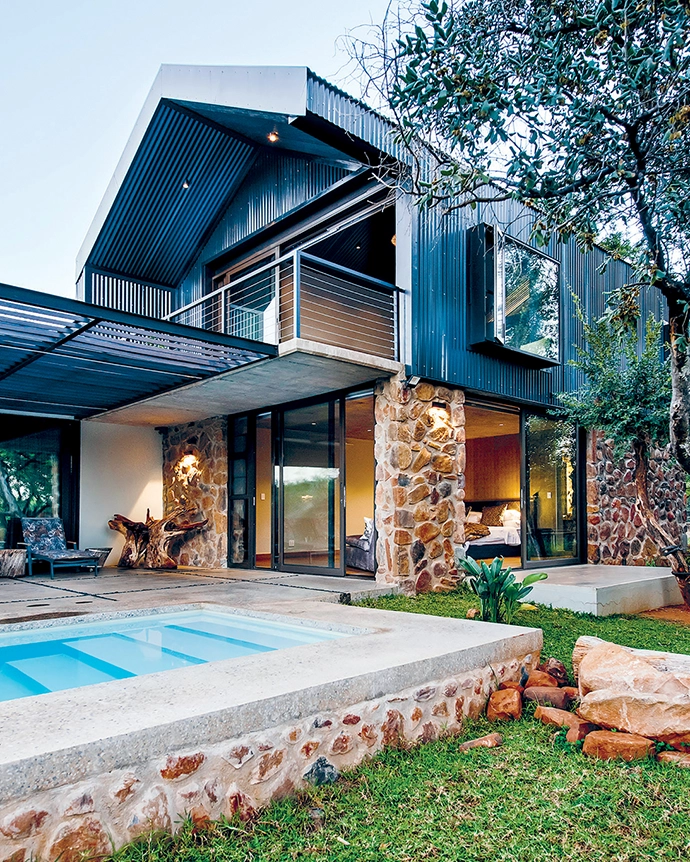
This house quite literally rose from the ashes of its predecessor. The owners returned from a game drive one evening to find their thatch-roofed home ablaze. “Nothing could be saved,” says architect Nadine Engelbrecht, whom they tasked with rebuilding their bushveld retreat.
The owners had seen Nadine’s work featured in a TV programme, and admired her approach. She’s made a name for herself creating, as she describes it, “simple and innovative architecture that’s constantly exploring building materials and sustainability”. Although architects essentially create interiors, Nadine admits to enjoying being outside more, and has a knack for inviting the outdoors in, designing in harmony with natural surroundings. This resonated with the owners’ vision for the replacement for their home-away-from- home. “We wanted an easy living house that remained rustic,” say the owners. “It had to be constructed out of natural materials and using local stone sourced on the farm – and, most importantly, with nothing flammable.”
Although the owners largely gave Nadine carte blanche with the design – “We did not impose any design ideas on her” – there were some constraints. To minimise impact on the site, they wished to build on what remained of the existing platform – a task complicated by the fact that they’d been in the process of building a new suite adjacent to (but not connected to) the house at the time of the fire, which had survived intact. It consisted of an open double garage with a guest suite above it, which needed to tie in with the new house both structurally and aesthetically.
Read the full story on this bushveld home near Rustenberg.
Zwaanswyk House
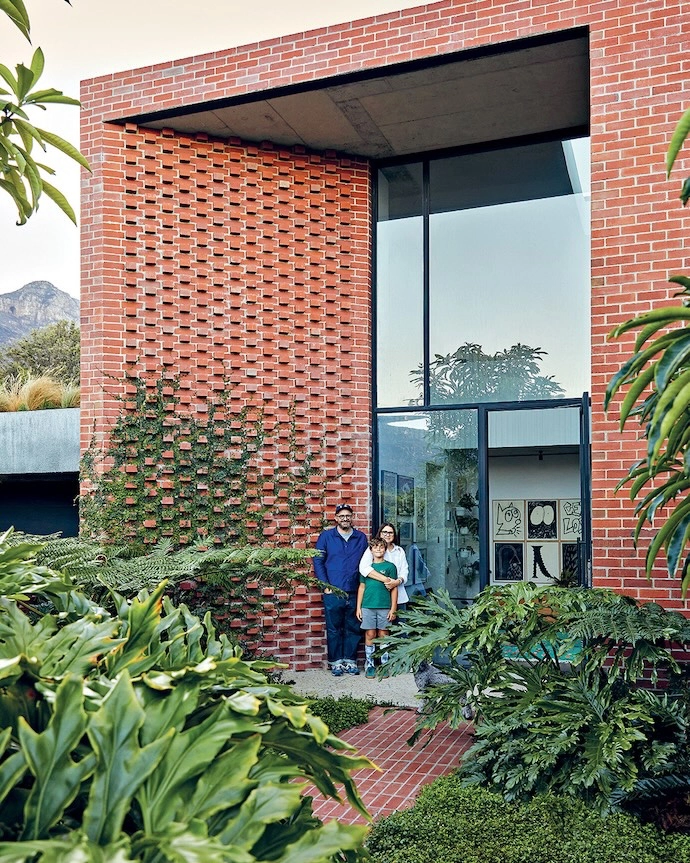
“Francis isn’t impressed by it at all,” says homeowner Willeen Le Roux, laughing, about the striking raw-brick facade of the Cape Town home she shares with her nine-year-old son and her partner, creative director Craig Ferguson. “We’ve tried to explain to him that the inspiration was the Yves Saint Laurent Museum in Marrakech, but he isn’t convinced by that.” Young Francis has dubbed his home “the Minecraft house” – a reference to its looking, in his eyes, much like a building block from the popular online game – and even though he and his parents have lived here for five years now, he still regularly asks, “When are we going to paint the outside?”
Certainly, its blend of bold architectural lines with a zesty red brick facade and arresting “popped-out” steel window frames makes this home a somewhat unconventional building for the area – the peaceful, equestrian hillside locale of Zwaanswyk in Cape Town’s southern suburbs, where new dwellings tend to be low-slung, plastered and painted in subtle shades of pale. Rather like the house alongside this one, which occupies the other half of the large, subdivided plot of land that the couple found in 2019 with Craig’s brother Nick, a property developer. The plan was always to subdivide and build concurrently, which is what the siblings did – with the very capable assistance of Nick’s father-in-law, who is a master builder.
Read the full story on this house in Zwaanswyk.
Rotterdam Micro Apartment
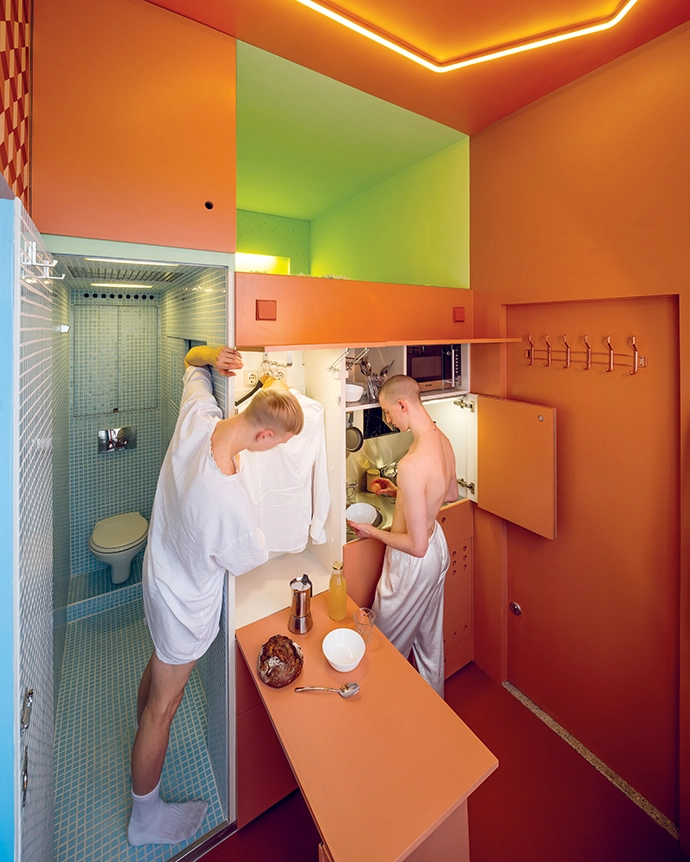
There are all kinds of cleverness going on here. Let’s start with the obvious one: the size. Called the Cabanon in deference to Cabanon de Le Corbusier, which the Modernist master built in 1951, this is most likely the smallest apartment in the world. Within the confines of its 6.89m2, its designers have magicked four rooms of ingeniously different volumes and materials. There’s a 3m-high living room with a kitchen, a 1.14m-high bedroom with plenty of storage, a toilet with a rain showerhead, and a spa with an infrared sauna and a whirlpool bath.
The clever folks behind this are STAR strategies + architecture, a firm based in Rotterdam in the Netherlands, founded in 2006 by Spanish architect and urbanist Beatriz Ramo. And Beatriz and her partner in work and life Bernd Upmeyer, founder of BOARD (Bureau of Architecture, Research, and Design), didn’t just design the Cabanon – they are also the owners and it’s their second home”.
So what inspired them to create such a small living space? “When we started designing the Cabanon, we never intended to make the smallest apartment in the world,” says Beatriz. “What we wanted for ourselves was a mini spa area – but we also needed a guest room for our family when they visited us. As architects, we like to optimise every project, big or small. It is about ensuring you get the maximum possibilities within your given area, budget or programme. In the Cabanon, optimisation was a key issue.”
Read the full story on this micro apartment in Rotterdam.
Koringberg Boutique Hotel
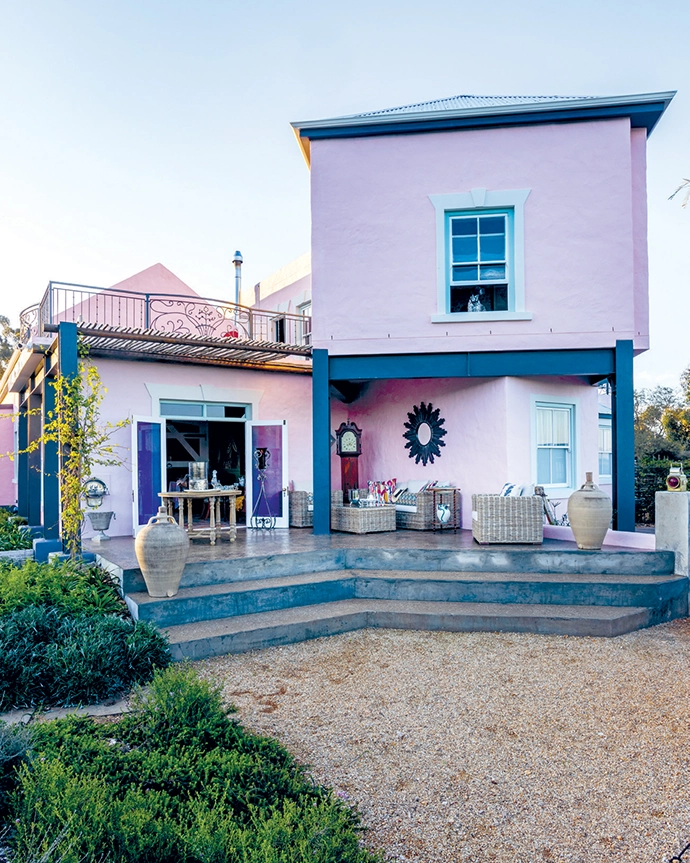
If there was an award for Quaint West Coast Town You’ve Never Heard Of, Koringberg would probably win it. Even Google Maps battles to locate the little hamlet, sending you up towards Koringberg the berg, rather than Koringberg the town. And as fun as those gravel back roads are to navigate, what the online algorithm should tell you is to head up the N7 from Cape Town and, at 112km, look for a “Koringberg” sign that points left.
Someone who turned left more than 20 years ago is Joanne Marrian-Hurst. She grew up in KwaZulu-Natal and has long had a passion for renovating old properties, so when she moved to the Western Cape, it was a tip-off that the local NG Kerk’s old pastorie (rectory) was for sale that saw her quite literally put down roots here.
After planting some vineyards beneath the West Coast sun, she and her late husband Chris started the acclaimed Wildehurst Wines – “Our first Shiraz earned four Platter stars straight out of the box” – and the first iteration of what’s now the Marrian George was where Wildehurst’s barrels were stored. After Chris’s passing, Joanne was ready to retire, and the idea of creating a small hotel as her “memoir” was born. Construction began in 2023 with the renovation of the storage barn and the addition of an angled second storey for three of the hotel’s five bedrooms.
Read the full story on the Koringberg Boutique Hotel.
Bishopscourt House
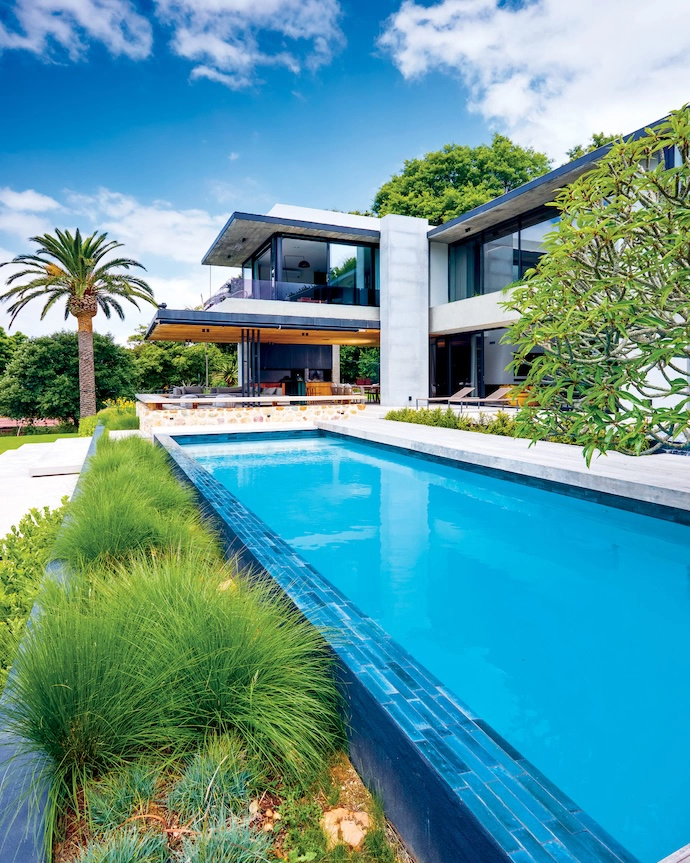
Architect Kate del Fante will be the first to tell you: she’s unapologetically contemporary, favouring a minimalist aesthetic over an ornate one any day of the week. “It’s a style that celebrates the sculptural aspects of architecture,” she explains. “Materials are pared back to one or two elements, so that you enjoy the space and the form of the building.”
While the stripped-down sophistication of contemporary architecture might not scream child-friendly, Kate’s clearly defined aesthetic doesn’t come at the expense of liveability and fun – which has secured her a dedicated family fanbase.
Case in point: the three-kid clan who tasked Kate with a sprawling three-storey villa on a forested hill in the sought- after suburb of Bishopscourt. The brief? To modernise the existing Mid-century residence into a contemporary home that seamlessly accommodates the divergent needs of a five- member family – each of whom, naturally, would like their own view of Table Mountain. The result is a home that blurs the boundaries between inside and outside with features such as wraparound stacking doors, and courtyard penetrations that introduce light and greenery into every aspect.
Read the full story on this Bishopscourt house.
Clifton Beach Apartment by ARRCC
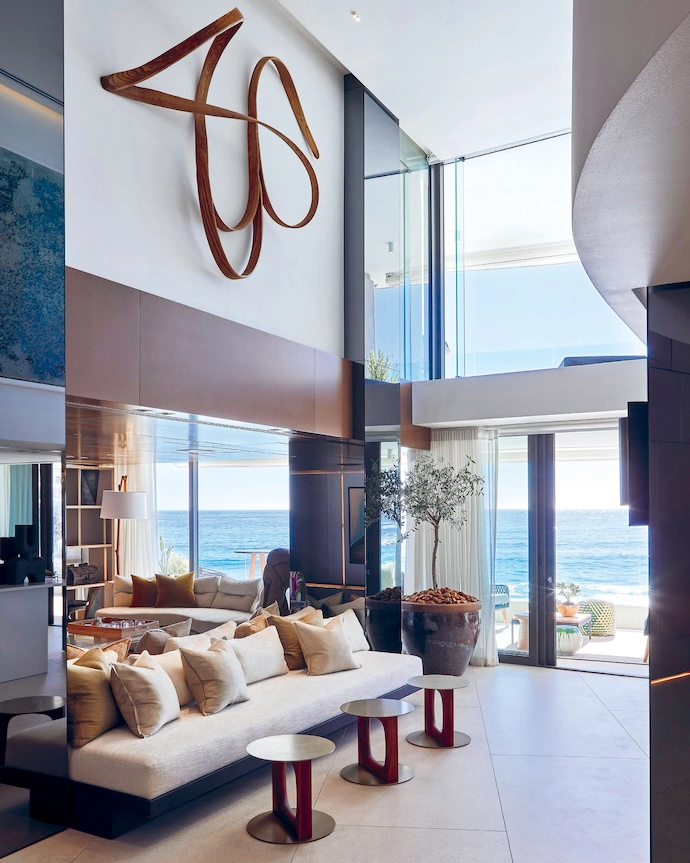
What you’re looking at here is a masterclass in how to solve an interior architectural challenge. How do you merge three apartments over two levels into one beachside home, and do it in a way that maximises natural light, incorporates the views and seamlessly integrates all the spaces, while satisfying the homeowners’ desire to showcase their extensive art collection?
Originally designed by SAOTA in 2009, the nine-storey apartment building overlooks Cape Town’s legendary Clifton beaches. The task of merging the apartments was given to interior design studio ARRCC, in collaboration with Karen Stanek Design.
ARRCC’s first priority was to unify the floor plan and create a grand entrance on the top floor – one that would overlook the living space and offer unfettered views of the ocean. “Removing the slab between the apartments to create a double-volume living space was key,” says Michele Rhoda, ARRCC director and lead designer on this project. “It allowed us to maximise light, enhancing the brightness and sense of openness in the space. One challenge was integrating the support columns into the architecture without disrupting the flow – something we solved by using reflective surfaces, such as smoky mirrors, to make the columns less intrusive, and to reflect the natural light and surrounding views.”
Read the full story on this Clifton Beach apartment by ARRCC.
Don’t forget to sign up to our weekly newsletter for the latest architecture and design news.