-

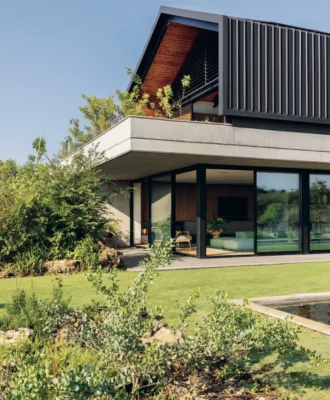
The courtyard’s sliding glass doors can be used to open the centre of the house to light and warmth in dry weather. -
The main bedroom leads out onto a covered courtyard space. The outdoor couch and armchair are vintage Danish beechwood. -

The wood-burning stove by Kratki in the open-plan living space was installed during the renovation, and is clad in the same terracotta tiles as those used elsewhere. The dining table and chairs are by James Mudge. -

The lounge area is delineated by a Herringbone rug, and features a corner couch from Sofa Company. The Louis Poulsen-inspired standing lamp was designed by the homeowner’s brother. -
Bold colour and smart design come together in the home office, where a custom L-shaped desk was installed during the renovation. The blue paint colour is Celestial by Dulux; the plum-red Fenix countertop in Rosso Jaipur (0751) was sourced from MaxOnTop. -
In the main bedroom, wood cladding adds warmth in the form of a “headboard”. The built-in bedside pedestals were designed by the homeowner and made by Proline & Hardware, and the wooden dressing table and stool are by James Mudge. -
A Shoji-inspired screen sliding door, designed by the homeowner, has been installed between the bedroom and its en suite dressing room/bathroom. -

The guest bedroom also features a built-in wooden headboard with integrated bedside pedestals. -
Textural appeal has been added to the guest bathroom with Ceragran marble agglomerate wall cladding. -
The guest bedroom is just off the courtyard. -
The blue vases on the hallway shelf are by Sarah Walters. -
The panel of wooden wall cladding in the hallway, designed by the homeowner and added during the renovation, includes a semicircular mirror and a built-in shelf with storage drawer. -
The terracotta tiling on the front of the house is offset by the bold pink tones of the coleus plant in a bright blue pot alongside the front door. -
The original kitchen was largely retained during the renovation. The homeowners added a marble agglomerate backsplash sourced from Ceragran, and an elegantly linear light fitting by Spazio. -
A drinks trolley from Iconomy does double duty as a plant stand for a flourishing peperomia. -
In a corner of the kitchen, a tall vintage coffee pot and Weylandts canisters make an eye-catching display. -

The multimedia artwork on the wall of the passageway is by Liza Grobler, and the patterned runner is from Hertex Haus. -
Displayed on the built-in shelf on the wall in the living room are a small framed artwork plus a terracotta vase and a black stoneware vase, both from Weylandts. -
The exterior walls of the atrium space are clad in terracotta tiles sourced from Union Tiles, cut down from larger squares into smaller, more contemporary pieces.


Combining considered architectural features with warm, layered finishes and welcoming interiors, this compact Cape Town home is the ideal “machine for living in”, 21st century-style.
WORDS Robyn Alexander PRODUCTION Jeanne Botes PHOTOS Greg Cox/Bureaux
Almost 100 years ago, in his influential 1927 manifesto Vers Une Architecture (Towards An Architecture), architect Le Corbusier declared: “A house is a machine for living in.” Much discussed and critiqued since, the concept retains its explanatory usefulness. For modern designers, buildings should always balance functionality with aesthetics. That may sound simple, but it definitely isn’t easy to do well – and when it’s managed as beautifully as it has been in this home, it’s something to celebrate.
The home isn’t large; it has just two bedrooms and bathrooms, an open-plan area for cooking, dining and lounging, and a small outdoor living space and garden. Tuck in a pocket-sized home office near the front door and a double garage just large enough for two modestly sized cars, and there’s the entire footprint. But while it might be the size of a cottage, due to its thoughtful design and subtly layered interiors, the home punches well above its weight. The home’s previous – and original – owner was the architect who designed it. “He used this tiny sliver of land to make something special,” says the current owner. Visited at dusk on an autumn evening, the house feels welcoming and cosy, yet also airy and spacious. The homeowner points out a few of the ways that architect created the house as a scaling-down property for himself and his wife after his retirement from full-time practice. He made key design choices to add practical and aesthetic value to it. In the morning, natural light pours into the centre of the house via a central atrium courtyard, reaching into the west- facing living area in the afternoon via fully retractable glass sliding doors – all of which, like the rest of the windows in the house, are double-glazed for optimal insulation.

The retractable doors are also topped with clerestory windows that perfectly frame the home’s vista of nearby Devil’s Peak, outlined against the sky. “My husband and I are dedicated hikers, so we especially love this view,” says the homeowner. The couple had previously lived in an old Victorian house in which, she says, “We had fixed everything – a few times!” This much more contemporary structure, with its open plan, clever details, and top-quality finishes, was thus an immediately attractive proposition. That said, the previous owner was “a serious minimalist”, the homeowner says – almost every element of the house was either white or grey when they purchased it – and so, her project in terms of adapting the house to suit herself and her husband has been to “add layers”.
This is a rather modest way of describing the wealth of textural and visual appeal that the house has now. The existing terrazzo floors in the “public” areas have been retained – “I’ve always loved terrazzo,” says the homeowner. And offset by crisp white interior paint, tactile elements of warm terracotta tiling, beautiful marble agglomerate cladding and wooden elements were added.
Outside in the courtyard, a charming wishing well swimming pool is also clad in the terracotta tiles that feature in several places around the property, standing out against lush greenery and a peach-coloured patio wall.
In the bedrooms and home office, wall-to-wall carpeting was removed and replaced with engineered-oak flooring, and the layout of the study was reworked to enable the installation of a built-in L-shaped desk at which the couple can work simultaneously. And in the bathrooms, marble cladding was added for texture, and a couple of light fittings were hung that had been repurposed from elsewhere in the house during the renovation.
The final layer comprises furnishings, decor and art: handmade wooden furniture items can be found throughout the house, adding a further dimension of natural warmth to its various spaces. Every item has a story, and many elements were designed by the homeowner herself: “A lot of the features in my house were my own little projects,” she says – and a few family heirloom pieces pop up here and there, too. Finally, there is the art, where colour is allowed full and free rein, bringing fresh energy to the interiors.
In essence, the home combines a comfortable, laid- back feel with considered contemporary architecture. This is precisely the way we should interpret Le Corbusier’s famous edict for the 21st century: that, as seen here, the ideal house must be a place that is practical and functional – but to truly succeed from a design point of view, it should also gently stimulate and nurture its occupants.
Don’t forget to sign up to our weekly newsletter for the latest architecture and design news.