-

While all suites have an outside shower, only Tshukudu (Rhino) and Ditlou (Lion) also have an outside bathtub. -

The spa is immersed in nature courtesy of wall-to-wall stackable glass doors. -

The entrance to the Ditlou suite, which features wallpaper by Ardmore behind the bed. -

A section of the fencing around the pool can be dropped so that elephants can drink from it. -

The wine cellar and gift shop are housed in a passage between the suite rondavels. -

High ceilings and plentiful windows keep the inside dining and lounge area naturally cool in the heat of summer. All elements of the interior decor were made by local creatives: Kipekee Studio crafted the furniture, Mash.T Design Studio was responsible for the lighting, and Kalki Ceramics baked the bright bar tiles. -

High ceilings and plentiful windows keep the inside dining and lounge area naturally cool in the heat of summer. All elements of the interior decor were made by local creatives: Kipekee Studio crafted the furniture, Mash.T Design Studio was responsible for the lighting, and Kalki Ceramics baked the bright bar tiles. -

A wood-fired KolKol hot tub sunk into the outside deck of the Nkwe suite is the perfect cocktail spot for couples looking for privacy. -

The OSB board on the roof of the main guest area, made of shredded raw wood, is a cost-effective example of the owners’ eco-friendly ethos. -

The life-sized bright-yellow giraffe sculpture is made of scrap metal. -

Another striking Johnny Allison mural in the Nkwe (Leopard) suite, which also features a knitted bed throw by Zydia Botes of Something Good Studio. -
Curves, waves and circles result in a modern but organic look in the main guest area of Dzombo Lodge. -

The sculpture at the farm dam-like pool is by Casper Versluis. -

The bold statement of the deep burgundy walls in this bathroom is softened by a cute woven laundry basket with an elephant’s face on it. -
A spectacular graphic elephant mural by Johnny Allison overlooks a unique Pedersen+Lennard table-tennis table. -

A fun neon sign at reception is a nod to owner Hendri Van Dyk’s favourite band, Guns N’ Roses. -

A circular window offers a “termite’s view” peek into the lounge and bar. -
The domed rusted metal roof at reception lends an almost steampunk feel to the traditional hut structure. -

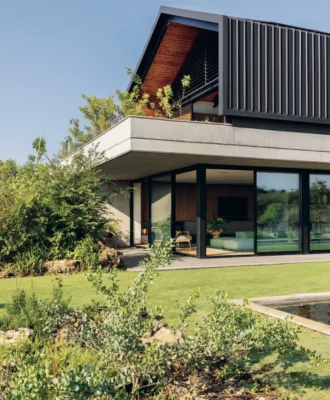
Snuggled into its surroundings, the lodge seems to be shaped by the landscape, rather than imposing on it. -

The entrance to the Ditlou suite.


Nestled in a lush wildlife sanctuary, this small boutique lodge has been inspired by termites and vibrant local design.
WORDS & PHOTOS Dook
“Vibrant” would best describe Dzombo Lodge. In this wildlife sanctuary – the Black Rhino Game Reserve at the Pilanesberg National Park – you’ll find a yellow giraffe amid green leaves under a blue sky, with an orange sun as a backdrop. The giraffe is a life-sized metal sculpture at the lodge’s entrance, painted so brightly that it’s guaranteed to put a smile on your face.
It’s a testament to the whimsical approach of owners Hendri and Liezel Van Dyk. He is an urbanite brought up around bustling kitchens; she’s a third-generation bushvelder, who grew up with the Kruger National Park as her backyard. Also driving Dzombo’s design approach is the fact that it’s not the couple’s primary source of income – so their goal here is not to fill lots beds or boast a healthy bottom line, but to share their love of the bush with as many people as possible, and to do it creatively. The smaller lodge provides a more intimate experience for couples, but can also be block-booked by family and friends.
They rejected the easy build of bland, thatched, cookie-cutter dwellings, choosing rather to express themselves while keeping their African roots front of mind. They wanted something that would be fun, an unforgettable visual bite, with added vitamins of local design to perk up the energy. Plus there was a budget to keep to – and it wasn’t a big one.
The architect the couple chose to bring their vision to life was Gillian Holl, founder of Veld Architects and one of VISI’s favourites, whose work has often graced the pages of this magazine. Her brief was a dream, quite literally: Hendri had dreamt of a lodge that looked like termite mounds, and Gillian’s interpretation was a design dominated by circles and organic curves, with carefully placed round windows inspired by the natural airflow tunnels used by termites to control the temperature in their mounds. “The design was deeply influenced by nature,” says Gillian, “and the structures were shaped by the landscape, not imposed upon it.”
Each of the lodge’s five private suites is named after one of Africa’s Big Five, in Sesotho. There is also a main area with a boma and a spa, and a circular, farm dam-like pool. It feels more like a tiny village than a lodge, with welcoming staff adding to the feeling of community. As the clay soil was not stable enough to build on, the lodge was raised up to float off the ground on steel stilts. This also provided the added benefit of allowing smaller creatures to move around underneath unhindered, as well as orientating the buildings to gain clearer views of the mountains of the Pilanesberg. The structures were placed carefully among the trees, and joined together by sweeping raised walkways made of recycled plastic planks for the minimum amount of ground disturbance.

In keeping with the lodge’s eco-ethos, the suites feature repurposed teak parquet flooring from a demolished house in Johannesburg. Evidence of Hendri and Liezel’s adventurous personalities is found throughout Dzombo, but nowhere more so than in the three spectacular murals by illustrator Johnny Allison: a giraffe and a rhino in two of the bedrooms, and an elephant in the main lounge. The latter is a nod to the lodge’s name – Dzombo was a legendary Kruger tusker. It’s a naming convention echoed by Mabazo, the sister lodge next door, named after Liezel’s father Lynn van Rooyen. “Mabazo” was his Xhosa nickname, also after a revered Kruger elephant, and given in honour of his 39 years of conservation work with these majestic animals.
To furnish the lodge – and inspired, they swear, by a pile of VISI magazines – Hendri and Liezel went on a road trip with a list of names of local designers whose work they wanted for the interiors. Their journey took them to Johannesburg, where Thabisa Mjo of Mash.T Design Studio created the lampshades; the KZN Midlands, where they watched Lindsay Scott’s gifted hands mould clay artworks; Cape Town, where ceramicist Mervyn Gers spun his magic for the everyday crockery; Swaziland, where they witnessed Ngwenya Glass artisans blowing recycled bottles into glassware; Durban, where Kalki Ceramics baked all the tiles; and Ballito and Kipekee Studio, where Michael Bornman and his team fashioned wooden furniture from his wife Kylie’s designs.
Judging by the buzz of guests taking selfies during our visit, this radiant, quirky little lodge in the lush Pilanesberg is now the dream spot for other people. dzombolodge.co.za | veldarchitects.co.za
Don’t forget to sign up to our weekly newsletter for the latest architecture and design news.