-

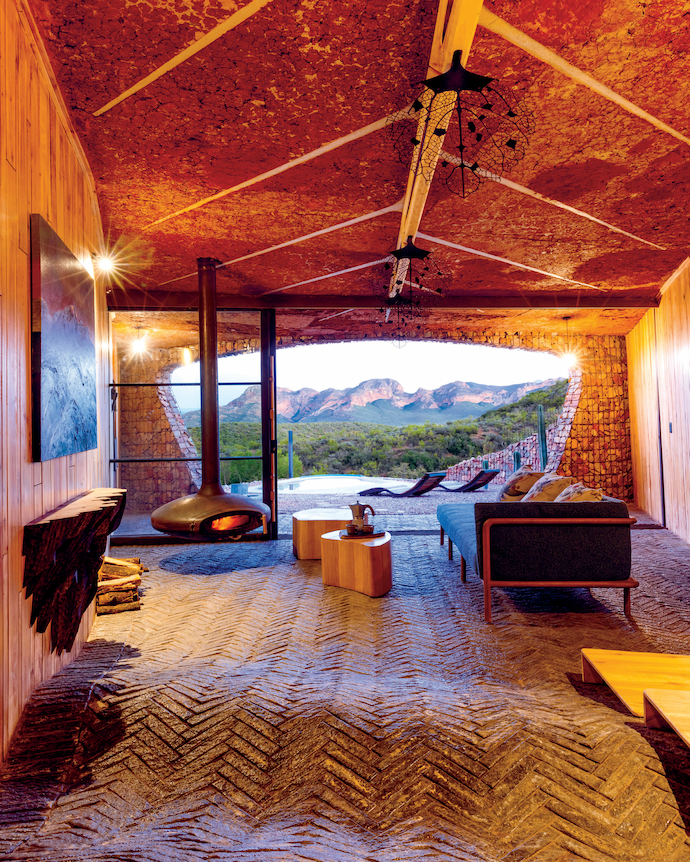
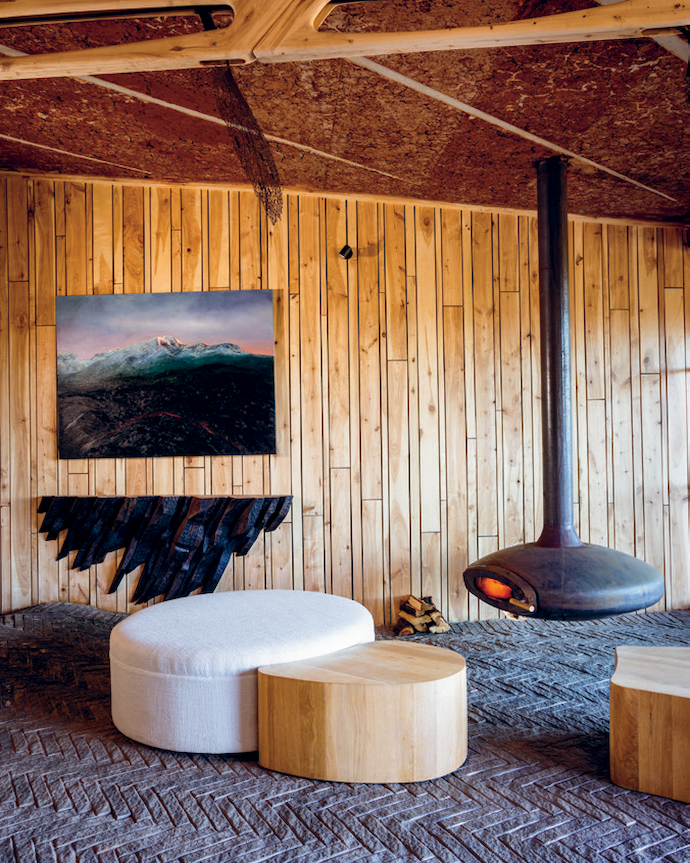
A painting of the Swartberg mountains by Hermann Niebuhr hangs above the Cliff server by Meyer Von Wielligh, made of alien red river gum and inspired by the magnificent cliff edges of Meiringspoort. The leaf pattern on the ceiling is concrete cast on a thin layer of mud that comes from the dam 200m away. The Melike sofa is also by Meyer Von Wielligh. -

Aardts Cabin owner Abrie von Wielligh. -
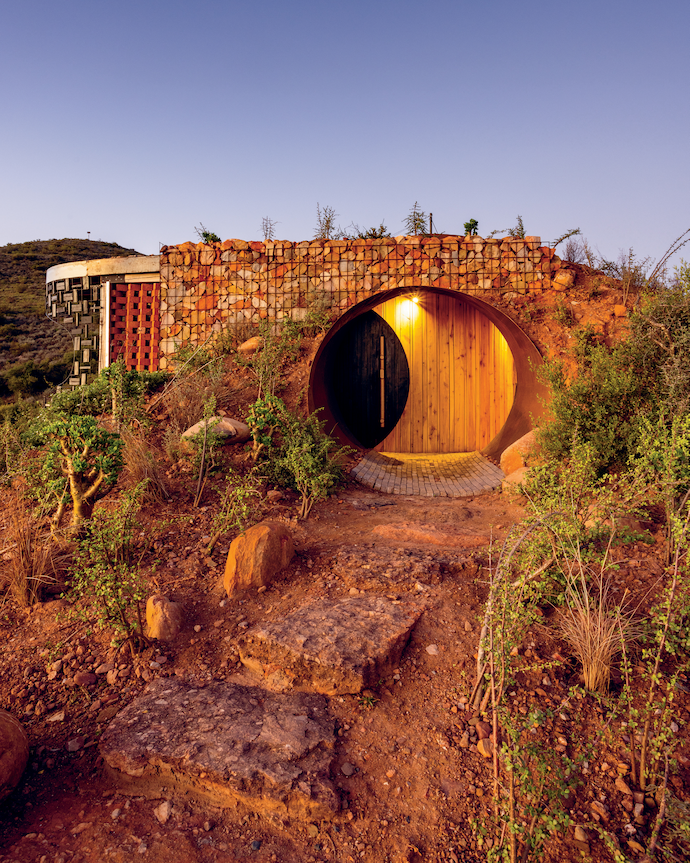
The heavy front door is made of an old reclaimed metal silo clad in treated poplar – a type of wood common in the Karoo. -
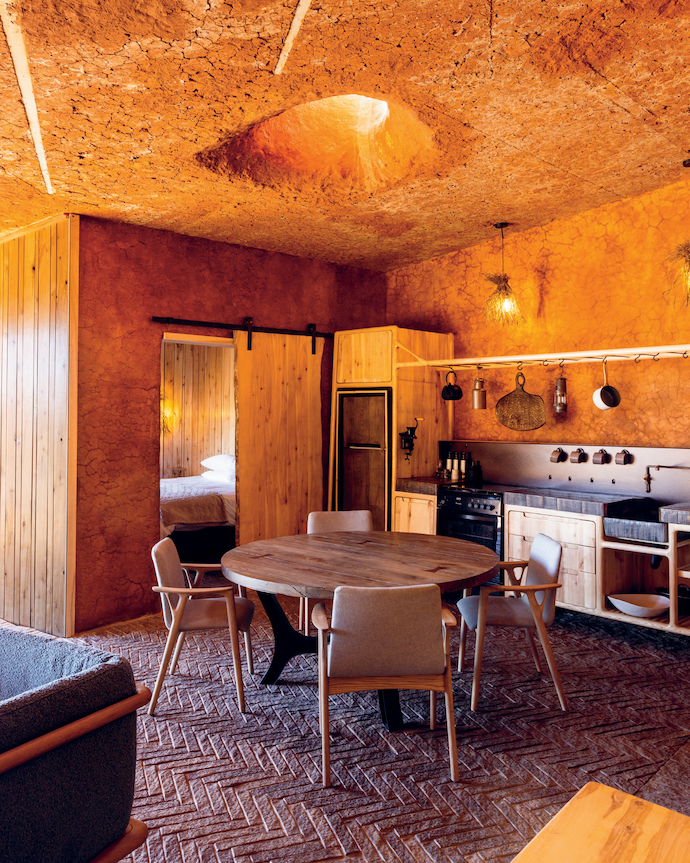
The bespoke kitchen and barn door by Meyer Von Wielligh are made from poplar, an invasive species that commonly grows in Karoo riverbeds. The cracked mud plaster on the walls is from a nearby dam, with the patinaed cracks controlled by the ratio of river sand to mud. -
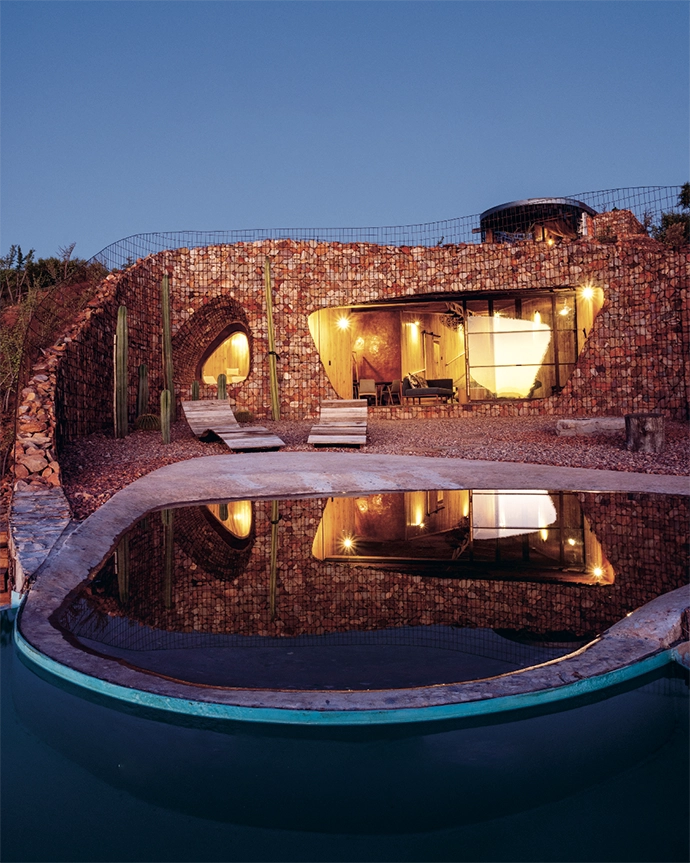
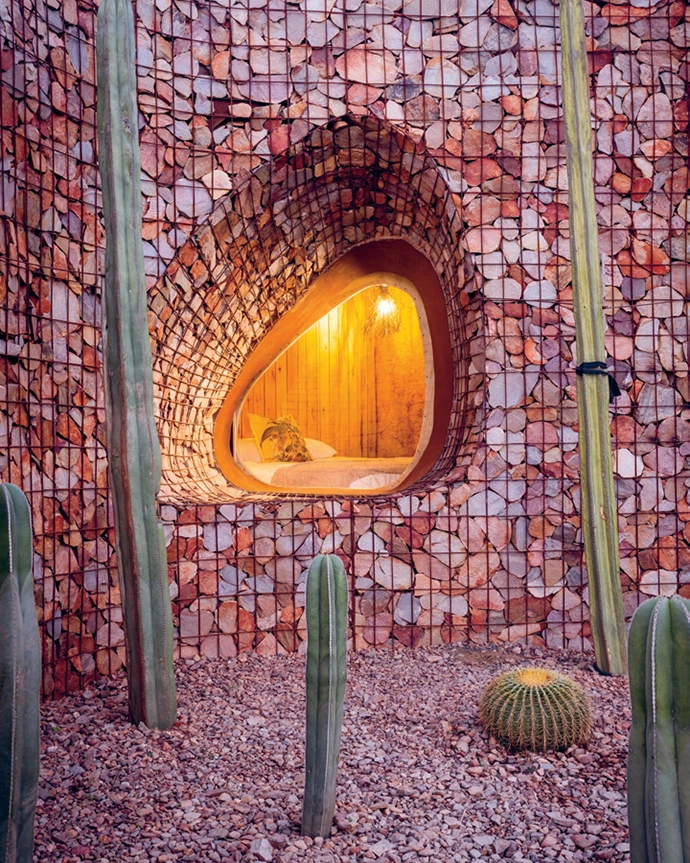
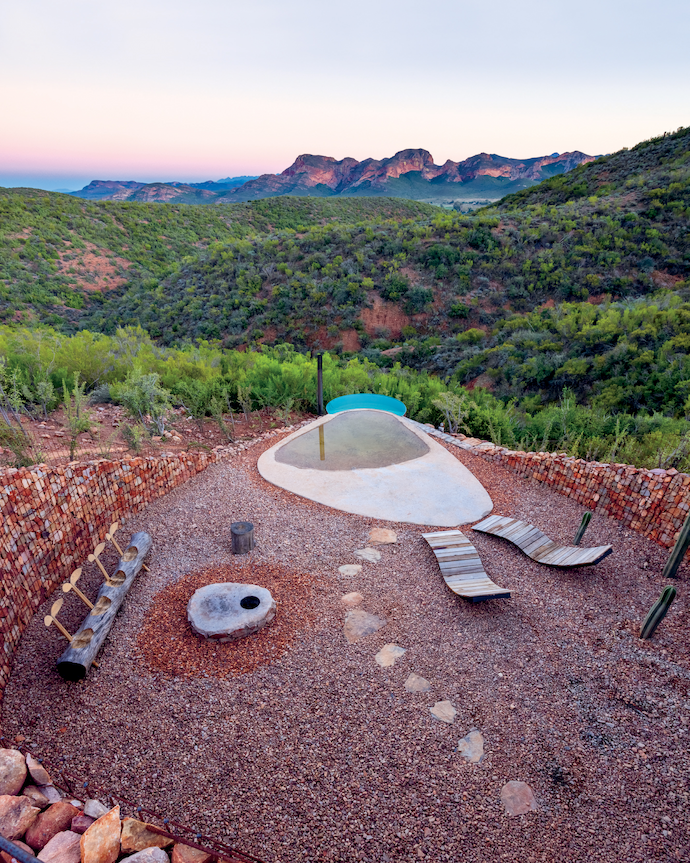
The gabion-style retaining wall is packed with stone from the surrounding koppies. Each pebble- shaped rock was cracked by hand to get a fl at surface, then packed into the steel mesh. The plunge pool gradually deepens towards the front edge. -
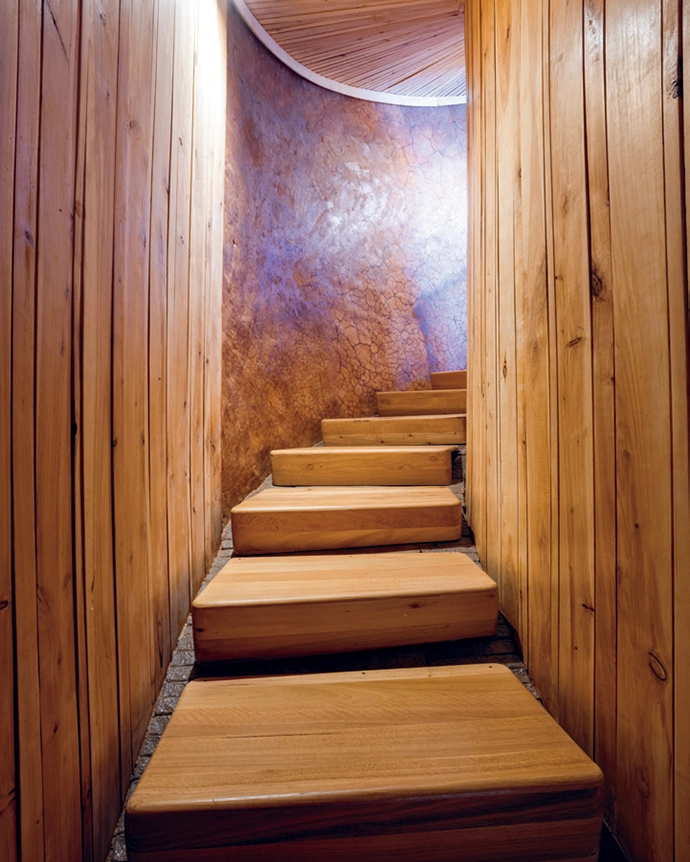
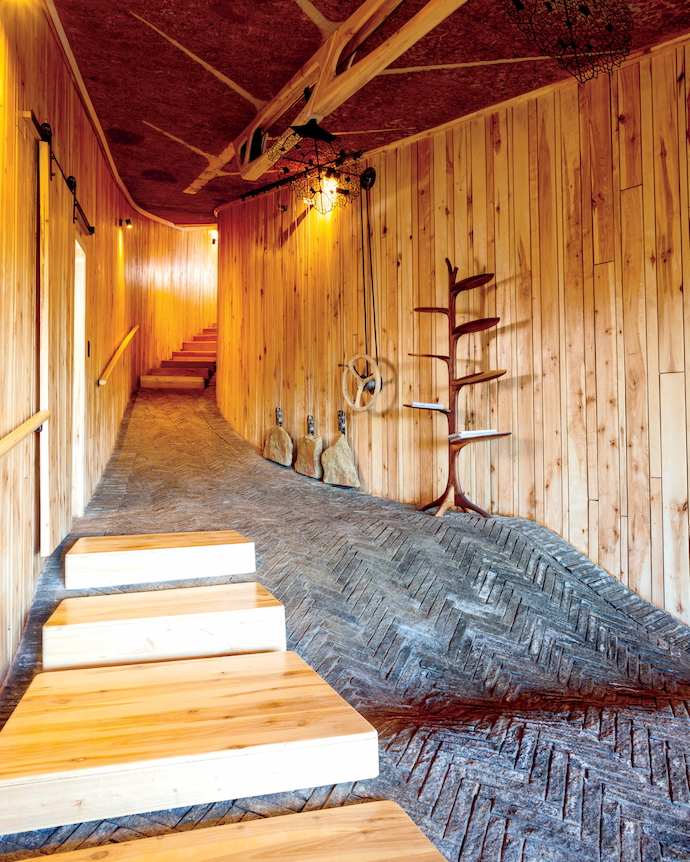
The floating timber stairs are made from the wood of invasive eucalyptus. -
The ottoman and sidetables in the living area are by Meyer Von Wielligh. -
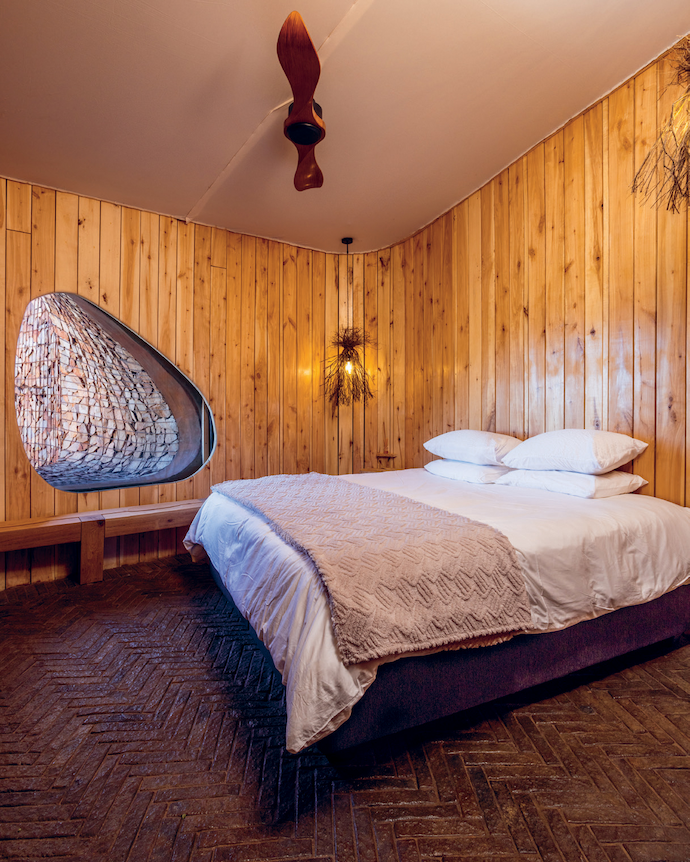
An organic-shaped window tapers outwards like an old telescope, providing a view of the mountains from the second bedroom. -
The rim-flow hot tub is made of the same reclaimed metal silo as the front door, and is heated by lighting a fire under it. -
Clad in poplar wood, the second bedroom features an Instomi bench by Meyer Von Wielligh. -
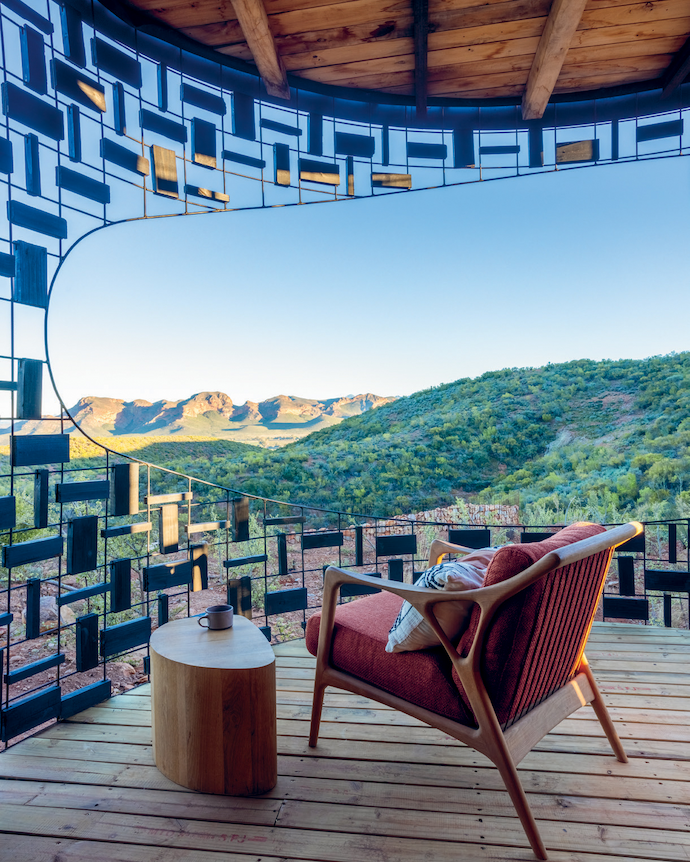
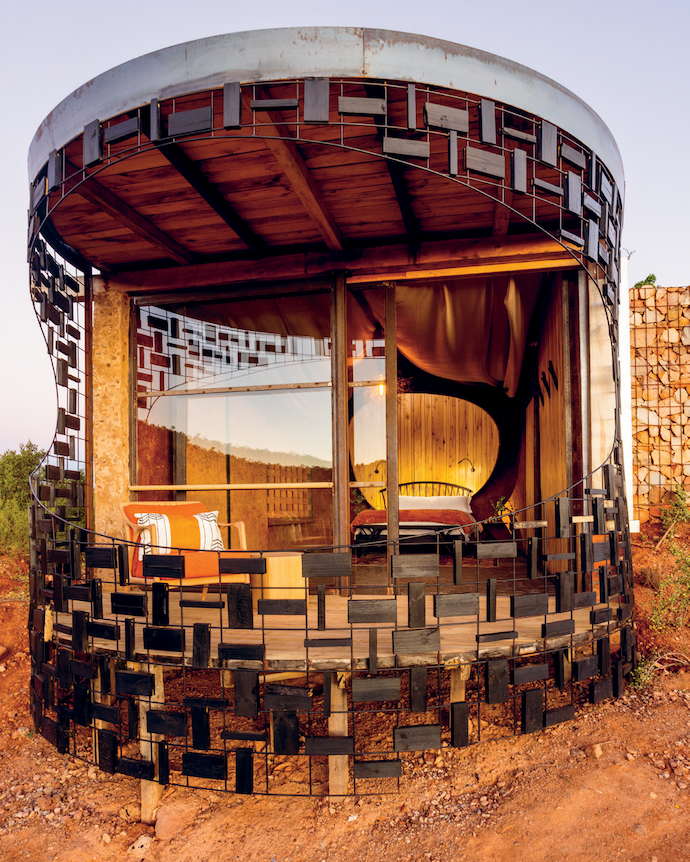
The main bedroom’s deck with a La Jolla armchair and custom sidetable, both by Meyer Von Wielligh. -
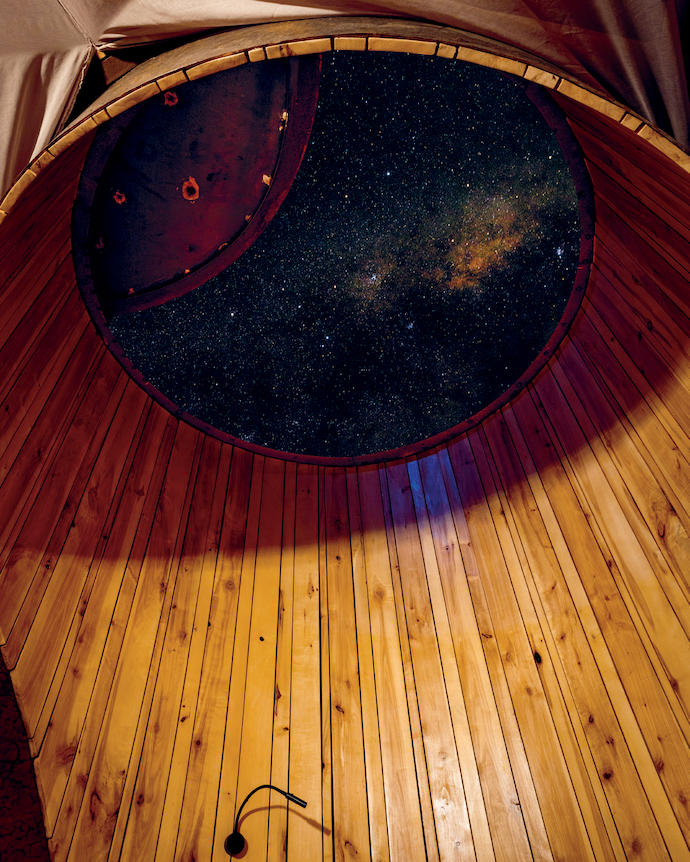
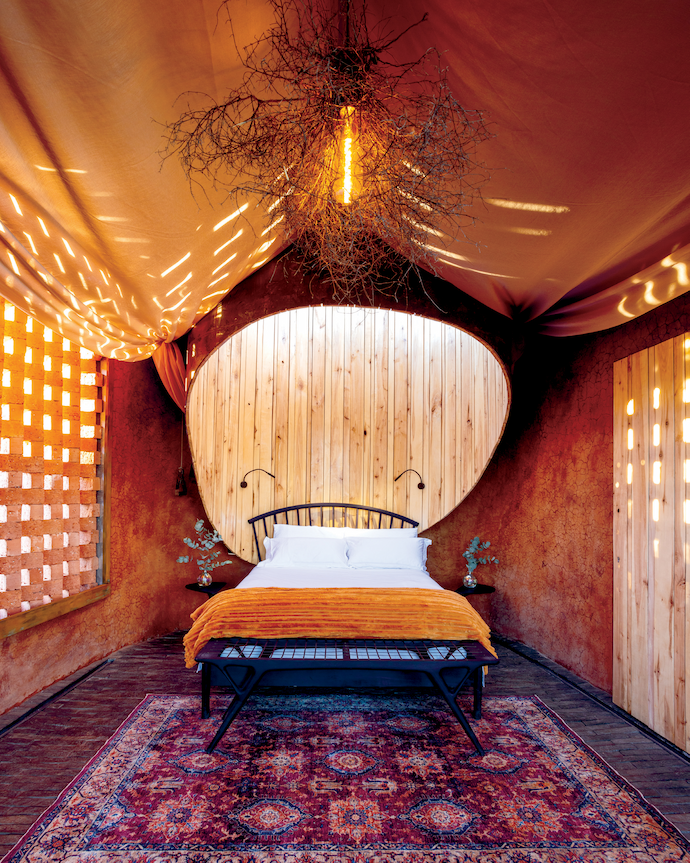
The metal roof above the bed in the main bedroom opens to the star-filled Karoo sky. -
The main bedroom is positioned above the underground cabin. -
Against the wall is a Leaf bookshelf by Meyer Von Wielligh. The bespoke wind-up ceiling fan works with a grandfather clock-like mechanism of suspended rocks hanging on cables. -
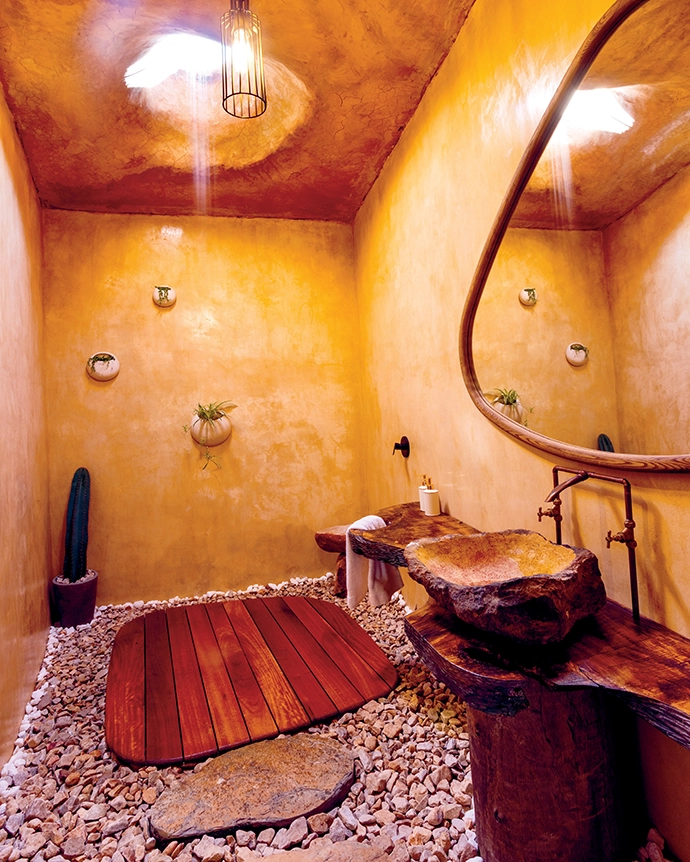
Below a Meyer Von Wielligh mirror, a stone basin carved from local rock sits on a timber slab, also by Meyer Von Wielligh, made from the wood of a fallen English oak. Shower water falls from the open skylight. -
The main bedroom features a headboard/skylight made of yet another piece of the reclaimed metal silo, a window screen of clay bricks by local brickmaker Johnson’s Bricks, a “lampshade” made of dried shrubs picked from the koppie, and an Ella bench with brass riempies by Meyer Von Wielligh.

Dug into a koppie in the Klein Karoo, this environmentally conscious cabin is the result of furniture-maker Abrie von Wielligh’s organic creative process and determination to build with locally sourced raw and upcycled materials.
WORDS & PRODUCTION Steve Smith PHOTOS Jan Ras
You need game-spotter eyes to see Aardts Cabin – the kind that can spot a motionless mountain zebra cloaked in a Karoo landscape. If you possess this model of eyeball, you’ll see both on a koppie outside the Klein Karoo village of De Rust – although you’re more likely to spot the zebra first, such is the way Abrie von Wielligh’s design appears to have emerged from its rocky, scrubby surrounds. It’s a design that caught Airbnb’s eye in 2022 – the concept was one of 100 global winners of their $10-million “OMG!” competition. The rental disruptor chose 100 designs, each receiving $100 000 to facilitate the build, with the proviso it be rented out on Airbnb’s platform for a year.
“Ag, but ja,” says Abrie dryly. “We ended up a bit short, and had to spend a little more on the construction. You know how it is when you’re building – you think, ‘Why don’t we add this and that…’” And Abrie knows dry well: although he currently lives in George, he’s originally from Namibia. “George is a bit busy and wet for us, so we started looking around for a place to get away. It didn’t make sense to have a beach house, as it’s the same climate as George.” The “we” he’s referring to are his wife Jorika and their two daughters. The family bought the piece of land near De Rust five years ago and, after walking around the property a lot, decided on a location that was hidden from the farmlands in the valley below and allowed them to burrow into the land.
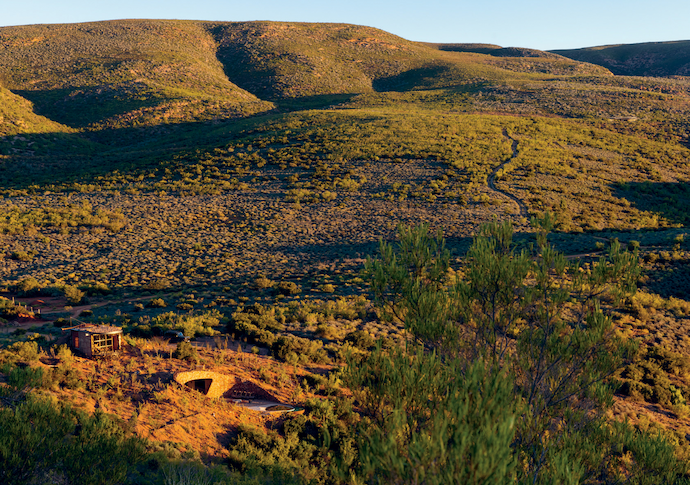
Aardts Cabin is Abrie’s own design (his day job is furniture-maker), and is inspired by the “earthship” structures built by US architect Michael Reynolds in the 1970s as passive solar earth shelters made of both natural and upcycled materials. It’s an approach the reflects the strong environmentally focused ethic that Abrie brings to his work – and it’s one ideally suited to this arid geography. The only part of the koppie built above ground is the master bedroom; the rest has been hollowed out of the landscape. “The earth was a lot harder and rockier than we anticipated,” says Abrie. “The excavators initially said they’d be here for about five days; they ended up taking a month and a half. It was quite a mission.”
Thanks to their eff orts, as you enter through a large, round door, you can either turn left to the master bedroom, or right to descend down a curved staircase into the living area and kitchen, with another bedroom attached. Open the living room’s expansive glass sliding doors, and you’ll find yourself in a sheltered semicircular courtyard with a wood-fi red hot tub and an uninterrupted view of the surrounding koppies.
This organic subterranean shape is one that’s bounced around Abrie’s head for a long time. “I’m not sure where it came from, and I didn’t know how I would use it, until this place. I like organic shapes; you can see it in our furniture – the rounded triangles and pebble shapes.”
It’s a shape that allows for natural heating and cooling properties too, with the stairs creating a draught as the rising heat flows out of the top entrance. In winter, hot air from the fireplace also moves up, warming the bedroom upstairs. These cooling and insulating properties were one of the main reasons Abrie chose to dig into rather than build on top of. But not everything was planned: “The design changed organically as we built it. One of my things is that you don’t have to figure everything out before you start something. I like to jump in and let things happen. Some people like to see it all planned out before they begin – but if you just jump in, you’ll discover things you would’ve never discovered otherwise.”
The ceilings are an example of exactly that. Structural integrity and waterproofing required a concrete slab, but Abrie and Jorika weren’t keen on the concrete’s industrial look; neither did they want to hide it with wood cladding. Given the way the ceiling tapers, curves and opens up, straight lines would be off-square no matter how it was laid out. So they added a thin layer of mud underneath the slab before casting, to give it texture. “The idea was for the concrete to flow into the mud’s cracks and look like the veins of a leaf. But then we had a lot of rain, and water seeped all the way through. I like the way it’s worked out.”
The pendant lights are another example of design by discovery. The day prior to our photoshoot, Abrie and Jorika still hadn’t decided what lampshades to use over the naked Edison light bulbs – but instead of going out and buying something, they tied dried shrub branches around the bulbs. “I hate just buying stuff,” says Abrie.
When it came to the interior design, the couple did it all themselves. All the furniture is from Meyer Von Wielligh – the brand Abrie co-founded with partner Norman Meyer – while Jorika curated all the softs. The end result is a unique structure and interior space that are very much a reflection of the couple’s creative process. “Using materials that are local and close to you lends itself to a design that’s going to be timeless rather than merely trendy. The materials age with the landscape, and the building blends in.”
And given that the first thing we spotted when approaching Aardts Cabin was three (pretty chilled) mountain zebra, rather than the cabin itself, it’s safe to say Abrie and Jorika created something that does exactly that. @aardts.co.za | airbnb.co.za | meyervonwielligh.co.za
Don’t forget to sign up to our weekly newsletter for the latest architecture and design news.