-

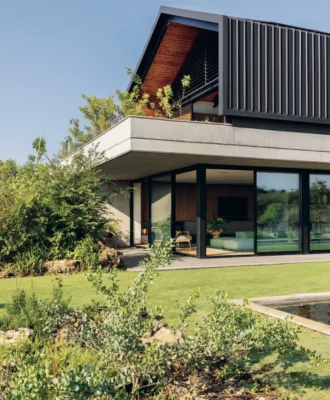
While the footprint and structure of the existing house were retained and refined to create the ground floor, a new upper level was added to capture the panoramic views. -
While the footprint and structure of the existing house were retained and refined to create the ground floor, a new upper level was added to capture the panoramic views. -

Indigenous planting helps to integrate the architecture with the landscape. -
Raw concrete, stone, steel and glass abound. -

The landscaping transforms the steep ridge into a series of platforms, extending the living spaces. -
Around the understated front door, elements of the original house were clad in travertine stack-bond bricks, renewing the old while retaining the familiar. The new level above is clearly expressed in raw concrete. -
With the glass sliding doors open, the main living area is transformed into the equivalent of a covered stoep, immersed in its natural setting. The fireplace becomes the braai. The powerful presence of the rocky ridge is almost within touching distance, nature “flowing in” and through the interiors. -
With the glass sliding doors open, the main living area is transformed into the equivalent of a covered stoep, immersed in its natural setting. The fireplace becomes the braai. The powerful presence of the rocky ridge is almost within touching distance, nature “flowing in” and through the interiors. -

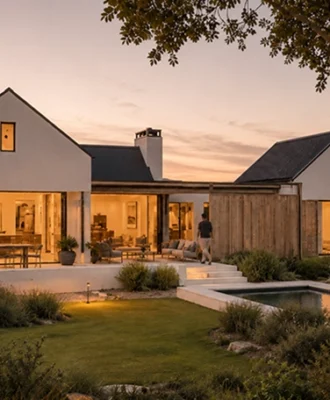
The terraces around the house are “activated” by features that encourage outdoor living – in this case a deck with a pool. -

Indoor and outdoor spaces merge in the kitchen. -
The glasshouse is used for entertaining as much as for growing plants. -
From the driveway, the house feels carved into the hillside. -
A reservoir enhances the “farmhouse feeling” of the property – and the geese love it! -
The kitchen counter is “mirrored” outside, extending the interior into the outdoor space. -
A separate studio is equally immersed in its setting. -
The original boma was refurbished. -

Stone from the site was used to create various walls and plinths. -
The children en route to a games room on the lower level. -
Hand-drawn scientific diagrams and illustrations on the bedroom wall. -
Infinite views. -
The design cascades down the hillside, creating multiple “ground floors”. -

Even on the upper level, planter boxes along the edge of the terrace draw the landscape into the view, creating an intimate sense of connection with nature, and blurring the boundary between the home and the ridge – especially in the main bedroom and bathroom. -

Even on the upper level, planter boxes along the edge of the terrace draw the landscape into the view, creating an intimate sense of connection with nature, and blurring the boundary between the home and the ridge – especially in the main bedroom and bathroom. -
Even on the upper level, planter boxes along the edge of the terrace draw the landscape into the view, creating an intimate sense of connection with nature, and blurring the boundary between the home and the ridge – especially in the main bedroom and bathroom.


Perched on a rocky ridge in Pretoria, this bold reimagining of a 1970s home fuses contemporary aesthetics with raw materials to capture the spirit of an urban farmhouse.
WORDS Graham Wood PHOTOS Paris Brummer
“A friend once said to us, ‘You don’t ever choose the easy way, do you?’” say Ryk and Irma Coetzee, the owners of this hillside home in Waterkloof Ridge in Pretoria. But then, as the saying goes, nothing good comes easy.
Ryk and Irma bought their house – built in the late 1970s and empty for some time, “with no kitchen, horrific plumbing and uncertain electrical wiring” – with the intention to renovate it. What captured their imagination was the spectacular view, say their architects, Grete Van As and Johan Wentzel of W Design Architecture Studio. The house is perched on the steep, rocky slopes of a ridge, with the ground dropping away dramatically below it; and despite its suburban setting, it felt wild and untouched.
“We semi-renovated it just enough to make it liveable,” say Ryk and Irma. Then, they lived there for five years before deciding on a more substantial renovation that would ultimately transform the entire hillside site. They wanted to make the most of the view while preserving the original flow of the house. They were anxious that it should “retain the magic”, but they were also drawn to the notion of a suburban farmhouse. They were already halfway there, having arrived with a menagerie of cats, dogs, rabbits and geese. Their wish list included vegetable gardens, an olive grove and a greenhouse.
Grete and Johan describe the project as a “complete rethink of the property”. They took cues from the way traditional farmsteads were arranged, breaking up the built elements and scattering them across the site rather than consolidating them into one building. The footprint of the existing house was preserved, becoming the core of the home. A new top level was added – “almost like a hat”, says Johan – constructed of raw concrete and glass to house a penthouse-like master suite, complete with a gym and a study.

“We created a series of terraces or platforms, claiming back the land that otherwise falls away, preventing effective use,” explains Grete. These terraces are activated with a swimming pool, a pickleball court, a studio, a glasshouse, a renovated boma and a new one. A reservoir (beloved by the geese), a vegetable garden and an olive grove complete the picture.
“The site drops away so dramatically that each level feels like a ground floor,” says Johan. “It’s not a five-storey house; it’s five ground floors.”
Looking at the raw concrete and glass, the last thing that comes to mind is a traditional farmhouse. But Johan and Grete are quick to point out that their interpretation lay not in nostalgia or a faux rural aesthetic, but in the spatial logic of a farmstead, sometimes with a twist. For example, Ryk and Irma embraced the idea of doing away with the typical stoep – a defining feature of the South African farmhouse. “The house is the stoep,” says Johan.
When the weather is right, sliding glass doors open fully, and the boundaries between inside and outside vanish. The fireplace becomes a braai. A window above the kitchen counter slides open to meet a mirror-image counter outdoors, complete with stools. “The pizza oven is on wheels, so it can move with the party,” says Grete. “The lounge has been designed to let nature flow through it,” adds Johan. With the doors open, the rocky hillside feels almost within touching distance, and the result is a living experience that feels neither entirely indoors nor out.
Despite its contemporary appearance, the house reprises elements from its past life. Grete and Johan used materials that would have been familiar in the original building: brick, slate, parquet flooring, timber, raw concrete. The design approach draws on the modernist houses that emerged in Pretoria in the second half of the 20th century. “The house still feels as though it was built in the ’70s in some respects,” says Johan. All the stone used for cladding the plinth and various walls was harvested from the site. “We weren’t importing a language; we were letting it emerge from the place.”
The landscape, architectural references and raw materials all contribute to a sense of “memory and emotional resonance” – the familiarity that Johan and Grete believe is so important, even in new homes. “Beautiful places without energy are empty,” says Johan. “We focus less on what it looks like, and more on doing the right things in the faith that beauty will emerge.”
It has. And the Coetzees have filled it with their own life and energy, too. From the wall with hand-drawn images of their son’s favourite scientific preoccupations to a photographic installation in the hallway that traces the family’s journey through the build, the house is filled with moments of meaning and memory. “Johan and Grete didn’t just help us renovate a house,” say Ryk and Irma. “They helped us turn it into a home.” Perhaps they didn’t take the easiest route – but it’s certainly brought the richest rewards. | wdas.co.za
Don’t forget to sign up to our weekly newsletter for the latest architecture and design news.