WORDS Annette Klinger
Ever wondered who inspires our current generation of architects? For Paul Oosthuizen, the fluidity and minimalism of Brazilian architects Oscar Niemeyer and Paulo Mendes da Rocha’s designs continue to stimulate his creativity.
How does one design? It’s a question that’s consumed Paul Oosthuizen since his studies in architecture at the University of Pretoria and University of Cape Town. Creativity is important, yes – but so is execution.
Design needs to be able to stand on its own, but it’s also part of a greater whole. “If I tell you, please design me a four-storey pigeon coop on top of a building, where do you begin?” says Paul. “Do you begin by measuring the size of the pigeon? How far from one another you want them to live? Do you then start the design process with a mathematical, scientific approach? Or do you begin with a vision, and then work your way back towards the logistics?”
READ MORE: The Fall: A Dullstroom Home Designed by Paul Oosthuizen
He adds that good architectural design can’t be separated from the mastery of one’s medium: “It’s one thing to be an academic designer, and it’s another thing to take that idea and materialise it. You need to be able to understand how materials want to be before you can start to manipulate them.”

In terms of a foundational education, both his parents played a key, if somewhat unintentional, role. “My father worked in the then-newly built Trust Bank building in Joburg, designed by Colyn & Meiring. It was this modernist, steel-and-glass building, strongly reminiscent of Mies van der Rohe’s Seagram Building in New York. My mother worked at the new RAU campus, which was designed by Willie Meyer and was a magnificent, concrete, horseshoe-shaped structure, where I spent a lot of time running around after hours, exploring the tunnels and service ducts.”

Another structure that captured Paul’s imagination as a child was the enigmatic Coromandel Estate Manor House in Lydenburg, designed by Marco Zanuso. Paul’s grandmother worked with the estate’s owner, and the family would visit often during school holidays. “The farmhouse looked like an old stone ruin,” he explains. “It was unlike any residential structure I had ever seen, with stone arches and flat roofs planted with the same veld grass and bushes of the surrounding vegetation.”
READ MORE: Return to Eden: Keurboomstrand Home
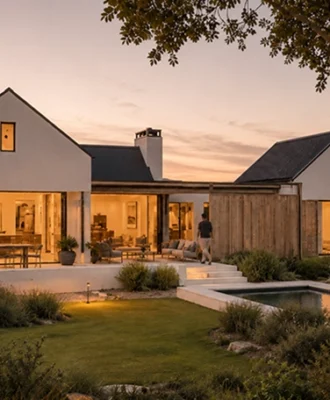
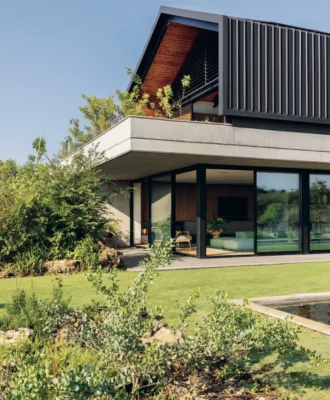
Surveying Paul’s impressive portfolio of work of the last 30 years for his own architectural practice, there are definite echoes of the impact of these childhood influences: the organic, curvaceous lines and masterful manipulation of concrete; the showcasing of traditional artisanal practices like carpentry and stonemasonry; the minimalist approach of heroing the essential structure’s aesthetic. Also in evidence is his appreciation of endemic building traditions, biophilic design and unconventional floor plans.

“South America has a rich culture of practical building technologies, from grass shelters and adobe bricks to wattle and daub walls. I once saw a wall made of paint-tin lids overlapping like shingles, which had an almost reptilian appearance,” he says. “It inspires me to use available materials out of context: turn roof trusses upside down; use synthetic countertops for sun control; use dimpled HDPE drainage membrane on formwork to pattern off-shutter concrete…”
READ MORE: Grey Green Blue: Plettenberg Bay Home
As for the allure of biophilic design, Paul remains inspired by the scientifically proven benefits of living in close quarters with nature, from enhanced concentration to an improved intuition. “Antoni Gaudí’s plans flow in a way that reminds more of wandering in a park than transitioning through a building,” he says. “Although he richly decorated the buildings afterwards, his structures are minimalist. The buildings seem to grow out of the earth, as opposed to being balanced on top of it.”

Two other architects whose work Paul greatly admires are Brazilians Oscar Niemeyer and Paulo Mendes da Rocha. “Early in my career, I liked the purity of what Modernists like Le Corbusier did, getting away from the clutter of decoration to get to a bare minimum that’s both elegant and functional – but the Modernists had a mechanical world-view that didn’t resonate with me,” he explains. “Oscar Niemeyer worked under Le Corbusier for a time, but he took his ideas a step further and became much more fluid in his plan forms. He made modern architecture sensual and alluring, even in the great red desert-like plains of Brazil, far from the ocean and the mountains. I’m also inspired by the crisp and often unconventional plan forms, unapologetic use of raw material, and austere grittiness of Paulo Mendes da Rocha’s work.”
But back to the question: how does one design? Through years of refining and honing his craft, Paul has come to the conclusion that the magic happens in that liminal space between the rational mind and intuition. “There’s a lot of meditative time spent in design,” he says. “I don’t move from the place of stillness until there’s inspiration. And to have inspiration, there has to be an intention. For me, that intention is the love of life and our place in the grand scheme of things.”
Looking for more architectural inspiration? Sign up to our weekly newsletter, here.