-

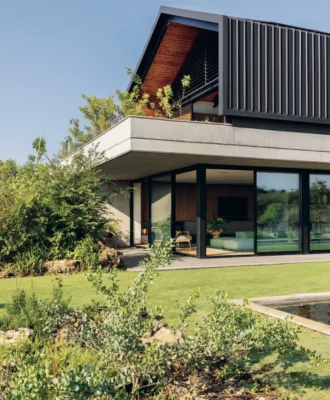
The street-facing aspect of the house has a clean-lined, Mid-century feel that is enhanced by the white-painted brick exterior. Tall, elegant windows punctuate the facade, with additional visual interest provided by built-in planters that frame the shallow steps leading up to the front door. The ocean-side facade is serene yet linear and contemporary. The house is just a few metres from the shoreline pathway, where Piers and Alida walk almost daily, and from which southern right whales can regularly be seen. -

The street-facing aspect of the house has a clean-lined, Mid-century feel that is enhanced by the white-painted brick exterior. Tall, elegant windows punctuate the facade, with additional visual interest provided by built-in planters that frame the shallow steps leading up to the front door. The ocean-side facade is serene yet linear and contemporary. The house is just a few metres from the shoreline pathway, where Piers and Alida walk almost daily, and from which southern right whales can regularly be seen. -

The street-facing aspect of the house has a clean-lined, Mid-century feel that is enhanced by the white-painted brick exterior. Tall, elegant windows punctuate the facade, with additional visual interest provided by built-in planters that frame the shallow steps leading up to the front door. The ocean-side facade is serene yet linear and contemporary. The house is just a few metres from the shoreline pathway, where Piers and Alida walk almost daily, and from which southern right whales can regularly be seen. -

The street-facing aspect of the house has a clean-lined, Mid-century feel that is enhanced by the white-painted brick exterior. Tall, elegant windows punctuate the facade, with additional visual interest provided by built-in planters that frame the shallow steps leading up to the front door. The ocean-side facade is serene yet linear and contemporary. The house is just a few metres from the shoreline pathway, where Piers and Alida walk almost daily, and from which southern right whales can regularly be seen. -

The street-facing aspect of the house has a clean-lined, Mid-century feel that is enhanced by the white-painted brick exterior. Tall, elegant windows punctuate the facade, with additional visual interest provided by built-in planters that frame the shallow steps leading up to the front door. The ocean-side facade is serene yet linear and contemporary. The house is just a few metres from the shoreline pathway, where Piers and Alida walk almost daily, and from which southern right whales can regularly be seen. -

The ground-floor deck is finished in weathered garapa wood and furnished with a hanging chair by Studio Stirling, from which views of the surrounding fynbos can be contemplated -
The indoor lounge is delineated by a Hertex Haus rug, and features a modular Ellis sofa by Sofa Company and a coffee table by Normann Copenhagen. -

The staircase includes storage drawers in American oak, crafted especially for the space by Piers. -

The artwork at the top of the stairs is by British artist Philip Sutton. -

The first-floor public areas are completely open-plan, with terrazzo flooring that was poured and polished on site by World of Decorative Concrete. The Ivor dining table and upholstered bench are by Andrew Dominic Furniture. -
With loads of natural light – and sea views – streaming into the space, it’s a pleasure to spend time in the kitchen. The island is clad in clay brick pavers from Corobrik, the backsplash tiles are from Wolkberg Casting Studios, the countertops are Carrara marble from Stonehenge, and the paint colour on the built-in cabinetry is Reed Green (RAL 6013). Piers designed and made the green light fitting himself. The dark-wood Manu media cabinet is from Andrew Dominic Furniture and the painting above it is by a family friend; the wall behind the cabinet is finished in the same brick pavers as the island. -
With loads of natural light – and sea views – streaming into the space, it’s a pleasure to spend time in the kitchen. The island is clad in clay brick pavers from Corobrik, the backsplash tiles are from Wolkberg Casting Studios, the countertops are Carrara marble from Stonehenge, and the paint colour on the built-in cabinetry is Reed Green (RAL 6013). Piers designed and made the green light fitting himself. The dark-wood Manu media cabinet is from Andrew Dominic Furniture and the painting above it is by a family friend; the wall behind the cabinet is finished in the same brick pavers as the island. -

The master bathroom features an Omina bathtub from Boutique Baths, white KitKat tiles from Douglas Jones and matt-black Vernis tapware by Hansgrohe. The green Clover sidetable is from Chair Crazy. A vanity unit with deep drawers, built by Piers, was spray-painted by Colour Wheel in Reed Green (RAL 6013). The countertop basins are from Flush Bathrooms and the pill-shaped mirror cabinets were made by Piers -

The master bathroom features an Omina bathtub from Boutique Baths, white KitKat tiles from Douglas Jones and matt-black Vernis tapware by Hansgrohe. The green Clover sidetable is from Chair Crazy. A vanity unit with deep drawers, built by Piers, was spray-painted by Colour Wheel in Reed Green (RAL 6013). The countertop basins are from Flush Bathrooms and the pill-shaped mirror cabinets were made by Piers -

Tranquil simplicity reigns in the main bedroom, where a bed from Weylandts is set atop a thickly textured rug from Hertex Haus and flanked by three-legged wooden stools, also from Weylandts, that serve as bedside pedestals. The artwork is by Philip Sutton. A wood-burning stove by Hergom keeps the room cosy during the Cape’s chilly (and often stormy) winter months. As this was the original home’s living room, large sliding doors lead out onto a weathered wooden deck, where two Puppy sculptures/seats by Eero Aarnio for Magis keep watch over a wire outdoor lounge chair from Chair Crazy. -
Tranquil simplicity reigns in the main bedroom, where a bed from Weylandts is set atop a thickly textured rug from Hertex Haus and flanked by three-legged wooden stools, also from Weylandts, that serve as bedside pedestals. The artwork is by Philip Sutton. A wood-burning stove by Hergom keeps the room cosy during the Cape’s chilly (and often stormy) winter months. As this was the original home’s living room, large sliding doors lead out onto a weathered wooden deck, where two Puppy sculptures/seats by Eero Aarnio for Magis keep watch over a wire outdoor lounge chair from Chair Crazy.


WORDS Robyn Alexander PRODUCTION Sven Alberding/Bureaux PHOTOS Greg Cox/Bureaux
On the shores of Walker Bay in the Western Cape, a contemporary home created by a pair of graphic designers combines clean-cut architectural lines with fresh interiors.
Location, estate agents like to say, is everything. And this newly built home’s position in Vermont – a holiday hamlet on the pristine shores of Walker Bay – is exceptional. Tucked into the fynbos just steps from the ocean, the plot of land on which it stands has been in the family of one of the two homeowners, Alida Kannemeyer, for 60 years. Throughout her childhood, Alida spent her holidays in the house next door (the rest of her family still does so); in 2014, she was given this adjacent plot by her parents.
In 2017, Alida and Piers Buckle – her partner in both life and work (they run a graphic-design agency together) – decided to build their own holiday home on the property. At the time, the couple were living in Observatory, Cape Town, and the new build was envisioned as a weekend escape from the city at which they could also spend longer holidays. The initial plan, done with the help of an architect friend in Cape Town, was a simple single-storey cottage; it was later amended slightly by Onrus-based architecture firm Engelbrecht & Scorgie, who also assisted with the build.

“We always wanted to build something of our own rather than renovate. It’s good to know exactly what’s under the skin of your house,”says Piers, citing both the regularity of unpleasant surprises during renovations as seen on today’s ubiquitous reno TV shows, and the couple’s own experience of living in their Observatory home, with its heritage layout and sometimes temperamental fixtures.
They were on a fairly strict budget, and knew they wanted a contemporary cottage without unnecessary frills. They explored prefabricated options, but after careful research realised that a bricks-and-mortar structure would work far better, both budget-wise and to conform to Piers’s strict rule of seaside construction: “If it rusts, it’s not going in the house.” The result was a single-storey abode that combined a modestly sized indoor living space – plus outdoor lounging and cooking areas – with a slice of kitchen and two en suite bedrooms.
Then – just two years after its completion – along came Covid-19, accompanied by an unexpected and hard-to-refuse offer to purchase on the Observatory home. Why not take the plunge and settle in Vermont permanently? So, just shy of five years after completing the initial project, the couple embarked on a second build, using the same local architect to assist them in adding another floor to their beach house. Easily their single smartest design decision was, as Piers puts it, to realise that “the premium space is on the first floor”: they elected to keep all the sleeping areas on the ground level, with living, lounging and dining zones above.
The new floor is an open-plan pleasure, with an enviable kitchen and a neatly tucked-away scullery. On one end, adjacent to an indoor dining space, is a central stairwell that also functions as a light well for the entryway on the level below. There’s also a large indoor living area on one side that leads out onto a spacious outdoor veranda with seating space, a barbecue and gorgeous views of the sea. Thanks to strategically placed windows and large glass sliding doors between the indoor and outdoor spaces, just the right amount of natural light traverses this floor throughout the course of the day, ensuring that interior temperatures remain temperate and well-regulated, no matter the season.
Downstairs, a trio of minimalist yet cosy sleeping spaces – including the new master bedroom – each has its own bathroom, and the interiors throughout have a cool, laid-back aesthetic. Contemporary furnishings by South African designers and makers are punctuated by pops of bright colour – especially in various shades of green – and by the couple’s extensive collection of artworks by local creatives, including Richard Myburgh and Anton Kannemeyer, as well as British artists Simon Brett, Susan Jameson, Eric Gill and family friend Philip Sutton.
While location certainly counts for much, this house combines its ideal situation with thoughtful, context-driven, clean-lined architecture and interiors – something that many dwellings in small coastal towns fail to do. Alida and Piers have created a space that feels uniquely theirs, while also demonstrating a lightness and clarity of design that makes it a truly enviable home. | freshidentity.co.za
Don’t forget to sign up to our weekly newsletter for the latest architecture and design news.