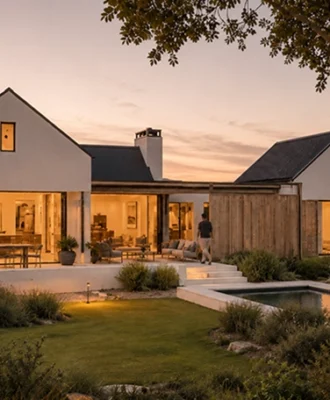
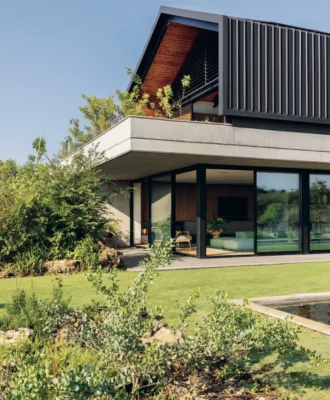
Johan Wentzel and Grete Van As, co-founders and principal architects at W Design Architecture Studio, talk about how Spanish architect Alberto Campo Baeza’s concept of the built idea, as realised in his De Blas House near Madrid, has influenced their work.
WORDS Johan Wentzel and Grete Van As PHOTOS Hisao Suzuki, Gergori Cive, Supplied
In April 2000, while working for a large commercial architecture firm in London (and before the availability of social media or online design platforms), we saw an article in Wallpaper magazine featuring Spanish architect Alberto Campo Baeza’s De Blas House near Madrid. Although the text was concise, the concept of “the constructed idea” forever changed our approach to design and architecture. It’s a philosophy that allows for the creation of iconic buildings, which are both fundamentally rational and deeply connected to their surroundings.

Architects tend to reveal the keys to architecture in their drawings, their philosophies, their fl oor plans – and also in their writing. In his book The Built Idea, Campo Baeza conveys his deeply held ideas and convictions. “The reasoning on which one bases one’s work in their attempt at architecture is what is going to be reflected consciously or unconsciously,” he says. “Realising the ideas expressed in words in built works is the best proof that the ideas are valid, and the words true.”
The theory: idea, light and gravity
“The history of architecture, far from being a history of forms only, is basically a history of built ideas,” says Campo Baeza. “Forms are destroyed over time, but ideas remain and are eternal.” The sketches and ideas for De Blas House illustrate Campo Baeza’s elemental principle of Stereotomic + Tectonic = Architecture – an understanding that part of the building wishes to belong to the earth (stereotomic), and that part also separates itself from the earth (tectonic). It recognises that the entire building works in continuity with the earth, establishing minimal contact with it, and therefore helping in the production of a new architectural organism.
- STEP 1 A mountain and a tree – the natural surroundings, the context.
- STEP 2 Establishing a platform – a base.
- STEP 3 Carving a space into the platform – the stereotomic, the earth, the solids, the gravity.
- STEP 4 Providing cover or enclosure to protect from the elements. This is the tectonic – the built form, the voids, shaped and defined by light.
Campo Baeza’s architecture is characterised by precise geometry, horizontal planes, and a focus on the relationship between structure and form. His work seeks to create spaces that evoke emotion and a connection with nature, while also maintaining a rational, logical order.
The idea is the synthesis of all the elements that make up architecture – context, function, construction and composition. It’s imagined as an operation of alchemy – a distillation of elements to achieve a unique and unitary result. This result means that the idea is capable of being built, of materialising.
Just as forms pass and are destroyed, ideas remain. They are indestructible. The history of architecture, therefore, is a history of ideas – of constructed ideas, of forms that materialise and set up these ideas. Without ideas, forms are empty. Without ideas, architecture is “void”. It would be pure empty form.
Light is an essential component, indispensable in the construction of architecture. Light is “material” and, like stone, it is quantifiable and qualifiable. It is controllable and capable of being measured. Without light, there can be no architecture. We would only have dead constructions. Light is the only one capable of tensing the space for occupants. To put a person in relation to the space created for them tightens it. It makes it visible.
Without gravity, architecture – whose history is a struggle to direct gravity, to dominate it, and to overcome it – would disappear. It would atomise. Without gravity, there is no possible architecture, because its necessary materiality would disappear. Gravity builds space.
The heavy material “elements”, which make the forms that make up space real, must end up transmitting gravity – the weight of their materiality – to the earth. The gravitational support system – the structure – is what orders space, what builds it. The resulting essential space is made up of only the indispensable number of elements capable of accurately translating an idea.
Architecture based on this approach, whose materiality is a constructed idea, whose time is constructed by light, and whose space is constructed by gravity, is the architecture we call essential. Light is capable of defeating gravity. The passage of time strips architecture of the superficial so that only the essential remains.
Time, built by light, slowly and patiently makes the superficial elements that so often adorn the flirtatious architecture disappear. Time, like a doctor seeking to bring it back to life, strips it to its bare essentials. Architecture is left with only its essential attributes. Dimension, scale and proportion give life to the material that carries within it the invisible tension of gravity. And all of this is touched by the light, which, as the builder of time, produces the visible tension that makes man mute.
The practice
The resulting structure – De Blas House – realised the exact idea. It is honest and direct; it is architecture not burdened with wanting to “look good”, but that instead employs all its energy to rather “be good” (and, as a secondary result, often also looks good).
This honesty reminds us of a famous quote from Ayn Rand’s novel The Fountainhead, and the philosophy of absolutism: “A building has integrity, just as a man and just as seldom. It must be true to its own idea, have its own form, and serve its own purpose.”
W Design’s interpretations
HOUSE #1: “UNFOLDING THE LAND”

Idea “Unfolding the Land”.
Gravity The natural Dullstroom mountain landscape – the stereotomic. Solid bedroom structures, above-ground and earth-covered, are shaped by the native stone scattered in the landscape.
Light The “liberated” barn structure – the tectonic. The open living room functions are fully focused on the extended landscape.
HOUSE #2: “BETWEEN A ROCK AND AN OPEN PLACE

Idea “Between a Rock and an Open Place”.
Gravity The natural Bronberg mountain landscape – the stereotomic. The solid structures are carved into the hillside, providing the “perch” for all living spaces.
Light The open living spaces of the home, part building, part landscape – the tectonic – are balanced inside the space between the rocky mountain landscape and the infinite.
HOUSE #3: “GRAVITY AND LIGHT”
Idea “Gravity and Light”.
Gravity The old structure, the history – the stereotomic. The solid structures, represented by the 1910 Cape Dutch gables, are “cut open” to “liberate” the living spaces.
Light The new open living spaces of the home, the voids – the tectonic. Spaces are defined by the relationship between the history and the contemporary. It’s at once completely familiar – and completely new. | wdas.co.za
Don’t forget to sign up to our weekly newsletter for the latest architecture and design news.