-

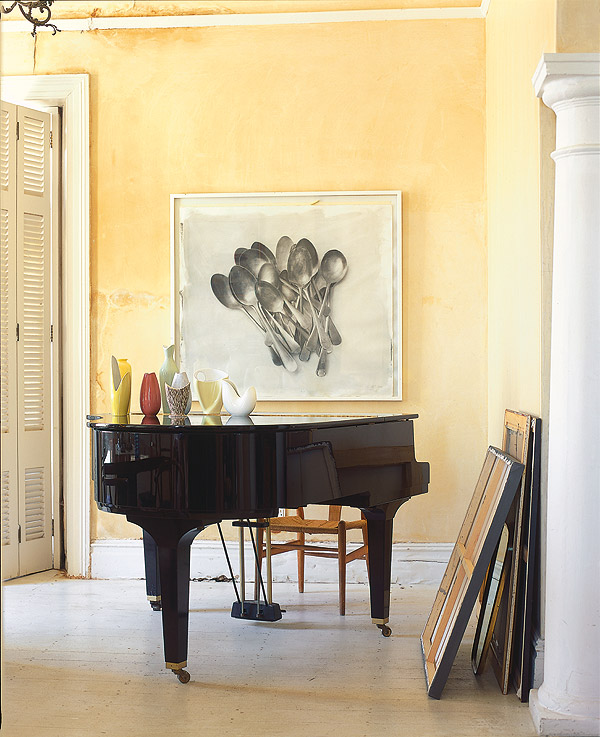
House of spirits : A collection of Rosenthal vases is displayed on the same grand piano on which Craig and his sister received their childhood music lessons. The title of the art photo by Stephen Inggs in 'Spoons'. -

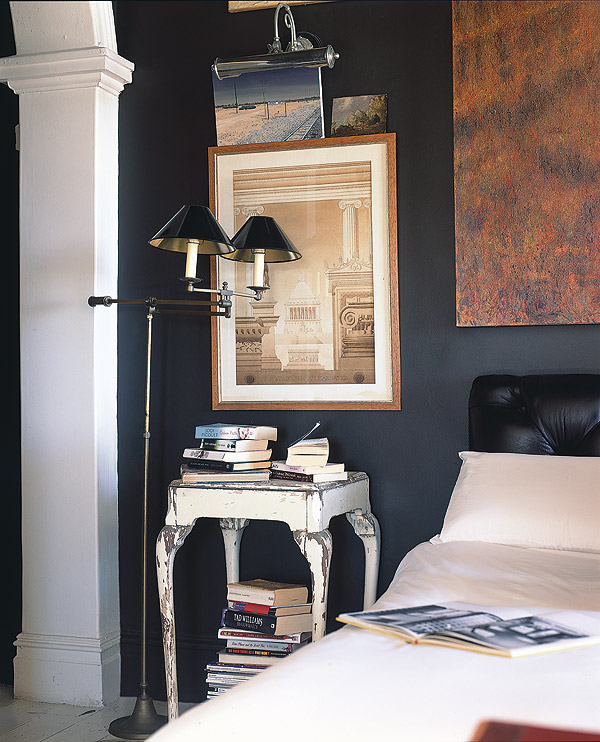
House of spirits : A 2m x 2m painting by Anton Karstel hangs above the black leather headboard with deep buttons. Above the bedside table is French architecture student's 1920s watercolour rendering of a Greek temple. Above it is a painting by Durban's Aidan Walsch. -

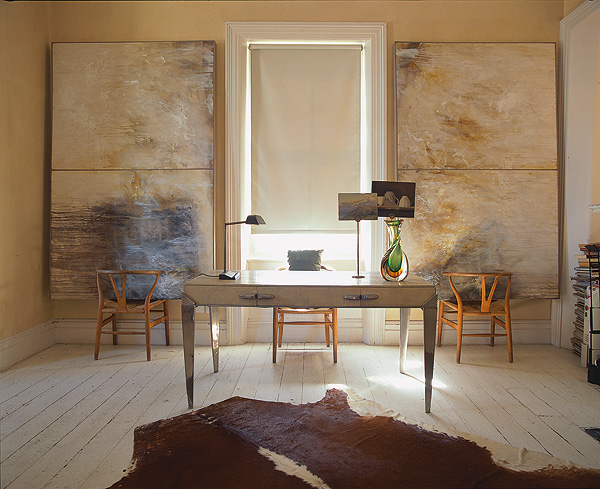
House of spirits : A huge painting by Anya Subotsky rests on original Wegner chairs on either side of the window. The original French inlaid-shagreen desk dates from the 1930s. -
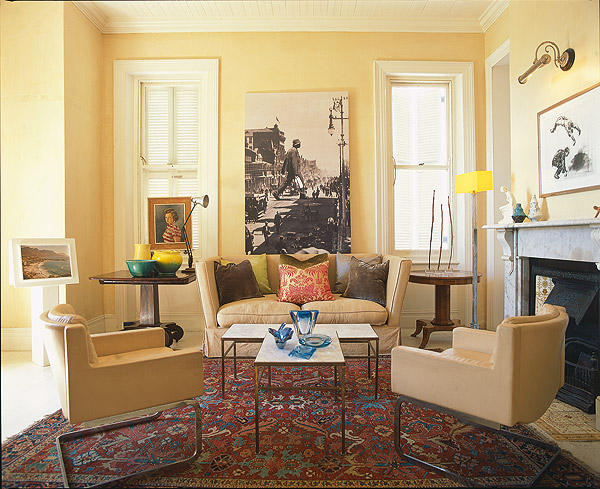
House of spirits : Much conversation takes place in the sitting room: 'Jo'burg Man' by Dale Yudelman and Arlene Amaler-Raviv takes pride over the sofa. Craig's favourite work of art is the portrait of his mother at 18 which is in the left window. -

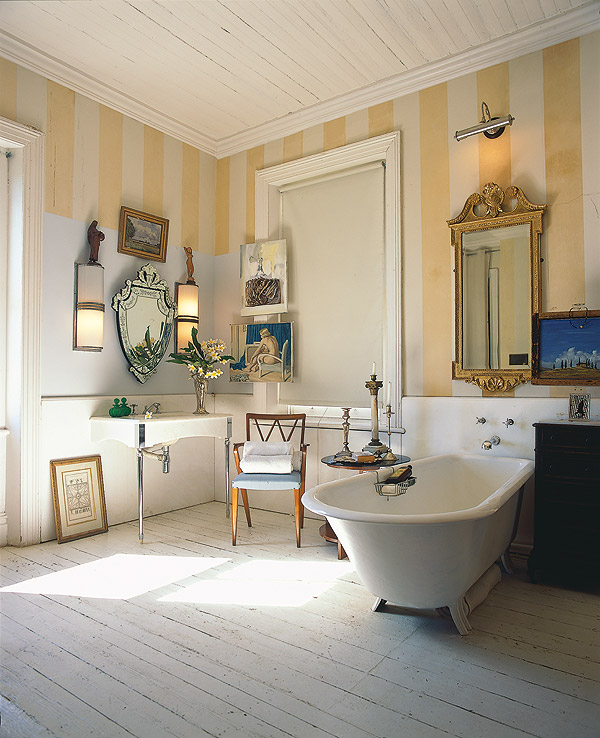
House of spirits : The bathroom walls are lined to waist height in marble. Artworks and mirrors each have their own place of honour in this room. -
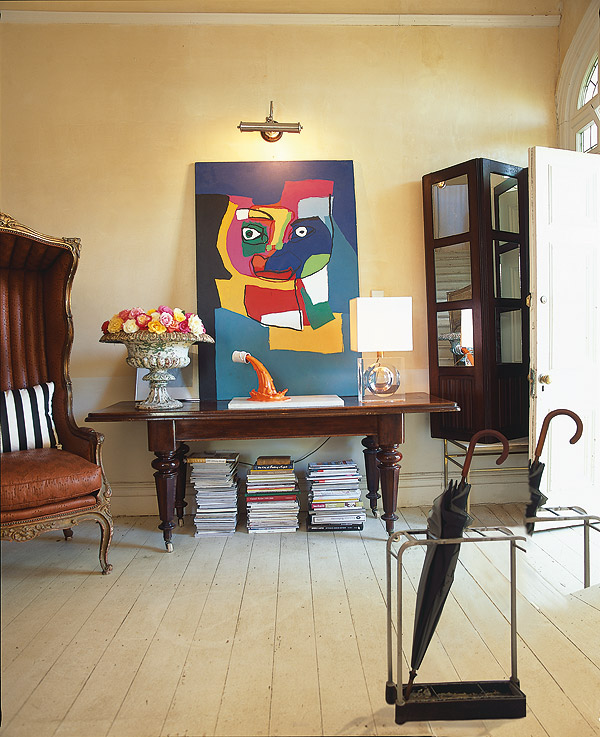
House of spirits : A maquette by Andrew Porter made for a sculpture competition sits between an old Victorian vase and an Italian lamp form the 1970s. The painting is a slavish copy of post-cubist work by Dutch artist Karel Appel-one of Craig's second-year projects at WITS. -
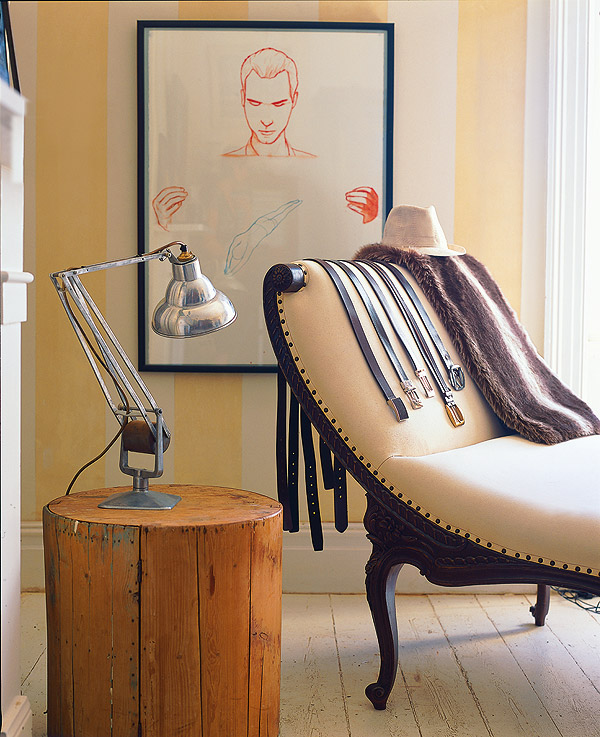
House of spirits : A painting by Tom Culberg hangs above the wide Victorian chaise and farm-drum table.
PHOTOS: Lien Botha | PRODUCTION: Mark Serra | WORDS: Johan van Zyl
In this house, one of the last unrestored Victorian gems of Green Point, not one piece of furniture has been bought new. And yet Craig Kaplan has created a tribute to local art that is entirely modern.
Silence never quite reigns in the house on the corner. Even in the dead hours before sunrise, when the surrounding streets are all partied out and its bachelor owner lies fast aslumber, the rooms hum with conversation. Of secrets and rumours and histories exchanged. Believe it: here, it is the furniture and art that hold discourse until dawn.
Craig Kaplan explains: ‘There is interaction – communication – between well-designed pieces of furniture, even if they belong to different periods, provided one keeps height and balance in mind.’ His eyes wander from a 19th-century French concierge chair covered in embossed silk, to a Mies van der Rohe chair, to a Biedermeier table. ‘It’s about a sense of history, a feeling of age. I quite like the idea that somebody owned this chair 50 or 60 years ago; I can imagine their excitement when buying it.’
In a similar way, the impressive collection of art that he has bought and been given over the years reveals something of his personal history. (As Irish dramatist and Nobel prizewinner George Bernard Shaw put it: ‘You use a glass mirror to see your face; you use works of art to see your soul.’)
There are no hierarchies in this private gallery of Craig’s. All kinds of works of art have their own place of honour: against walls, on windowseats, floors, stands, pedestals, chairs, cupboards, tables, even on the backs of sofas.
But he’s quick to point out that he’s not a serious art collector. ‘An incurable magpie, yes, perhaps. But I have never bought art as an investment. I buy what I like. It’s simply a matter of luck that some of the works are worth a lot more today,’ he declares. (Those who know Craig well say it’s an old trick of his to play down his expertise and infallible intuition.)
‘Over the last four or five years I’ve given up going to antiques shops and auctions and simply buying everything I like. There are already two double garages packed full of surplus furniture. The whole basement is crammed and friends also have quite a few pieces they are storing for me. I am materially replete – and that’s official. I have no more space – not even in my head – and this is already double the amount of stuff that anyone should ever need.’
A sense of place and context
Architects usually dream of The Perfect House that they will one day design and build for themselves. Not Craig. He waves the question away: ‘I like old houses – something with a sense of place and context.’
From the outside this Victorian double storey is indeed frail and elderly, but each crack and peel and fleck of moss, each fallen frangipani flower, is worn with pride, like a medal. The same family had lived in the house for 84 years until a friend of Craig’s bought it 13 years ago.
When love lured her to Johannesburg shortly afterwards, Craig felt that he could not allow one of the very last unrestored jewels in Green Point to slip through his fingers. He was forced to sell the main house a few months later, but managed to keep the cottage at the back. Five or six years ago he was in a position to be able to buy back the main house and restore the interior to its former glory.
Today there are whitened floors, French doors, shutters that change the mood in the house in an instant, endless piles of books and magazines, a ‘Lindt-brown’ bedroom, lovely groupings of flower vases, and a chaise longue in the bathroom, where a row of belts, a hat and a work by Tom Culberg reveal why God is in the detail.
‘My house is very particular to me,’ Craig says later on the balcony, which overlooks the Cape Victoria guesthouse (which he owns together with his mother, Lily, and publicist Marcus Brewster) and the old Green Point stadium – a blot on the landscape surrounded by sky-high floodlights.
‘Few people realise that the new stadium is going to be even taller than those lights,’ he says, clearly as upset as most other residents of the neighbourhood, and hoping that the environment will get a last-minute reprieve before contracts are signed and bulldozers move in.
In this fragile house against the slopes of Vlaeberg there is no parade of wealth or expertise. Nothing is calculated or deliberate. There are no conditions, no excuses, no embellishments; only beauty, as defined by French novelist and philosopher Albert Camus: Beauty is unbearable, drives us to despair, offering us for a minute the glimpse of an eternity that we should like to stretch out over the whole of time.
• Craig Kaplan: 083 555 6440, craigkap@gmail.com