-

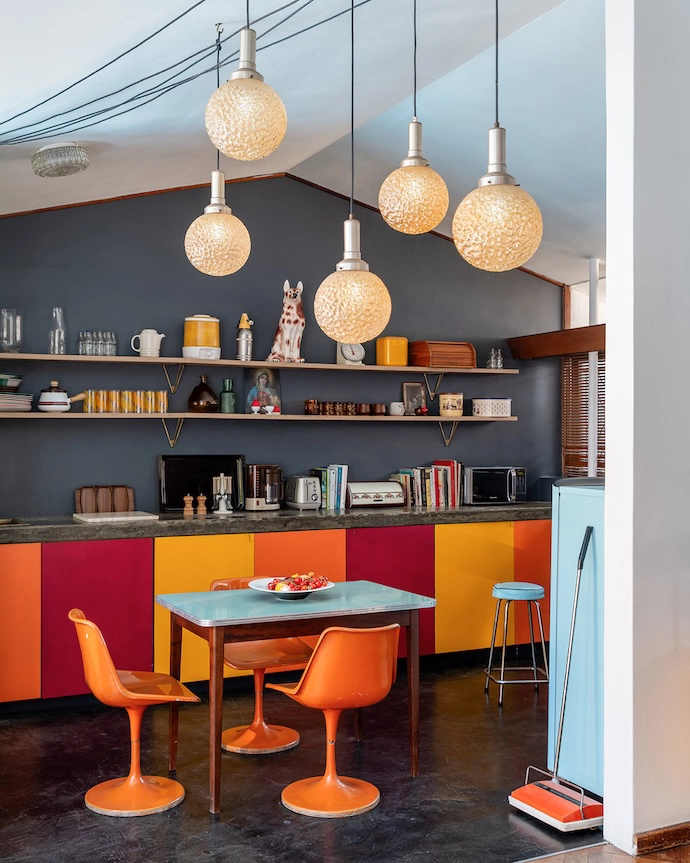
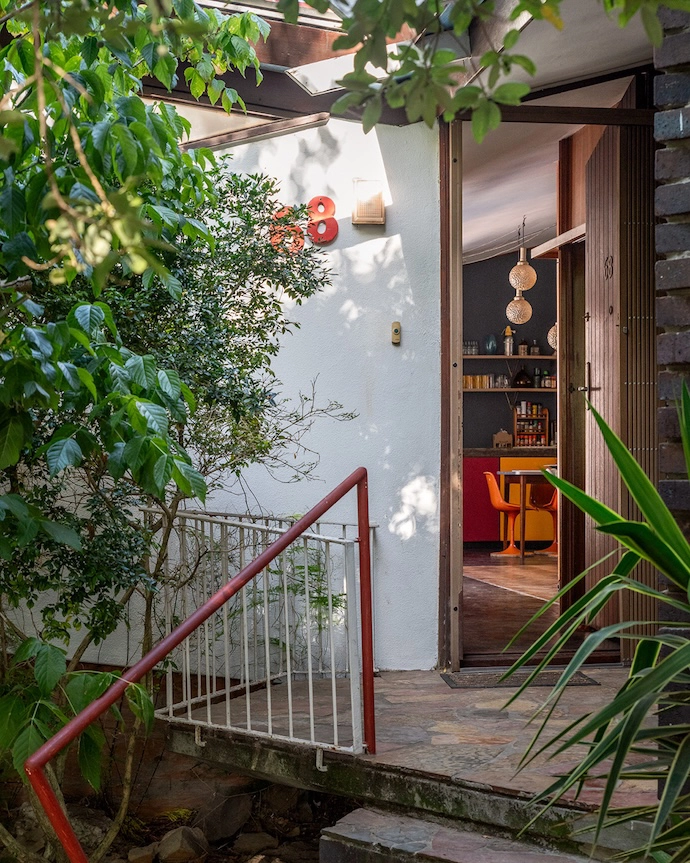
The Mid-century Modern palette of the kitchen cabinetry anchors the home’s enviable collection of designer finds, including the 1950s Tulip chairs by Eero Saarinen for Knoll. -

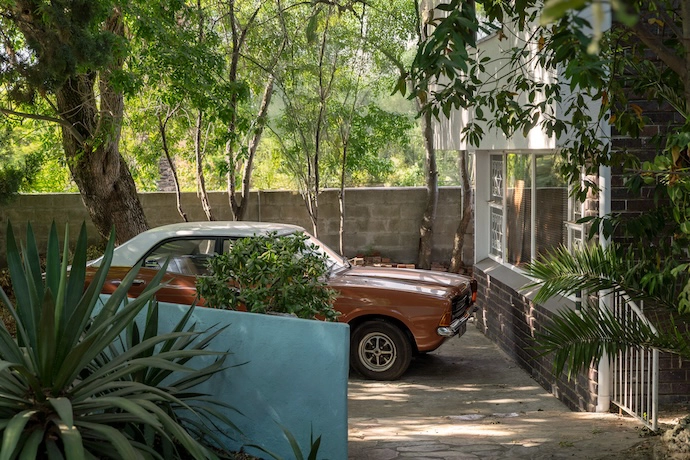
Owner Johannes Pieter Nel’s 1976 Ford Cortina looks fit-for-purpose in its retrophile milieu. -
The slasto “crazy paving” stoep and angled steel balustrade are typical of Modernist South African architecture. -
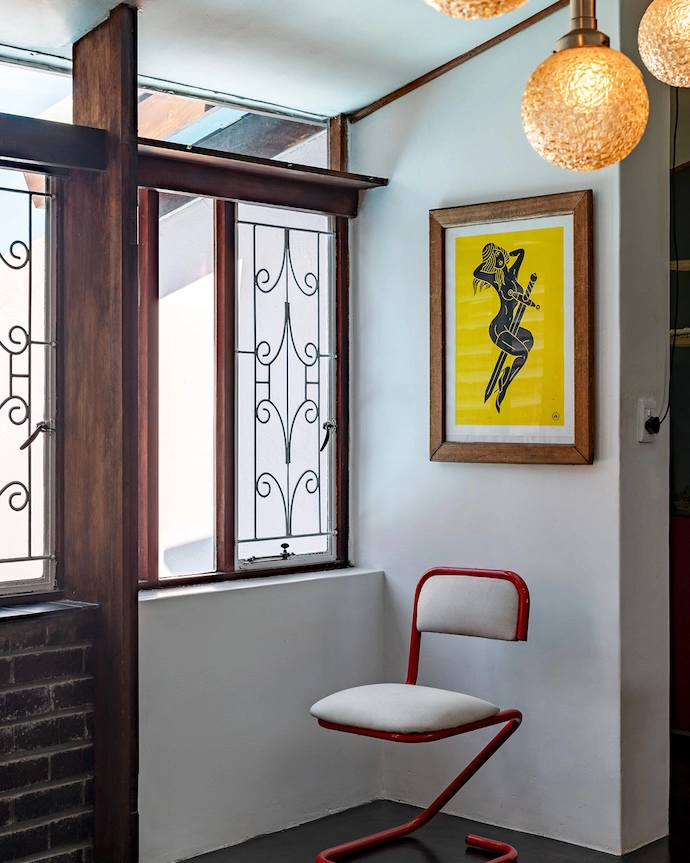
Quiet drama in the entrance lobby, featuring a Flying Dagger print by Marchand and a Marcel Breuer-style chair. -
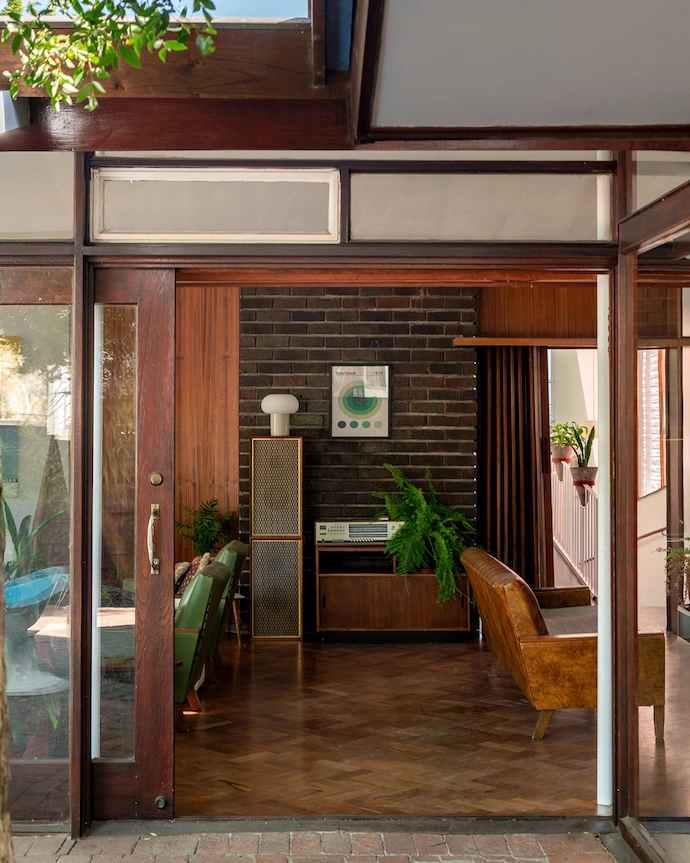
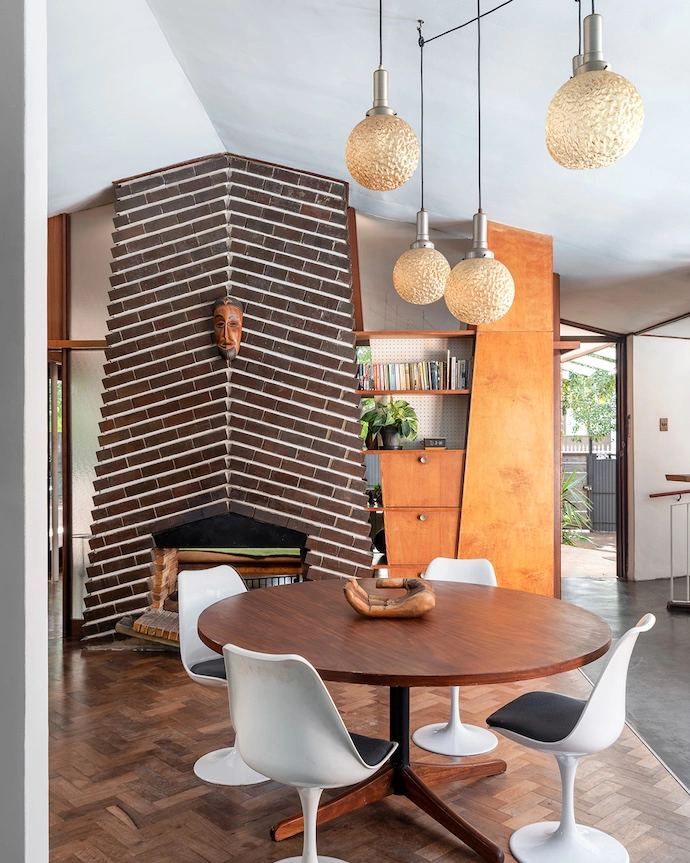
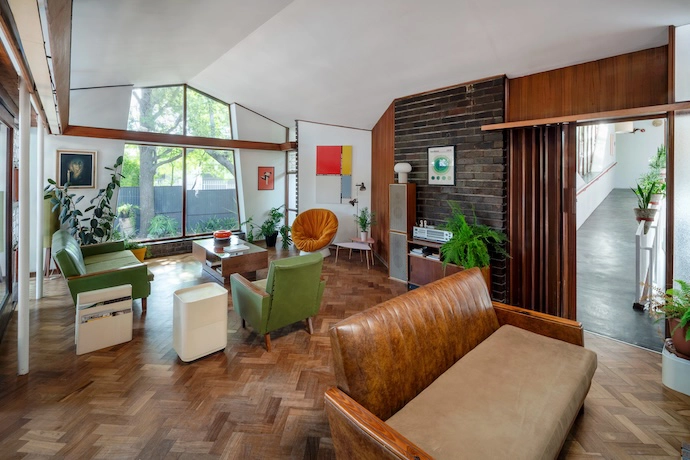
The open-plan living area contrasts a rosewood parquet with face brick and wood finishes. -
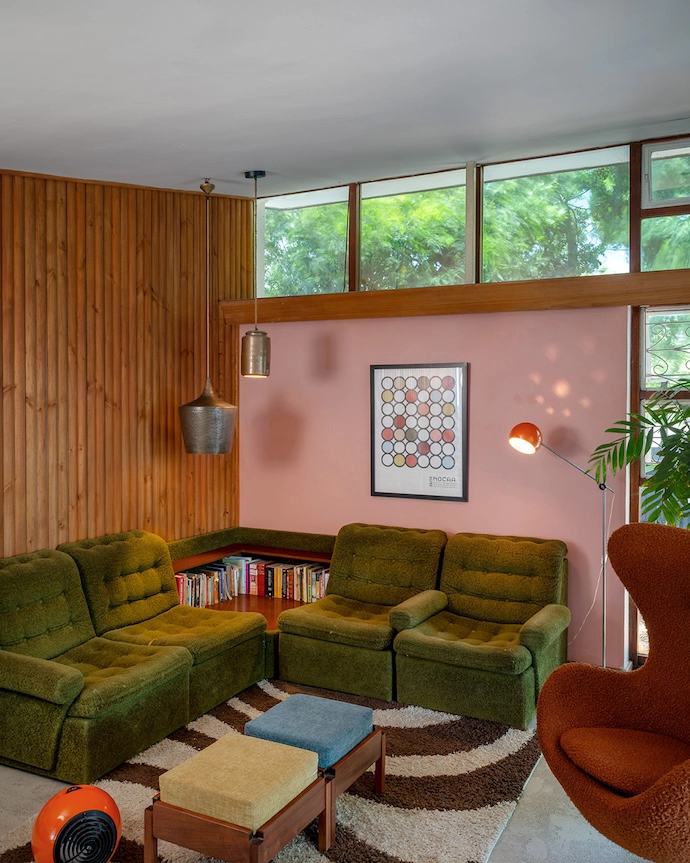
Starring a vintage GEC ball heater, an Arne Jacobsen Egg chair, and an orange Eyeball lamp by Robert Sonneman, the lounge shows off cinematographer Johannes’s set-design chops. -
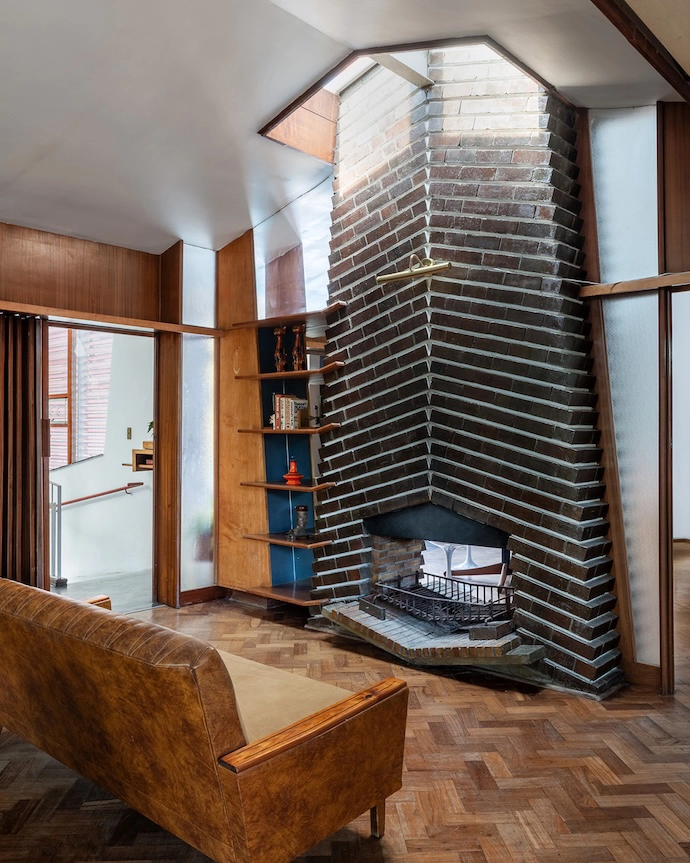
APS Conradie’s attention to detail is obvious in the fireplace’s diagonal brickwork, illuminated by a splayed skylight. -
Foregrounded by white replica Tulip chairs, the lounge’s bespoke timber joinery is another hallmark of APS Conradie’s interiors. -
Another APS Conradie design signature is floor-to-ceiling glazing, here illuminating the open-plan living room and its contents, including a Kartell Model 4675 magazine rack by Giotto Stoppino, a storage unit by Anna Castelli (also for Kartell), an orange papasan chair, and a print of Theo van Doesburg’s Principles of Neo-Plastic Art . -
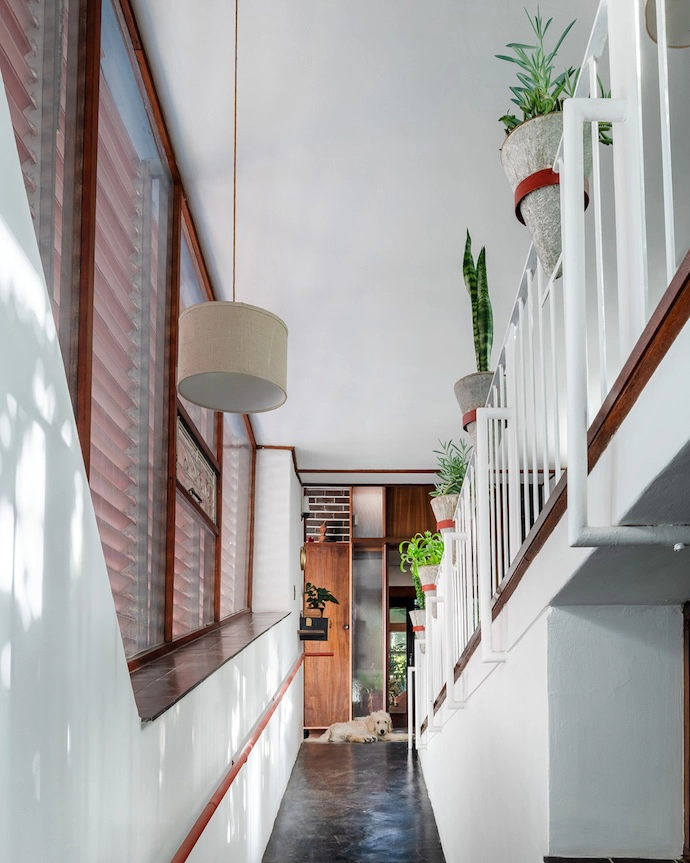
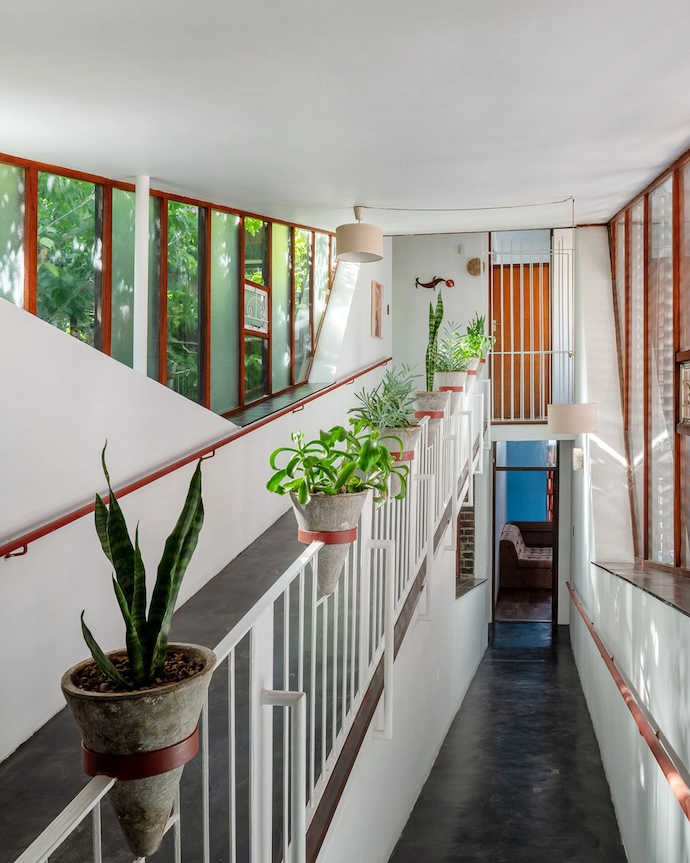
The three levels of the house are connected by ramps – which Johannes’s dog Borrie seems to enjoy. -
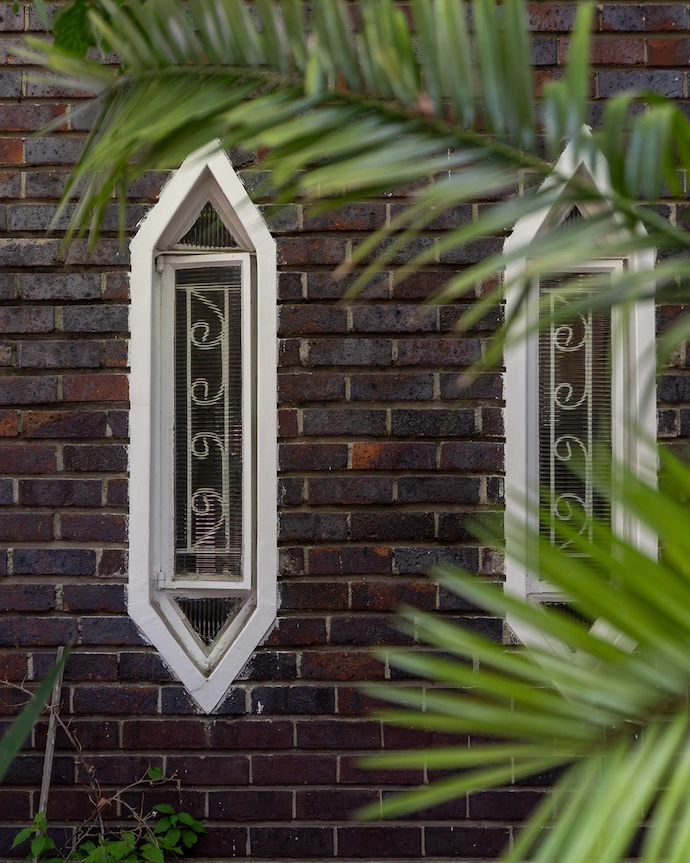
It’s all in the details, like these elongated hexagonal windows. -
The polished concrete of the ramps adds another layer of materiality. -
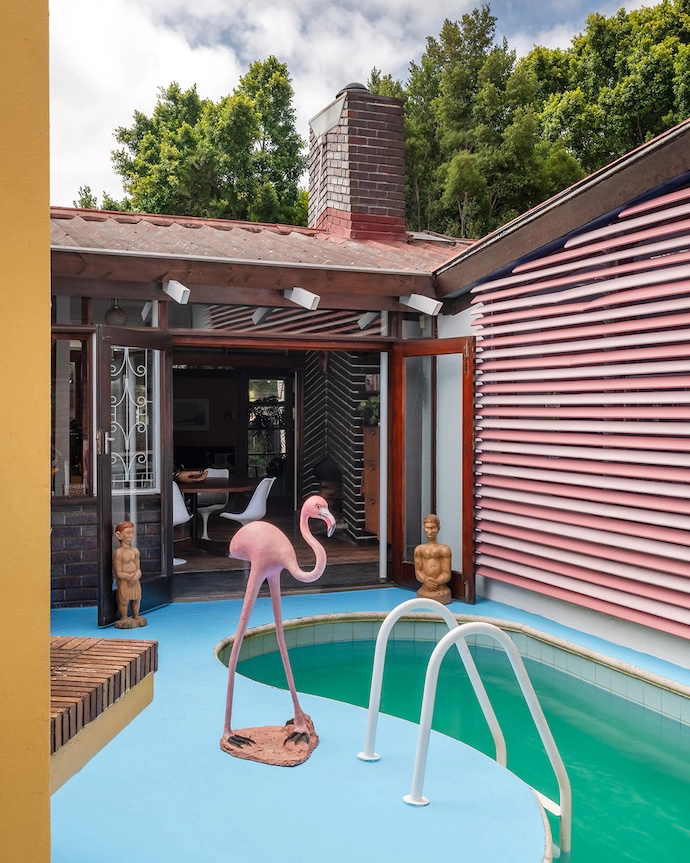
What the pool flamingo says, goes – hence the colour-matched horizontal louvre cladding. -
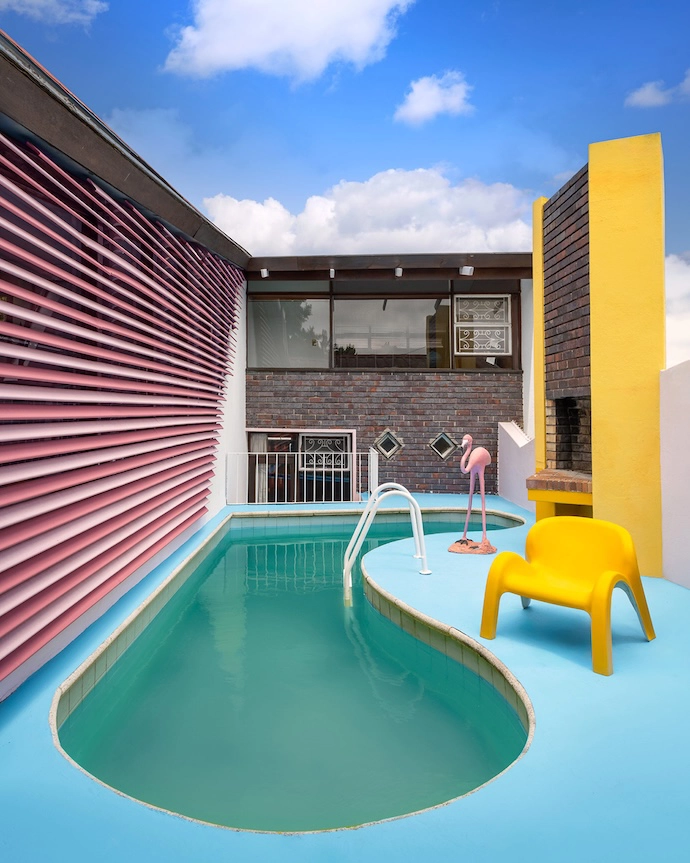
With a replica Garden Party chair by Luigi Colani for Heinz Essmann in the mix, the kidney-shaped pool and surrounding entertainment area recently received a 1970s Miami makeover. -
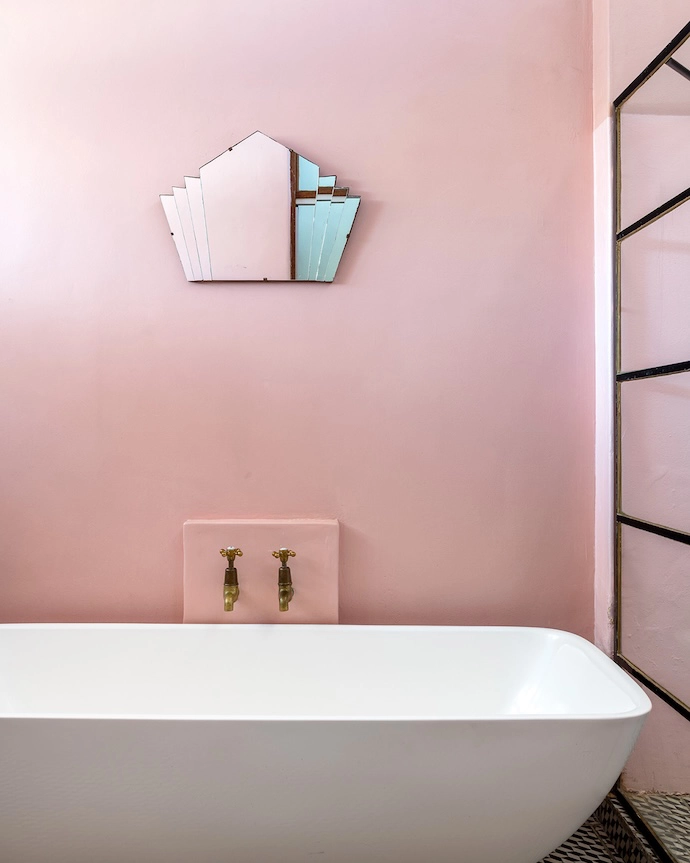
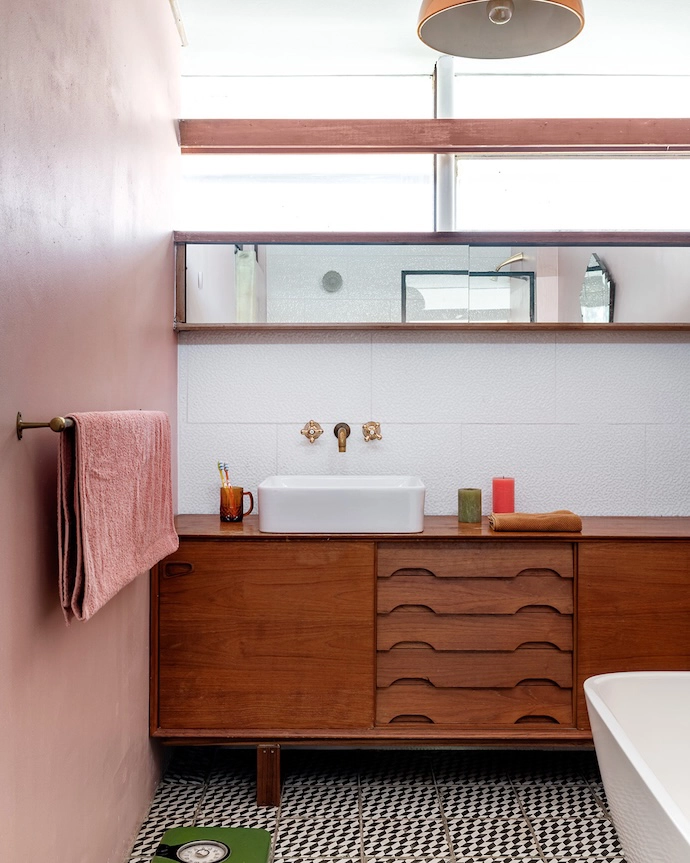
A muted pink wall and delicate Art Deco mirror encourage bath-time contemplation in the contemporary tub. -
Following the diagonal line of the window frame, the built-in vanity is a true one-off. -
Retro hound’s-tooth tiles, a vintage scale and a Danish Mid-century sideboard are juxtaposed with contemporary sanitaryware and lighting in the bathroom. -
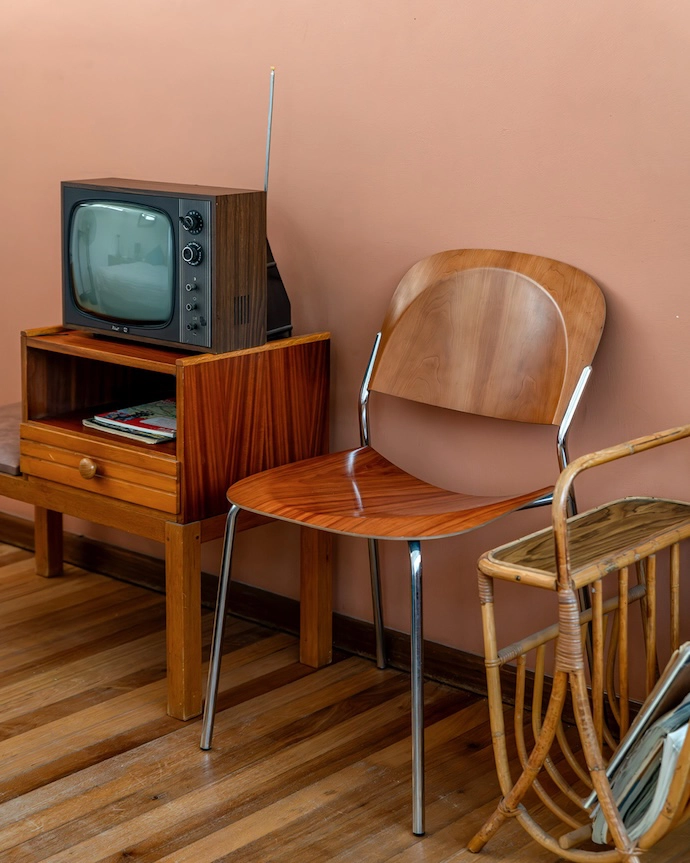
A terrestrial TV set, wicker magazine rack and Stylex wood veneer chair evoke analogue times. -
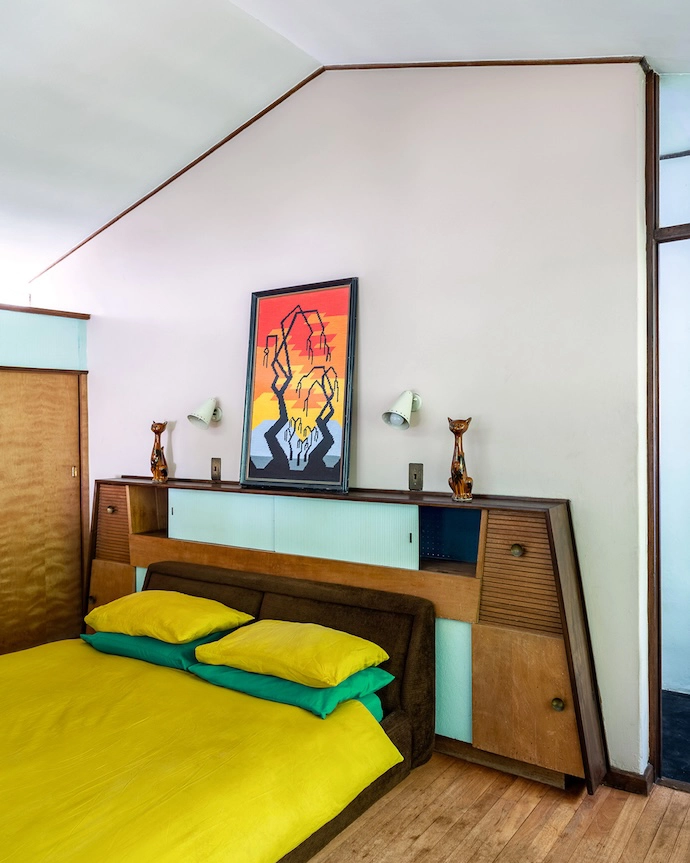
Echoing the diagonal lines of the home, the Mid-century Modern headboard seamlessly integrates into the timber-accented bedroom.
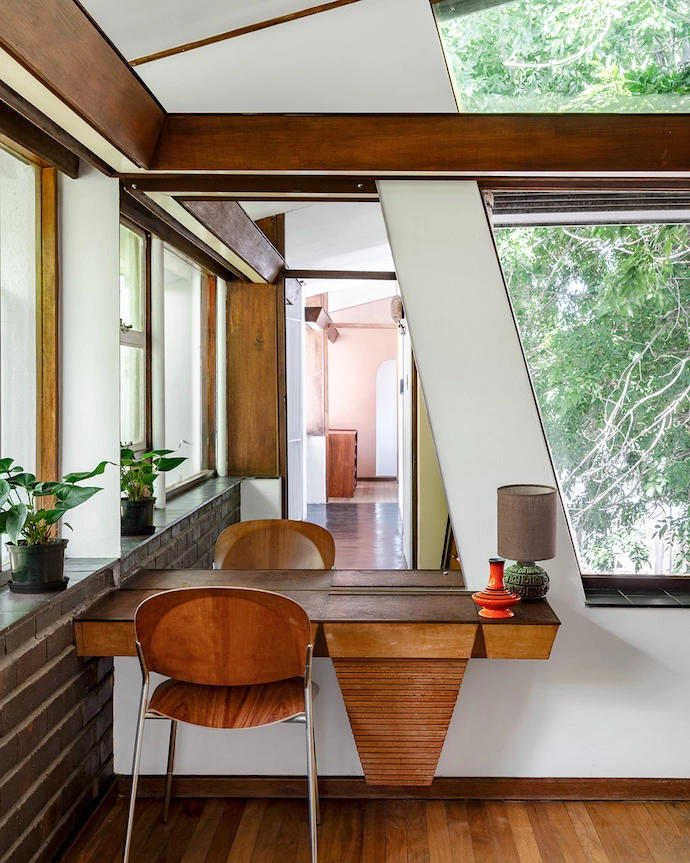
A beautifully preserved Mid-century Modern residence in Cape Town’s northern suburb of Boston has given its cinematographer owner more good angles than can be shot in a lifetime.
WORDS Annette Klinger PRODUCTION Steve Smith PHOTOS Paris Brummer
“I’m a cinematographerI, so my whole life is about looking at things and finding the best angle to make them beautiful,” says Johannes Pieter Nel, owner of a Mid-century Modern residence designed in 1958 by the late APS Conradie – hailed by some as South Africa’s answer to American architecture great Frank Lloyd Wright. “Being able to wake up and live in a space that aesthetically stimulates me 24 hours a day is very special.”
While Johannes was immediately drawn to the retro sensibilities of the house when it came on the market, he only learnt about its architect from the former owners, after which he did a deep dive into Conradie’s prolific Modernist oeuvre. It’s one that encompasses public works such as libraries, schools and police stations – but he especially earned renown for his Dutch Reformed churches and residences. “I started visiting some of the houses and churches he built, including his first church in Rawsonville, which is very similar to this house,” says Johannes. “There’s a very churchy, cathedrally kind of vibe to many of his earlier houses, I think because he started out designing churches.”
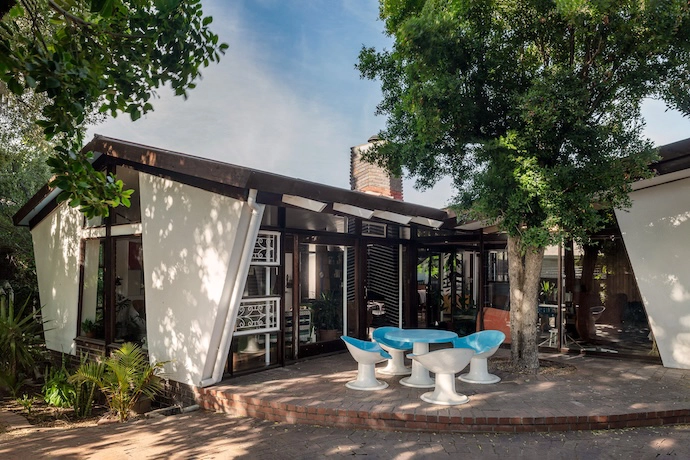
Beyond experiencing the house on a personal level – the beauty of its intricate brick- and woodwork, the rhythm of its oblique angles, the movement of sunlight through its many feature windows – Johannes didn’t know much about its specific history until he was contacted by the Cape Town Heritage Foundation, who requested that the building be included in an APS Conradie architecture tour. The resulting tour more than delivered on anecdotal gems, such as the fact that the five-bedroom house was commissioned by a Dutch Reformed minister, and that the splayed walls in the open-plan living space were purpose-designed to accommodate his organist wife’s electric organ. “On the day, one of the older architects attending approached me and told me his father used to do all the carpentry for APS Conradie. He recalled how he used to sit on his dad’s lap while he was working on his commissions, and actually became quite emotional.”
It’s easy to see why. The woodwork in the house – from the ramp balustrades and the window frames to the panelling and joinery – is finished immaculately, bringing a warmth to the design that would be difficult to replicate with another material. It’s also an inextricable hallmark of Conradie’s works that speaks to his meticulous nature.
Johannes’s keen eye for detail – and nose for a Facebook Marketplace bargain – served him well when it came to furnishing his home with an enviable collection of Mid-century finds. “If I wasn’t in the film industry, I’d definitely be in the antiques industry, because I’m addicted to driving to small towns and discovering pieces that I find aesthetically beautiful. I’ve gradually filled the space with a combination of Mid-century furniture and more contemporary pieces, so it doesn’t feel too antiquey.”
Owning a period home that seemingly doesn’t have a bad angle has had its perks for Johannes, who’s used it as a filming location for everything from a pizza commercial to a murder-mystery series. Asked to frame his perfect shot, he thinks for a beat before answering: “The swimming pool area faces west, where the sun sets. Around 6pm, for about 15 to 20 minutes per day, the sun filters through the blinds and makes these warm sun stripes that fill the entire ramp area, where my dogs are usually lying.”
You can almost imagine it – the sun setting, the shadows getting longer, before darkness eventually envelops the house and the scene fades to black…
Albertus Petrus Snyman “APS” Conradie
(16 November 1925 – 26 December 1999)
Known for his visionary, organic approach to Modernism, APS was a devout Christian all his life. He overcame a speech impediment to study architecture at the University of Cape Town, and graduated in 1951 with distinction. His work – especially his houses and churches in Cape Town – blended clean modern lines with sensitivity to landscape, climate and natural materials, drawing inspiration from Frank Lloyd Wright while forging a distinctly South African idiom. It’s accurate to say that Mid-century Modern architecture was championed in South Africa’s white Afrikaans community, and in line with the National Party’s promotion of a more progressive Afrikaner image. As a fierce patriot and an ardent supporter of the Afrikaans language, APS was at the architectural forefront of that.
Don’t forget to sign up to our weekly newsletter for the latest architecture and design news.