-

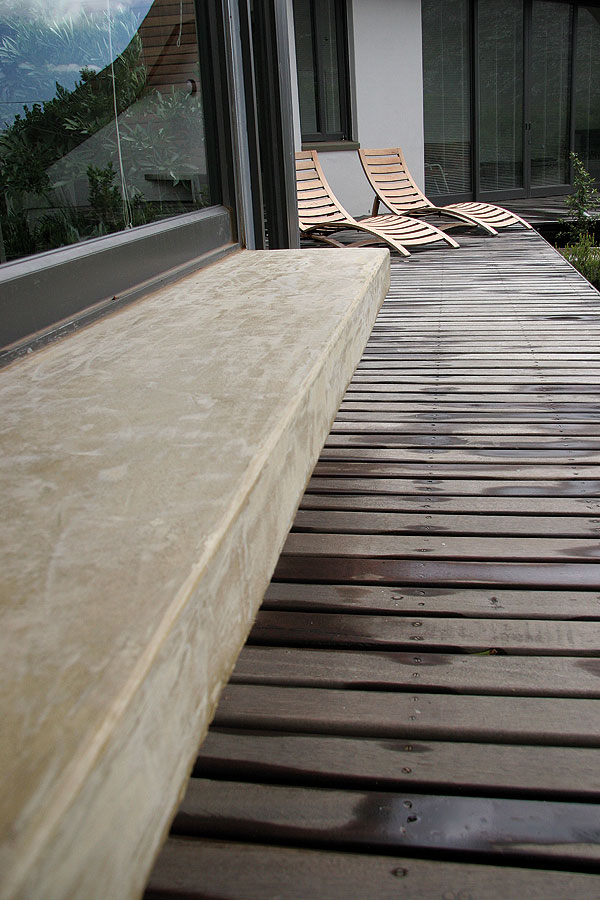
Relationship building : A cantilevered concrete seat over balau decking. -
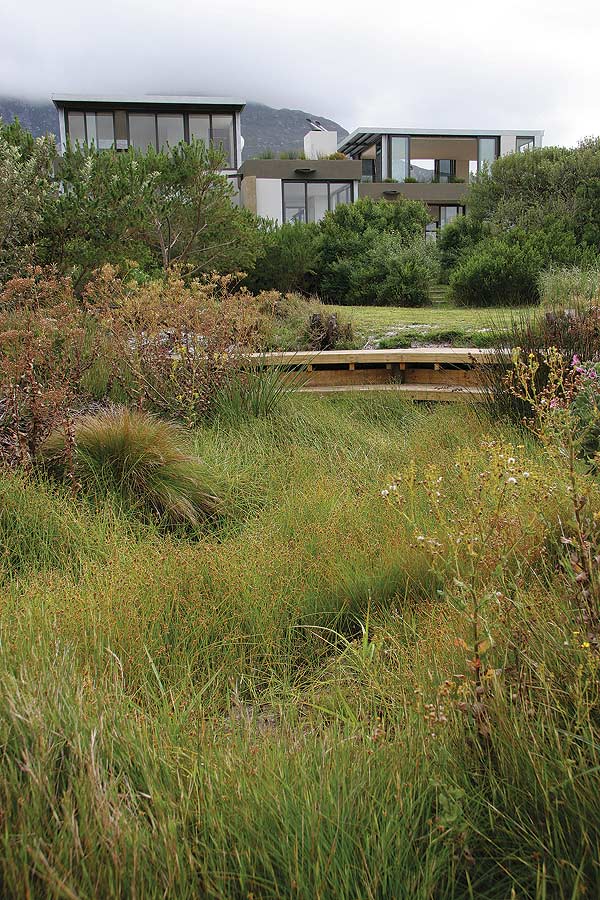
Relationship building : The building warps down to the ground on both sides, it's banks planted with fynbos and flowering shrubs that continue onto the roof. -
Relationship building : The house forms a delicate frame against the rocky mountainside, speaking of both the fragility and potency of its landscape. -

Relationship building : the upstairs sitting room is a tranquil haven that opens up on all sides and has breathtaking views of the Kogelberg Mountain. The fabrics used intentionally dialogue with the colours of the fynbos. -
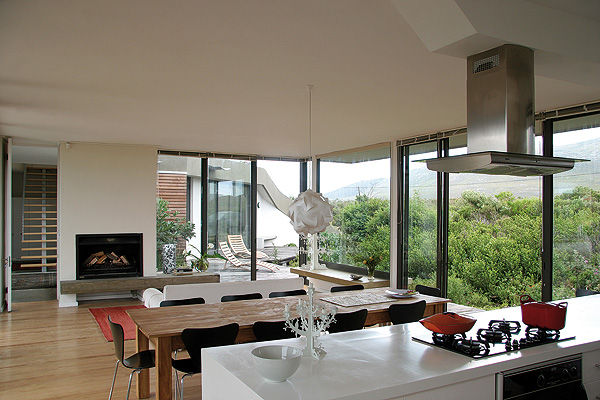
Relationship building : A panoramic mountain view and the warp of the building, which mirrors the mountain slopes beyond, define the living, dining and kitchen area. -
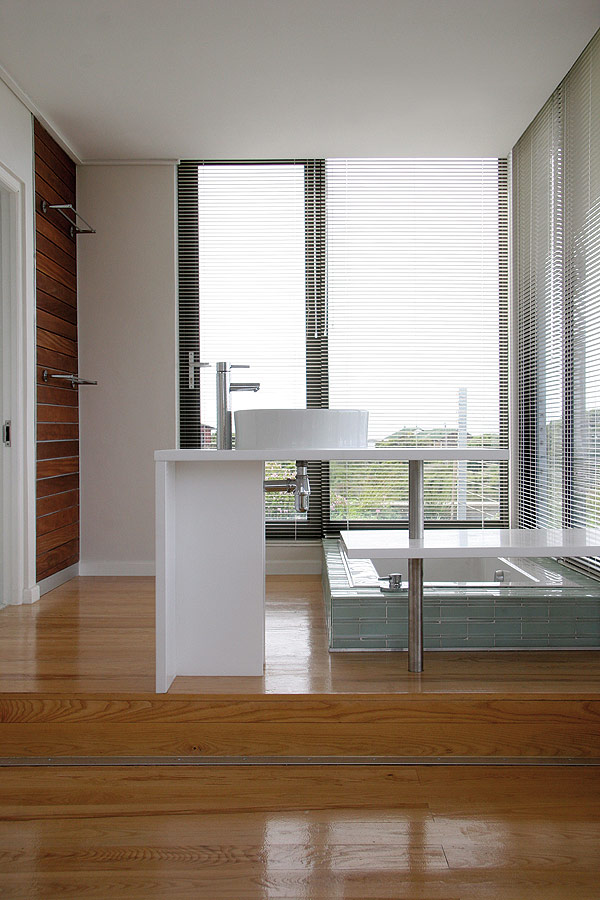
Relationship building : The upstairs bathroom on a platfom is part of the main bedroom. The architect wanted the simplest possible lines and the least possible interference from objects. The bath is Libra's Indulge and the basin is by Valadares. -
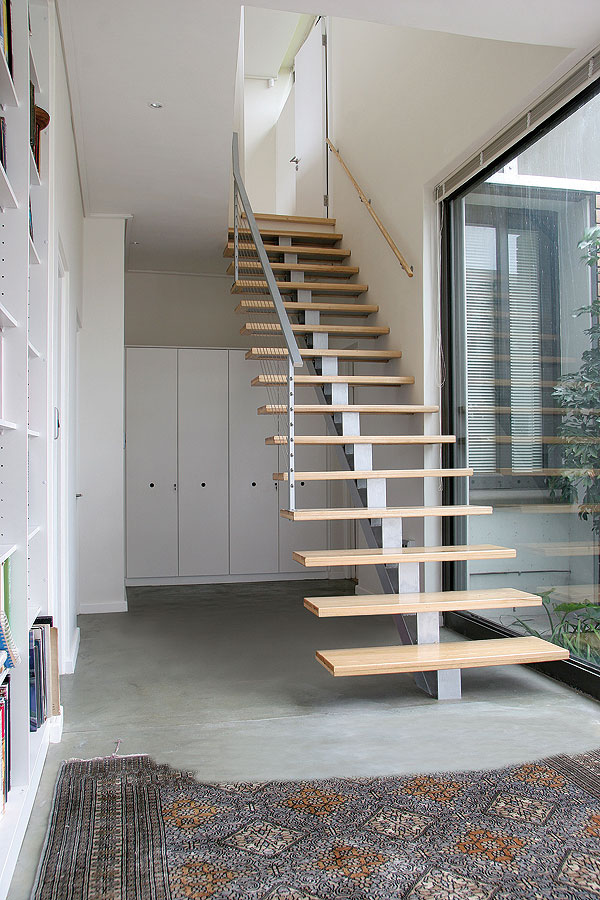
Relationship building : The ash-and-steel stairs to he upper bedroom were designed by the architect. -
Relationship building : The ground-floor experience is one of living, protected and private, in the fynbos. Rising above are the roof cubes. -
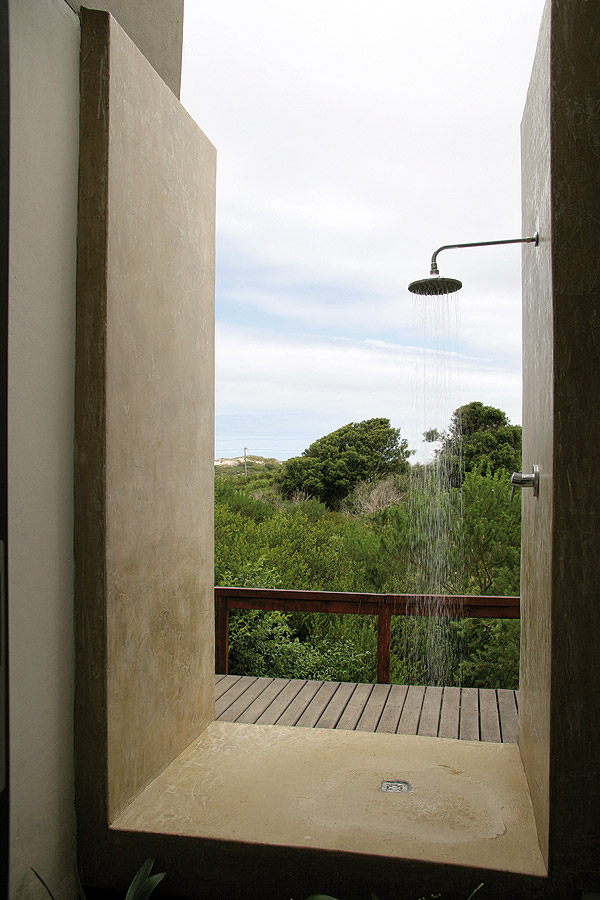
Relationship building : The outdoor shower is best at night, under the stars. -

Relationship building : Architect Sarah Calburn.



PHOTOS David Ross WORDS Sarah Calburn
Transformation is possible when powerful architecture is created in a dynamic relationship with its landscape, writes architect Sarah Calburn about her Fynbos House in Betty’s Bay.
It’s strange and wonderful and difficult being an architect. Because architecture works on so many levels, I can’t think of any other occupation more immensely challenging, or any other profession that’s so guaranteed to hold my grasshopping interest.
I consider architecture an art: it’s a complex technical, cultural, philosophical and spatial language. But looking at how it’s made and unmade the landscapes of South African suburbs, it’s fallen foul of being stylish and been coupled with development’s lowest common denominator.
People are generally unaware of architecture’s complex power. If you think of architecture as landscape-forming – rather than as a container for style-driven interior decoration, or a fashionable way of keeping out the weather – you realise it’s not simply a spatial medium with which we construct and house our desires and necessities.
It’s also a constant companion that frames our view, conditions our seeing and even interferes with our perceptions. We’re permanently between architecture and landscapes, the two forming and reforming our field of experience, with our domain being what’s between them. What is it about a house with a view? And how does a particular house reveal a particular landscape?
A question I ask my architectural self is what it is to be “between”. What is it to work in the space between architecture and landscape. Land is too often regarded as being passive – a site to be built upon, conquered and covered. Land is also more than a simple, sometimes-beautiful backdrop.
We can no longer afford to conceive of ourselves in our world as entities in opposition, such as man vs woman, black vs white or manufacturing vs the atmosphere. These previously “clear” states slide about in a continuum of movement and change; we’re part of a fluid quantum universe that’s moved from fairly static philosophical theories of “being” to the more powerful movable feast of “becoming”. We’re mutable, desirous and affecting.
I like to think we respond to our environments and one another in powerful and creatively unpredictable force fields of mutual “becoming” and deformation. We are cast into a constantly creative relationship with our domain.
Building becomes landscape-forming
So it’s no longer about simply designing a house on a site, it’s about getting between: between the great humpbacked mountains; the dense coastal thicket; the violent weather; the delicate beauty of the fynbos; surfing the conceptual wave of freezing blue seas and blinding beaches; the wind-free zones; the long lunches; the view from the bed.
It’s about getting between your visceral design unconscious and your rational, architectural self. That is quantum behaviour: things and ideas become both particle and wave, and project becomes projectile.
Of course, you’re also getting between Betty’s Bay, possibly one of the ugliest outcroppings of holiday architecture on the Cape coast, rising grim and humourless in face brick from its passive sea of crushed fynbos. I was not going to have a building erupt out of the fynbos like a five-bedroomed warship cast adrift on the hapless vegetation. So building becomes landscape-forming.
This house was designed to heighten the experience of both the potency and the fragility of its surrounds. It warps down to the ground at either end, its banks planted with fynbos and shrubs that continue onto a planted roof slab over the ground floor. The slab is concrete, brutal and potent, made to carry the weight of the earth. The banks’ angles, at 30 degrees, mirror the angles of the huge dune beyond, where 30 degrees is the soil’s natural angle of repose.
The ground-floor experience is one of living, protected and private, in the dense surrounding coastal fynbos – between the floating-timber floors and the underside of the concrete roof slab. Although the architecture is strong, the walls are mostly made of glass, so the dominating interior experience is of the ever-changing light across the mountains.
The building is often completely transparent from side to side, its various interior and exterior landscapes in constant contact. And because the exteriors define the interiors, there’s no real need for interior decoration.
Fynbos House has shaped itself in unexpected ways
The first floor is divided into two glass-and-steel cubes – they rise from the planted roof garden – from which to gaze over the fynbos to the sea, mountains and dunes. The building becomes fragile here because it’s at the mercy of the often-violent weather.
The beauty of the surrounding fynbos is brought into the foreground when sitting at the open window in the upstairs sitting room; when lying in the bath alongside the planted roof; or when walking between the cubes on the lawned roof. All spaces in the house open right up, allowing for parts to be kept open even in a gale. From a distance, when the house is opened up, it’s a fragile frame against the rocky mountainside.
So I return to the creative power of relationship: if powerful architecture can be created in a dynamic relationship with its landscape, change is possible – each state can move beyond its previously perceived limits. How does this particular building intensify this particular landscape? How is that building deformed by that landscape?
Fynbos House has shaped itself in unexpected ways. I like to think the building and the landscape are recast, seen anew, and are mutually affecting and desirous.
Sarah Calburn: 011 726 1162, sarah@sarahcalburn.co.za.
First published in VISI 30. See more of our favourite beach houses online and buy the Endless Summer edition of VISI for the ultimate beach house collection.