-

The “Manufacturing Modern” exhibition and open storage at the MillerKnoll Archives is home to countless iconic pieces, including Mies van der Rohe’s Barcelona chair, the Wassily chair by Marcel Breuer, and the Tulip chair by Eero Saarinen. -

The “Manufacturing Modern” exhibition and open storage at the MillerKnoll Archives is home to countless iconic pieces, including Mies van der Rohe’s Barcelona chair, the Wassily chair by Marcel Breuer, and the Tulip chair by Eero Saarinen. -
Inside the V&A East Storehouse. -
The Weston Collections Hall at the V&A East Storehouse features more than a hundred carefully curated mini-displays. -

Vitra Design Museum by Frank Gehry. -

Rows of iconic designs in Vitra Schaudepot’s basement. -

The Schaudepot Lab reveals how iconic designs come to life. -

The Schaudepot Lab reveals how iconic designs come to life. -

The exterior of the Vitra Schaudepot.


From hidden storage to open access, traditional museums and global design giants are lifting the lid on their collections.
WORDS Jo Buitendach PHOTOS Nicholas Calcott/MillerKnoll, Hufton+Crow, Kemka Ajoku/V&A, Thomas Dix/© Vitra Design Museum, Mark Niedermann/© Vitra Design Museum, Julien Lanoo/© Vitra Design Museum
Dusty corridors, dim lighting, do-not-touch signs… That’s old-school. Today’s museums are rethinking the script – focusing less on hushed reverence, and more on hands-on experience, interactivity and greater public access.
Most major institutions display less than 10% of their collections, with the rest kept in storage. The British Museum in London, for example, holds about eight-million objects but shows just 80 000 at a time – only 1%! But things are changing: a new wave of museum design is throwing open the collection doors and inviting the public in for a closer look.

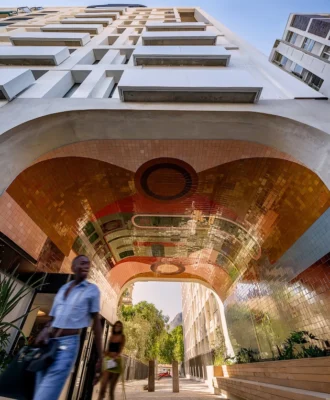
In May 2025, the V&A East Storehouse launched in London’s Queen Elizabeth Olympic Park. Part of the V&A – a family of institutions dedicated to the power of creativity – this public-facing facility reimagines what a museum can be. Designed by acclaimed architects Diller Scofidio + Renfro, it’s both a working collection and an open invitation: for the first time, visitors can access hundreds of thousands of objects that were once hidden away. Through the V&A’s radical new Order an Object service, anyone can book to view any item in the collection – free of charge, seven days a week.
“V&A East Storehouse is a completely new cultural experience – a backstage pass to the V&A,” says Tim Reeve, deputy director and COO of the Victoria and Albert Museum. “It transforms the way people access the V&A’s national collections on a scale unimaginable until now.”
From ancient Egyptian shoes and avant-garde couture, to 14th-century paintings, vintage band T-shirts and Mid-century furniture, the Storehouse spans nearly every creative discipline. Its vast four-level interior houses more than 250 000 objects, 350 000 books and 1 000 archives.
Visitors entering the central Weston Collections Hall are surrounded by a striking cross-section of the museum’s holdings. More than 100 curated mini-displays are cleverly embedded into the ends and sides of the storage racks, allowing guests to chart their own path through the collection. Highlights range from ancient Buddhist sculptures to PJ Harvey’s guitar, Vivien Leigh’s costumes, Glastonbury memorabilia, suffragette scarves, vintage football shirts, and Thomas Heatherwick’s model for the 2012 Olympic Cauldron. Six large-scale centrepieces anchor the space, including the 1930s “Kaufmann office” by Frank Lloyd Wright – the only complete Wright interior outside of the US – and a section of the now-demolished Robin Hood Gardens estate in East London. | vam.ac.uk

It’s not just public museums embracing this open-access trend. In June 2025, MillerKnoll Archives – created by the design collective formed by Herman Miller and Knoll – opened at the company’s Michigan Design Yard HQ. Bringing together the legacy of both brands, the archive offers a rare window into the evolution of modern furniture and design culture. Think the Eames lounge chair, the Noguchi low table, the Wassily chair by Marcel Breuer, and the Barcelona chair by Lilly Reich and Mies van der Rohe. “It’s been the opportunity of a lifetime to unite our shared history and preserve our culture of innovation, ensuring that these design legacies remain accessible for generations to come,” says Amy Auscherman, director of archives and brand heritage.
The archives are divided into three public-facing zones: an exhibition area, a reading room for researchers and design professionals, and a standout open storage section. Here, more than 300 pieces of modern furniture are on view, from early Knoll and Herman Miller classics to contemporary designs by brands such as NaughtOne, Geiger and HAY. Notable pieces include a prototype of the Knoll Womb chair (gift ed by Eero Saarinen to his mother), early office furniture by Florence Knoll, Gilbert Rohde’s 1933 World’s Fair designs and sculptural lighting by Isamu Noguchi. Complementing the furniture, wall- mounted racks showcase graphic design treasures – from Eames photography to George Nelson ads, and posters by Lella and Massimo Vignelli – telling a visual story of modern design’s influence. | millerknoll.com

MillerKnoll isn’t the only design giant opening its collection to the public. Swiss furniture company Vitra – known for its Mid-century Modern icons and designer collaborations – has long embraced this approach. On the Vitra campus in Weil am Rhein, Germany, two key institutions bring its design heritage to life.
The Vitra Design Museum, designed by Frank Gehry and opened in 1989, was one of the first major institutions of its kind. In 2016, it was joined by the Vitra Schaudepot, a purpose-built museum depot designed by Herzog & de Meuron. The Schaudepot is one of the world’s largest permanent exhibitions of modern furniture, with more than 400 pieces from the 1800s to today on display – including early Bentwood chairs; classics by Le Corbusier, Alvar Aalto and Gerrit Rietveld; as well as various experimental prototypes, anonymous designs and contemporary 3D-printed works.
Far from being a static archive, the Schaudepot is both a research hub and a living showcase, offering visitors a glimpse into the evolution of form, function and design thinking. | design-museum.de
Don’t forget to sign up to our weekly newsletter for the latest architecture and design news.