-

A thorn is a thorn : It’s no mystery why Euphorbia milii var. splendens is popularly known as Crown of Thorns. -

A thorn is a thorn : Stems bristling with vicious spines are bare in winter but produce bright green leaves and brilliant flowers like drops of blood in spring. -

A thorn is a thorn : In Limpopo, the sculptural naboom, Euphorbia ingens, has long been used as a living security fence for kraals and villages. Not only are the diverging spines along the ridges of the swollen branches a formidable deterrent. -
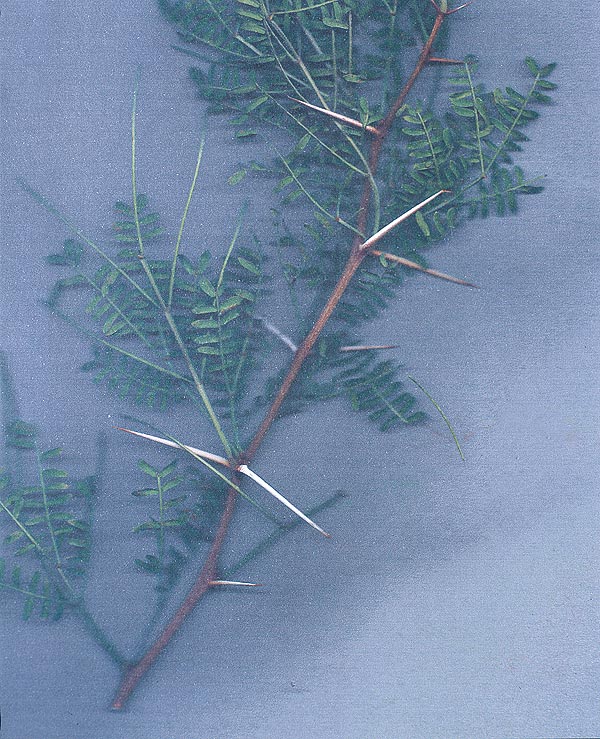
A thorn is a thorn : The thorns of Acacia karroo are modified stipules, straight and set in pairs at the leaf nodes. On young plants, the thorns may be as long as 100mm but on mature plants they average about 40mm in length. -

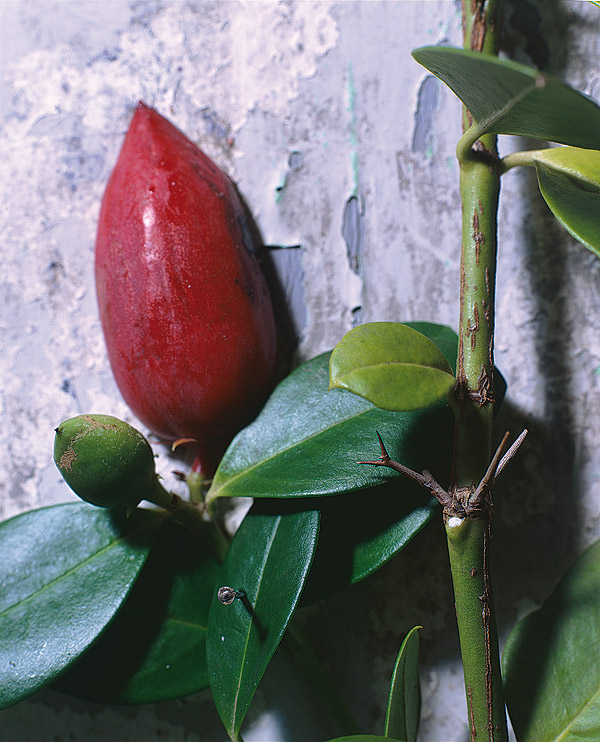
A thorn is a thorn : The num-num, Carissa macrocarpa, bears fragrant white flowers followed by crimson fruits. It also has a neat line in modified shoots that have become forked spines, and makes an excellent, impenetrable hedge. -
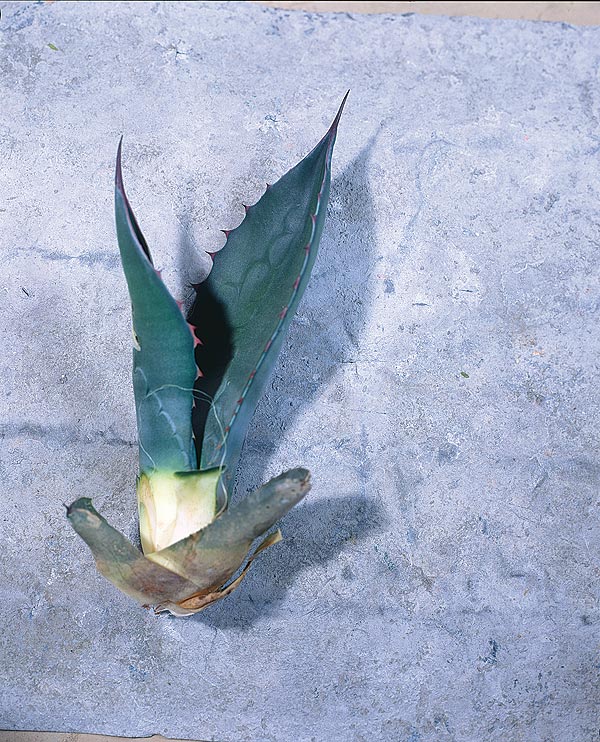
A thorn is a thorn : The leaf margins of Mexican desert dweller, Agave parryi, have developed sharp teeth (these are emergences) to protect their succulent leaves from being devoured.


PHOTOS: Lien Botha | WORDS: Dave Pepler & Allan Davies
The prick of a thorn is a reminder of our frailty, but it’s no accident that plants with thorns are amomg the most beautiful of all, because each one has something precious to lose or hide.
The Bible’s Old Testament bristles with references to thorns. You have only to look at Cruden’s great Bible Concordance, in particular Isaiah 34:13: “And thorns shall come up in her palaces, nettles and brambles in the fortresses thereof: and it shall be a habitation of dragons, and a court for owls.”
Thorns and thistles were a curse more fearful even than death or the plague. Thorns infested the humble patch of the first farmer, choked the crops, ruined the pastures. For the nomads of long ago, spring was a fleeting abundance; as the summer briars took hold, they had to move on, flee.
How and where did thorns come into being? Primitive plants all had their origins in the algae. But somewhere in the past some of them became more palatable, and so more sought-after. And this is where the arms race began, when incidental thorns gave certain plants a better chance of survival.
Plant eaters had to adapt, developing small mouths to graze between the barbs and robust teeth to crack them. Thanks to this ecological tug of war, today we have some of the most beautiful plants on earth: the acacias, the heavenly euphorbias of our deserts, the silk thistle and the rose.
Consider, also, Africa’s classic thorn trees. You have only to look at the silhouettes. There is nothing accidental about these divine shapes, because they have been carved out by others in search of the tree’s hidden treasure. Under the goad of the spines the lower layer has been pruned away and the crown compelled upwards. The whole landscape is defined by the finer detail, rather than by the big picture – the sky blue as nowhere else on earth, the forms pure Pierneef.
If I had to choose my favourite thornbush it would be the num-num. Was there ever a more rewarding and generous garden plant? You wake one summer morning with the bedroom windows open to the garden. The curtains billow and suddenly you’re enveloped in a cloud of the purest perfume. It reminds me of Guerlain’s Vetiver, as described by Luca Turin: “Stoic and discreet, Vetiver scorns all luxury save that of its own proud solitude”. Later in the season, you are rewarded yet again with the ripening of the num-num’s startling red fruit. Sweet and sour hidden among the double thorns.
We tend to forget that our world is a thoroughly prickly one. From the rose on your coffee table, the berries in your yoghurt – blackberry and raspberry – and the sweet chartreuse-green prickly pear, to the landscapes of Africa passing your car windows, from fynbos to Kalahari – thorns are everywhere.
A prick of the finger reminds us of our frailty. First the electric sting, then weakness – then the drop of blood, round and perfect. Redder than coral, num-num red. There is a beautiful verse, “Lascia la spina”, from Handel’s oratorio Il trionfo del Tempo e del Disinganno.
Leave the thorn and pluck the rose,
you go in search of grief.
Old age will creep up on you
when your heart does not expect it. (Bernadetto Pamphili)
The well-armed garden
• In the garden, sculptural plants such as aloes, cacti, thorn trees and agaves provide dramatic beauty as well as security fencing, but keep them away from paths, patios and play areas.
• Keep branches of trees well above eye level, or let them sweep to the ground.
• Arm yourself with heavy leather gauntlets for gardening.
• Aloe arborescens, the cat thorn, Scutia myrtina, the Kei apple, Dovyalis caffra, or various taller species of Euphorbia, all make striking and impenetrable hedges.
• If you have space, plant a thicket or exclusion area of thorny trees, shrubs and scramblers, which birds will love.
• Begin by planting thorn trees close together along the boundary. To the front, plant shrubs such as Cassinopsis ilicifolia, and Carissa macrocarpa. Add thorny scramblers, such as Asparagus falcatus and Smilax kraussiana.*
• Spiky exotics also make colourful security hedges and habitats, especially bougainvillea and heritage roses. Gwen Fagan** suggests planting a mix of the following old roses for a beautiful display: ‘Géant des Batailles’, ‘Alberic Barbier’, ‘Indica Major’, ‘Mermaid’, Rosa laevigata, Rosa multiflora varieties and ‘Russelliana’.
* For an extensive list of thorny indigenous plants for security barriers, see Bring Nature Back to your Garden by Charles and Julia Botha (ISBN 1 874 97503 5)
** In Roses at the Cape of Good Hope (ISBN 0 620 11032 5)