-

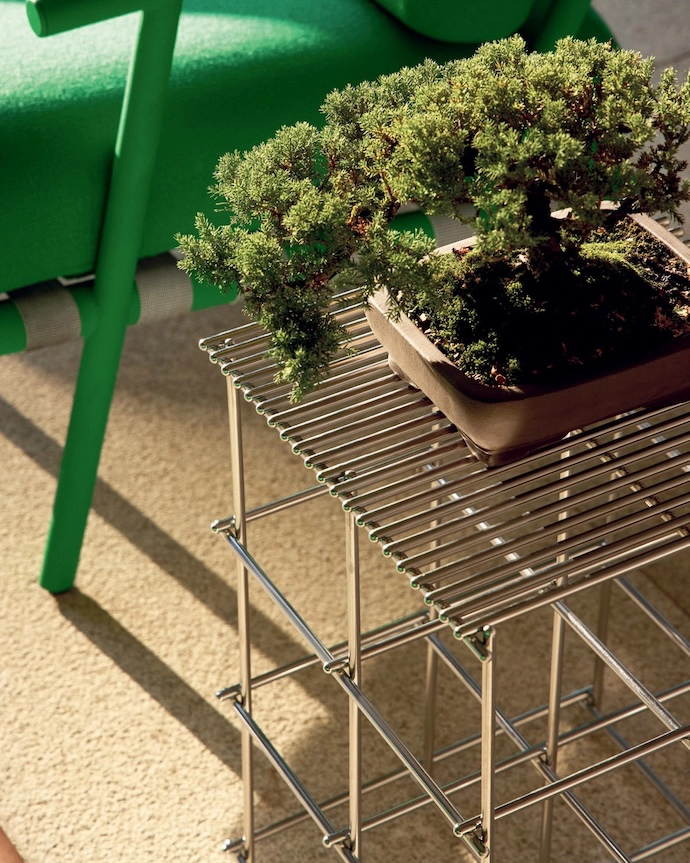
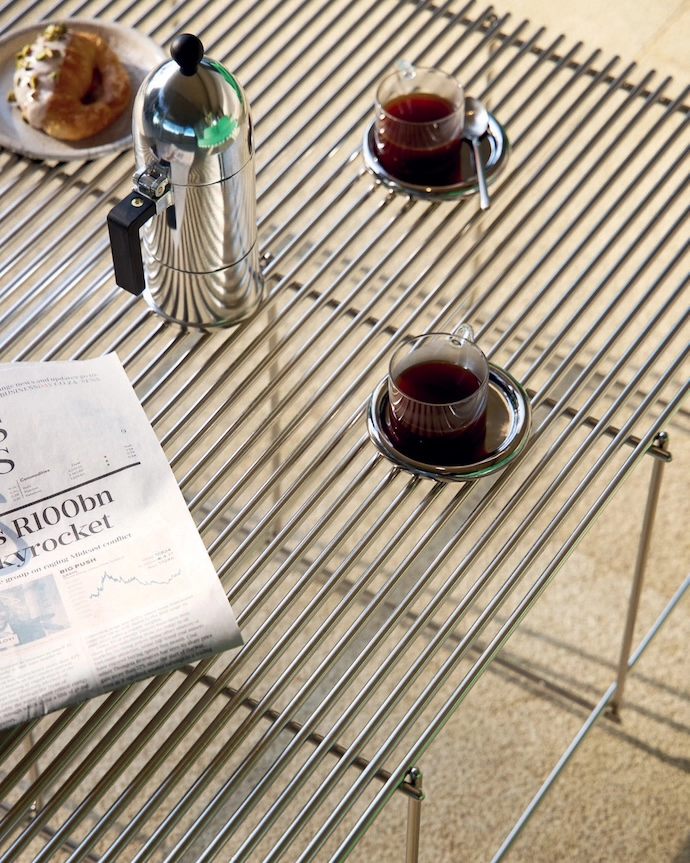
Scaffold’s structural elements and tabletop surface are both made from the repetition of identical rods that allow light to traverse the negative space. The range comes in polished stainless steel, and in steel softened by a pastel powder-coat palette. -
Scaffold’s structural elements and tabletop surface are both made from the repetition of identical rods that allow light to traverse the negative space. The range comes in polished stainless steel, and in steel softened by a pastel powder-coat palette. -
Scaffold’s structural elements and tabletop surface are both made from the repetition of identical rods that allow light to traverse the negative space. The range comes in polished stainless steel, and in steel softened by a pastel powder-coat palette. -
Scaffold’s structural elements and tabletop surface are both made from the repetition of identical rods that allow light to traverse the negative space. The range comes in polished stainless steel, and in steel softened by a pastel powder-coat palette.
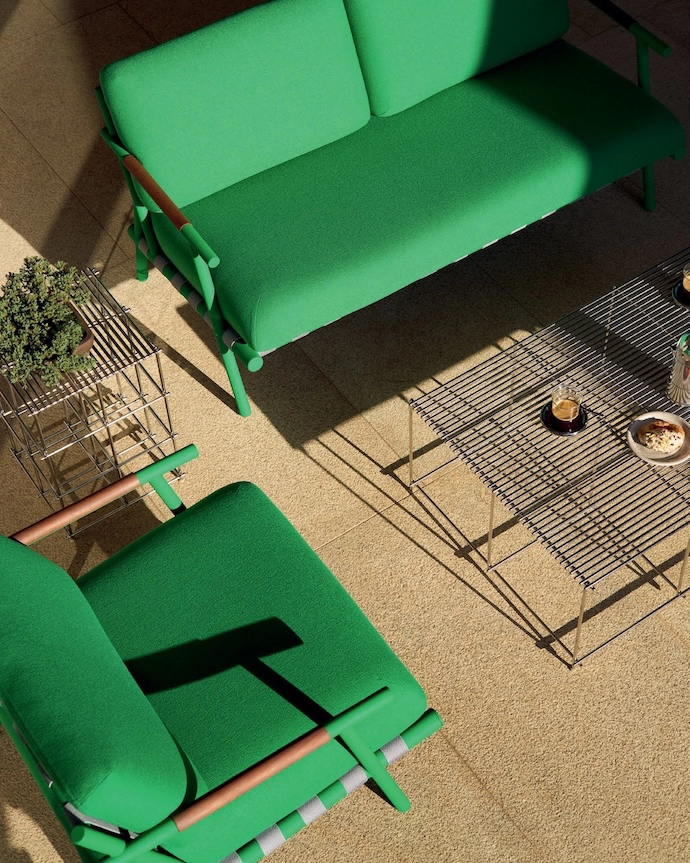
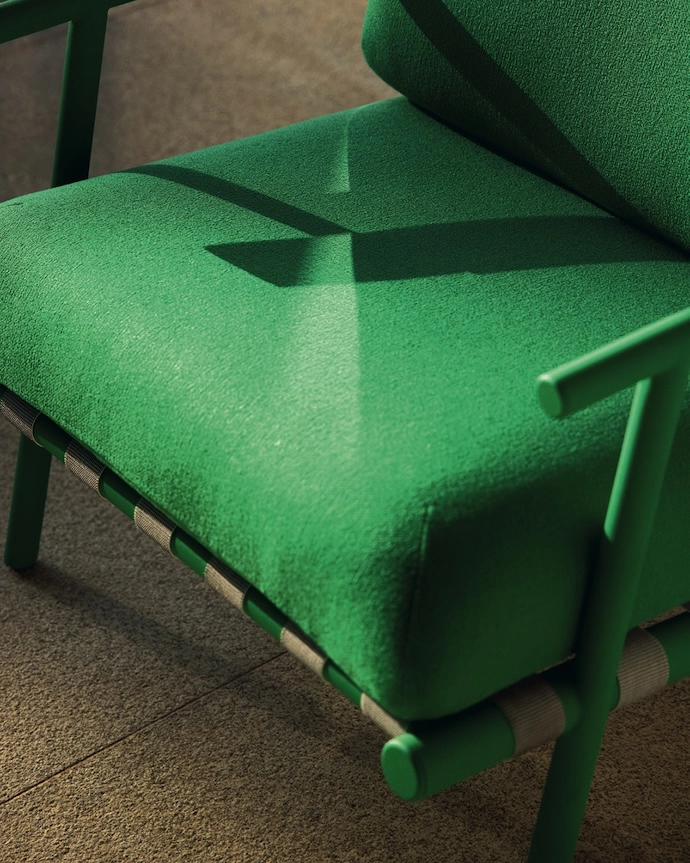
Scaffold is a new range of Brutalism-meets-Japanese bamboo scaffolding outdoor occasional tables by HALDANE. We got some insights into their creation from the brand’s designer Haldane Martin.
WORDS Steve Smith PHOTOS Inge Prins
Known for its legendary strength-to-weight ratio, bamboo scaffolding has long been used in Japan and Hong Kong’s construction industries where, despite appearing fragile, its grid-like structure provides massive stability. Inspired by this method of lashing together bamboo poles through the X, Y and Z orientations, Haldane Martin’s new tables represent a rational yet refi ned take on expressed materiality – and in so doing, add distinctly Brutalist vibes to this Oriental form.
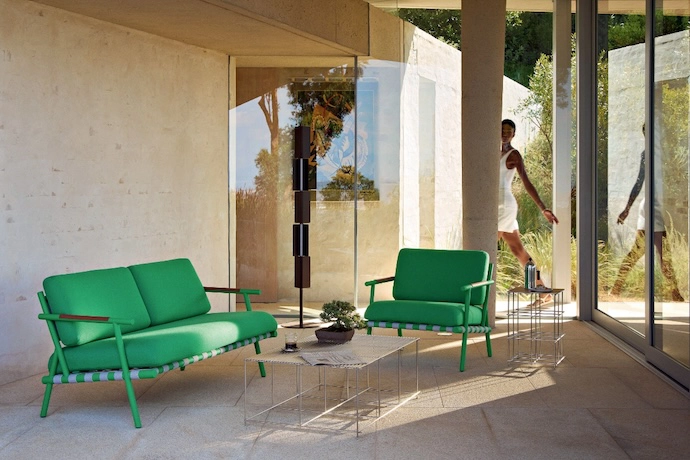
The 160mm x 160mm sidetables and 320mm x 320mm coffee tables are made from 8mm rods with 8mm gaps between them, each protruding rod neatly rounded to prevent them from snagging clothes. Visually, Scaffold tables are as sculptural as they are practical, with floating rational rectangles in varied heights and sizes.
We spoke to Haldane about the origins and execution of his latest design.
“Machine made honest” sounds almost like a manifesto. Did that idea lead the design, or did it emerge along the way?
“I did want to explore something more linear and machine-friendly from the start, but my designs are always evolutionary. I have a table design because machines are good at making things linear and orthogonal using Cartesian grids. This table collection very much takes that to the extreme. It’s partly a reaction to the sort of organic, biomorphic trend that’s been going on for a while. It’s the antithesis of that – more cerebral than somatic. Within our own collections, it explores a different form of language from collections like the Lucky chairs and Dombolo tables.
“Scaffold is extreme in its geometry, and not very curvy, which is appropriate because it doesn’t actually come into contact with the body. The coffee table and how you use it is more related to the mind. You put books on it. It’s an expression of the Cartesian grid – and when you manufacture something orthogonal, it makes it easy to join. In this particular instance, it’s joined with spot welding, which is almost invisible. Essentially, you put three pieces of metal together and pass an electric current through them to fuse them; it’s very elegant.”
Japanese bamboo scaffolding isn’t the most obvious reference for outdoor furniture. What drew you to this structure?
“The whole collection is inspired by the built environment – machines, manufacturing and building, and using the Cartesian grid, which is how man creates structure. Scaffolding relates directly to that built environment. The junction is basically exactly the same as the way Japanese scaffolding is bound together with rope. You have three poles crossing one another, you strap them together and the result is a crisscross joint, off set – which is the junction that I’ve used with the solid rod. I love that detail; it’s very Japanese in its honesty.
“I found a way to do that same junction in an 8mm rod, using spot welding. The reason that Japanese scaffolding is strapped together in this way is that it’s a simple joint, but also a strong one – you’re reinforcing the joint on three sides rather than at a single point. That principle translates across different scales and materials in the same way. So the joint itself creates structure.”
For something made entirely of steel, Scaffold feels surprisingly light. Were you chasing that feeling from the start?
“Breaking the table into mathematically elegant modules allows you to use finer and lighter materials because the span is supported every 320mm on the coffee tables and every 160mm on the sidetables. The tabletop is the same material as the structure beneath: 8mm stainless steel placed at 16mm intervals with 8mm gaps between. That allows the structure to protrude into the tabletop surface, and – most importantly from a functional point of view – it allows the surface to drain. It’s a functional surface for the outdoors that you can put things on, where rainwater doesn’t pool and leave ugly marks.
“And it’s not only physical lightness, but visual lightness too. Gaps between the rods allow light to pass through the surface, creating an interplay of visual translucency. If you look at scaffolding surrounding a building, it creates a hazy mesh. The building itself is heavy – made of concrete, for example – while the scaffolding is a light, airy structure wrapped around it. The Scaffold table does the same thing: it’s a light structure, very minimalist, functional. Many metal Brutalist designs tend to have a heaviness to them, so this unexpectedness is interesting. I definitely wanted to explore polished steel, using one material throughout – and the lightness contrasts the grouped rectangular form. They’re rectangles, but the lightness gives them elegance.”
They’re quite sculptural, almost like little architectural models. Do you see them more as furniture, or as objects that just happen to be useful?
“There’s a strong link to architecture, and especially Modernist architecture of the 1920s, where there was a definition of grids (constructivism), the construction of skyscrapers, and so on. That reference is most definitely present. The tables are sculptural, but they’re simultaneously extremely functional. They’re flat planes to put things on, next to your sofa, so they don’t sacrifice function for sculpture or sculpture for function.
“Designing for decoration is nothing more than pastiche. There is definitely a strong lineage aspect to the Scaffold tables. Not that there’s another coffee table that looks like this, but they are referencing Bauhaus architecture, and the principles of grids and construction – very much the Modernists in architecture. Scaffold expresses a Modernist heritage but it does so in a sculptural way, using stainless steel, which is on trend at the same time. I’m trying to achieve multiple things at once… That’s what I try to do in all my designs.” | haldane.co.za
Don’t forget to sign up to our weekly newsletter for the latest architecture and design news.