-

Tokyo's exclamation marks : Nicknamed 'the iPod of Tokyo architecture', the Dior building in Ginza was designed by Spanish architect Ricardo Bofill. Kumiko Inui designed the facade. -
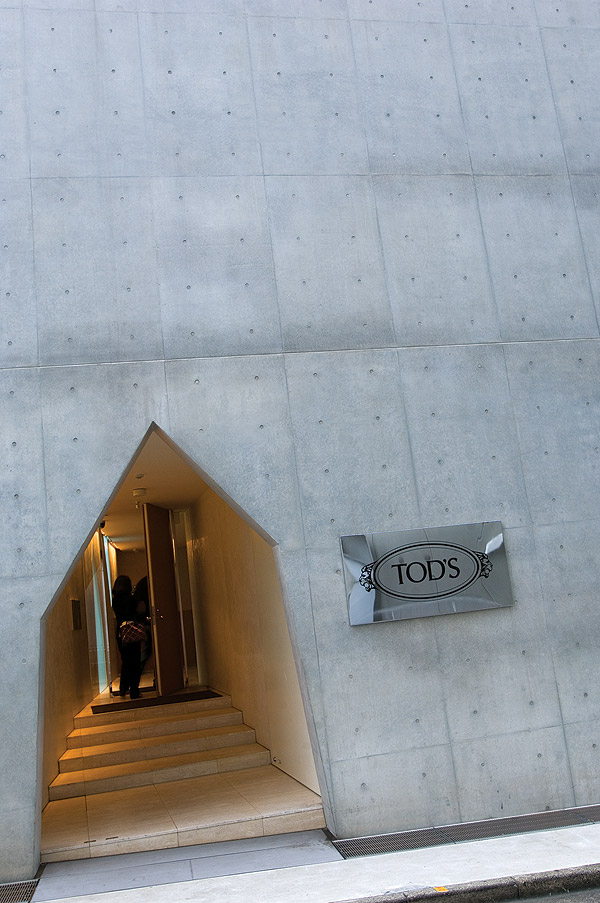
Tokyo's exclamation marks : The Tod's building in Omotesando is described by its designer, Toyo Ito, as 'an attempt to transcend the architectural modernism that has characterised the 20th century'. -
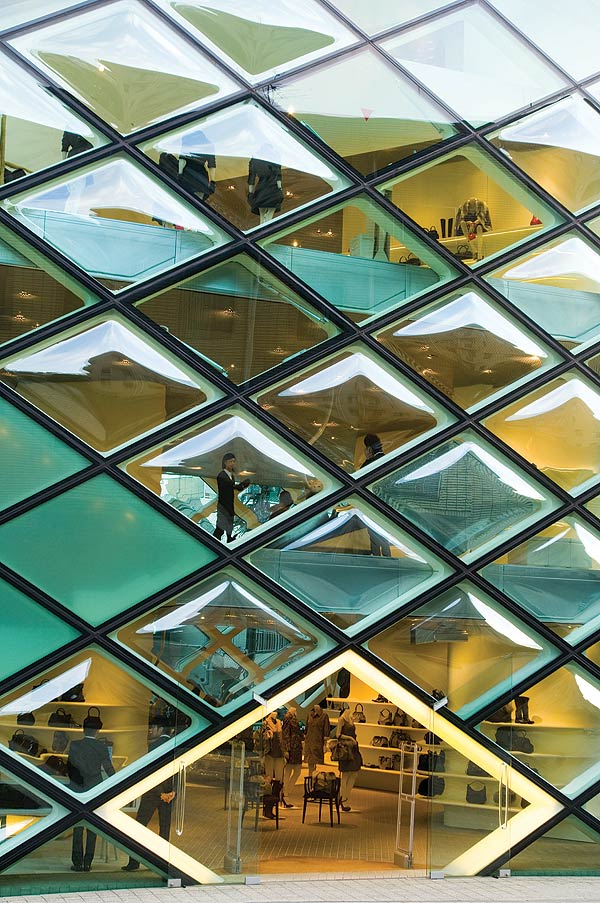
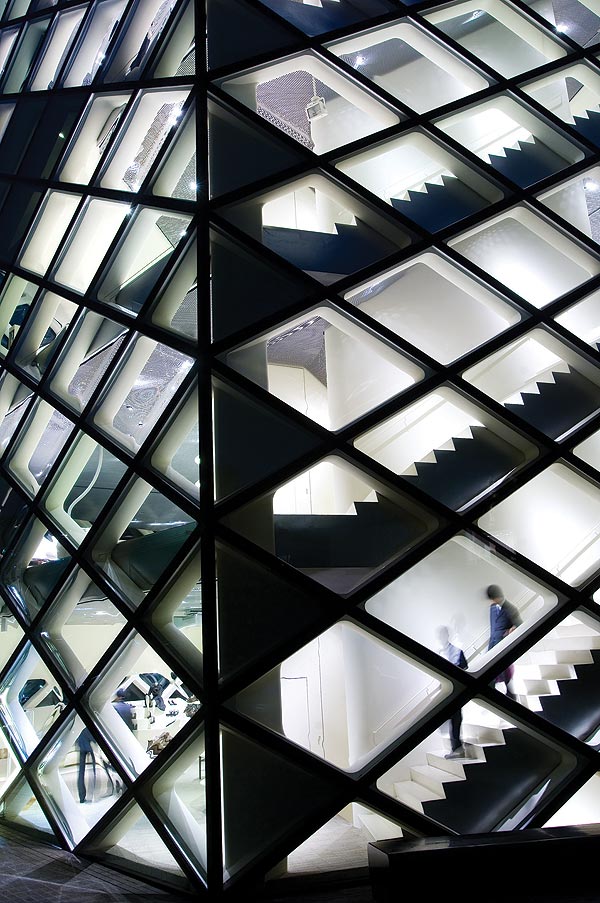
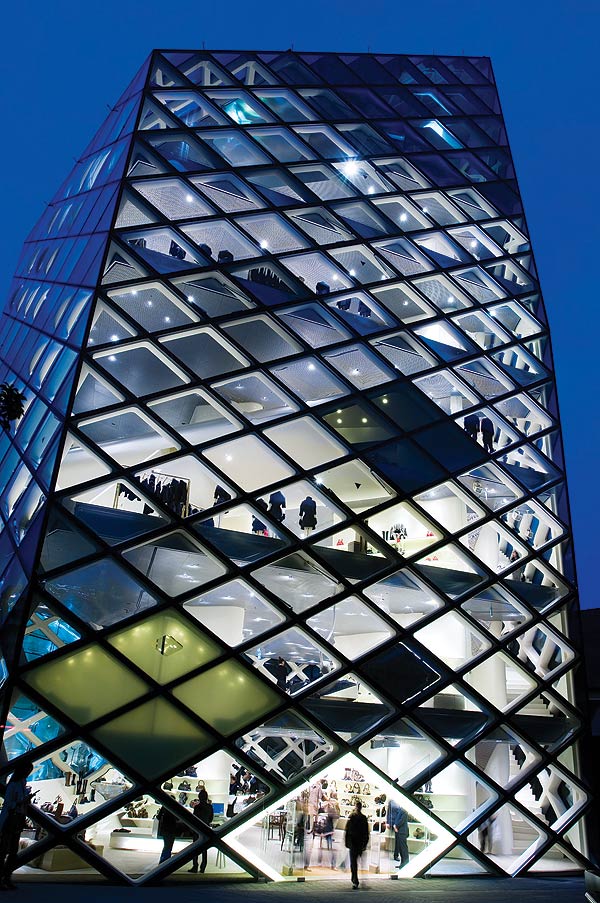
Tokyo's exclamation marks : The diamond design on the exterior glass envelope of the Prada store, a must-see building in Aoyoma. -
Tokyo's exclamation marks : The irregular motif on the Tod's building, which rests on a shock-absorbing foundation. -
Tokyo's exclamation marks : Another view of Herzog and De Meuron's Prada store. -

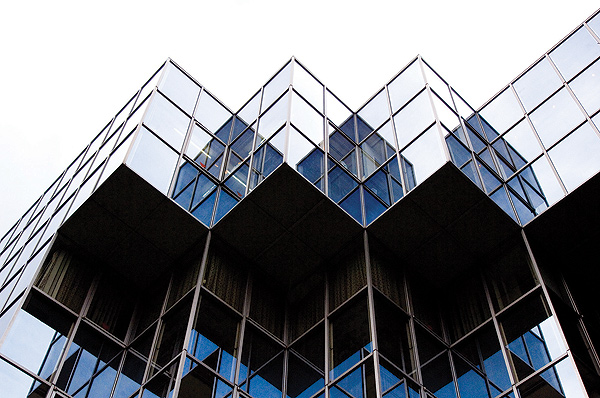
Tokyo's exclamation marks : Looking up at the roof of the Hanae Mori building by Japanese architect, Kenzo Tange, in Aoyoma. -
Tokyo's exclamation marks : When Prada commissioned the Swiss architectural pair Jacques Herzog and Pierre de Meuron to design this store, they wanted to it 'to foster a new type of architecture; one that involves an exchange of experience and participates in cultural debate'. -
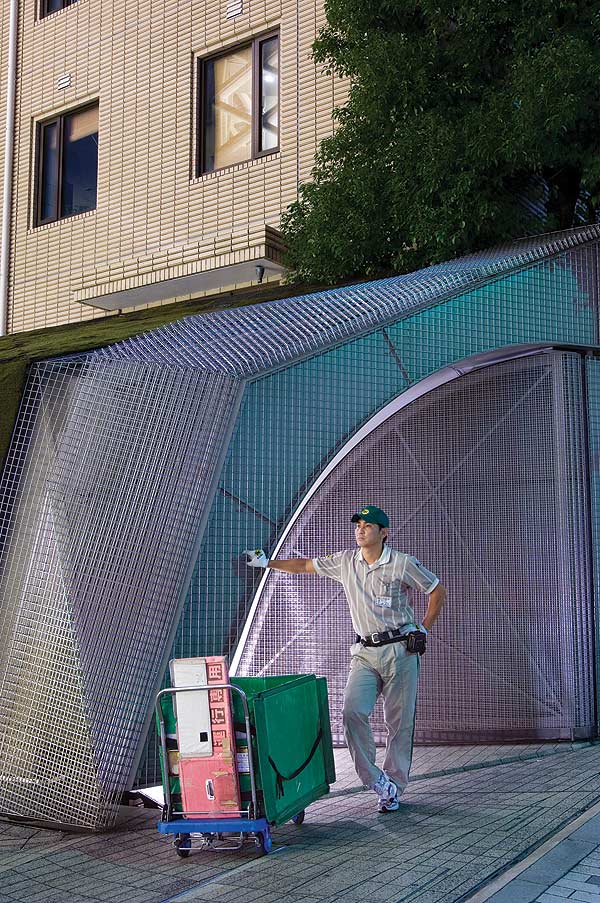
Tokyo's exclamation marks : The Prada building's service area. -
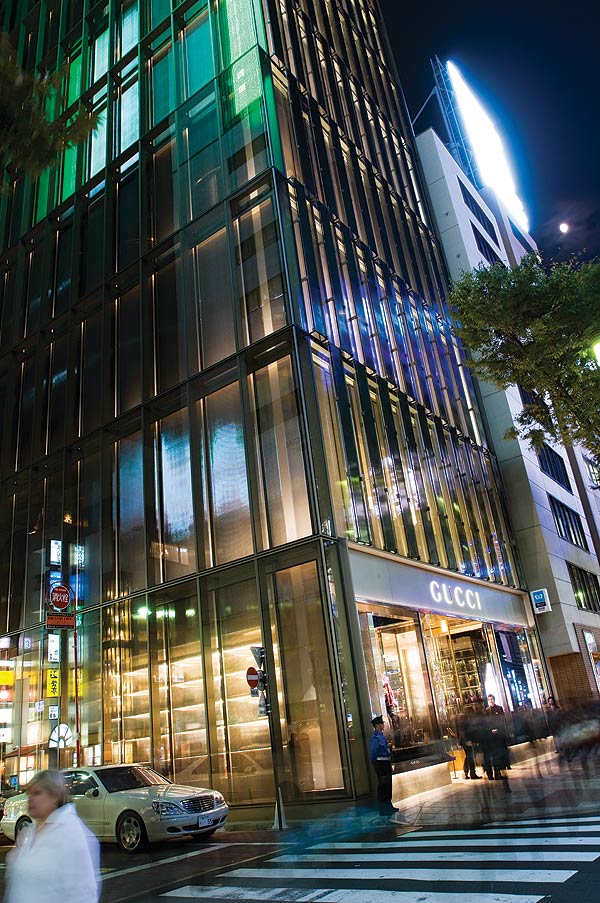
Tokyo's exclamation marks : Gucci's eight-storey flagship boutique in Ginza - the first Gucci store to be housed in its own dedicated building. -
Tokyo's exclamation marks : Another view of Herzog and De Meuron's Prada store. -
Tokyo's exclamation marks : The Miu Miu store is the only freestanding high-end European designer boutique in Shibuya. -
Tokyo's exclamation marks : A clever extension to the Comme des Garcons store, where on-sale items are presented. -
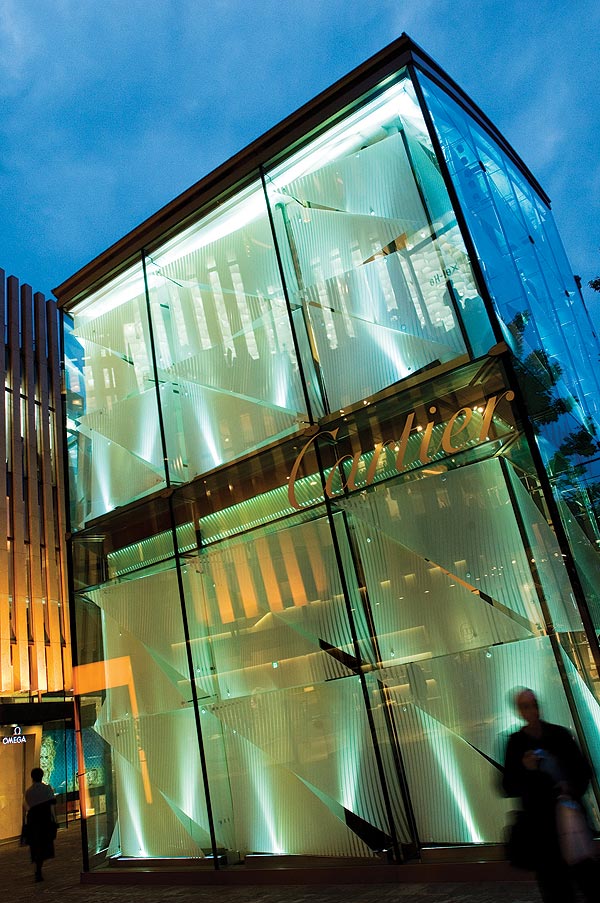
Tokyo's exclamation marks : French architect Jean-Michel Wilmotte executed Cartier's recently overhauled design concepts. He is also known for redesigning and refurbishing large sections of the Louvre in Paris. -
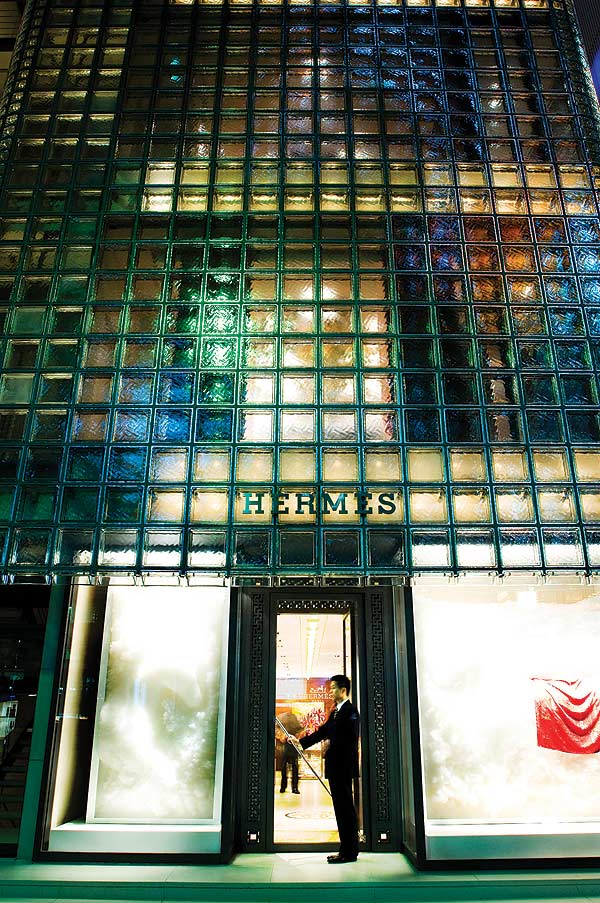
Tokyo's exclamation marks : The entrance to Maison Hermes in Ginza Time magazine once called its Italian architect, Renzo Piano, 'an absolute master of light and lightness'. -
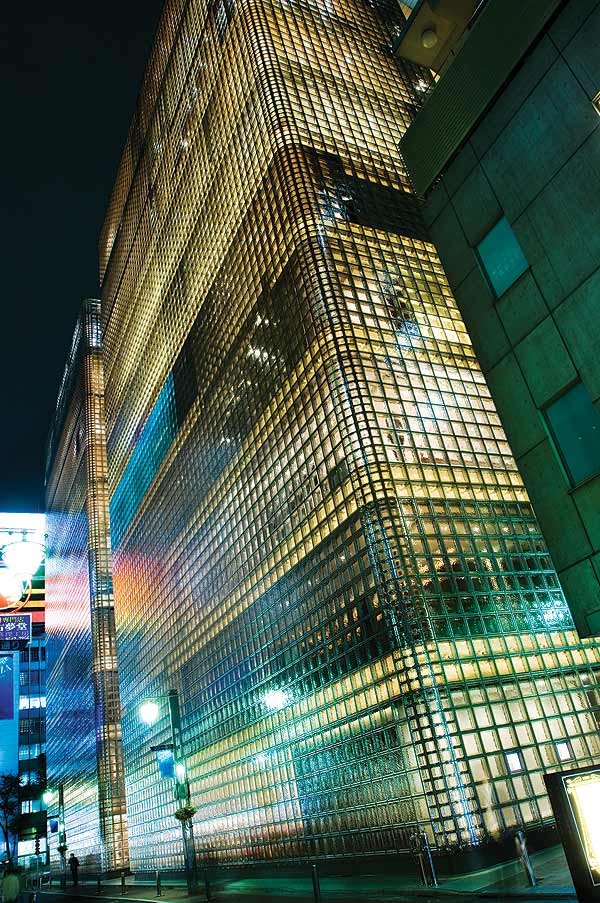
Tokyo's exclamation marks : The glass curtain wrapped around Maison Hermes is acoustically clever, shutting out the city's noisy buzz.




PHOTOS: Micky Hoyle | PRODUCTION: Sumien Brink | WORDS: Elmari Rautenbach
An architectural amble around Tokyo’s glittering shopping temples reveals a concrete clue to a uniquely Japanese appreciation of wrappings.
While living in Japan a few years ago, I got an opportunity to interview the avant-garde fashion designer Takao Yamashita. In concise English the Nagasaki-born founder of the cult Japanese label Beauty:Beast chatted about the difficulties he’d faced starting out in Osaka, his influences (John Galliano, shoemaker John Moore and punk stylist Judy Blame), showing in Paris, the philosophical significance of wordplay in Japanese society and, more surprisingly, architecture.
In a society where the well-heeled buy their fashion in architecturally impressive retail stores it was perhaps not so unusual for a fashion designer to be chatting about architecture.
But Tokyo-based Takao is more than qualified to talk about the discipline: as the son of ‘an old-fashioned Kyushu architect’ he, too, joined that comparatively macho profession, and came to fashion via it.
‘I was merely fulfilling the family tradition,’ he says, brushing aside the importance of his architectural studies. However, when pressed to discuss architecture’s impact on his playfully odd designs, Takao offered a unique insight: ‘If I have to think about it, three things have really influenced my designs – gravity, comfort and wrapping. Gravity is a directional thing, something that guides me as I design. It’s like a soft handkerchief falling over someone.’ His choice of the word wrapping was equally significant.
In Contemporary Urban Japan: A Sociology of Consumption (Blackwell), author and sociologist John Clammer describes Japan as a culture concerned with elegance, the erotic, emotions and, above all, the body. Consequently, he argues, Japan can be described as a society that’s dedicated to ‘the reign of the appearance’.
In a country where surface is everything, wrapping is pivotal – so much so that it’s a quintessentially Japanese labour. Not only is the art of wrapping ingrained in the intricate labours of wearing a kimono, essentially a garment made up of wrapped fabrics, it’s also evident in the poise and ceremony with which retail assistants package purchases.
First-time visitors to Tokyo
The easiest and perhaps cheapest way for first-time visitors to Tokyo to get a sense of how this cultural value operates, practically, is to take a leisurely stroll down any wide, neatly kept promenade in one of Tokyo’s upscale retail areas.
Go to places such as Ginza, Roppongi Hills and the vast Aoyama district, which incorporates the Omotesando neighbourhood – the epicentre of haute couture in Tokyo. Here fashion and luxury are more than commodities; they become fantasy objects displayed in secular temples devoted to earthly elegance.
A good example is the Tod’s building in Omotesando, designed by Toyo Ito. Located near the Dior building, the design is instantly recognisable for its irregular concrete-and-glass facade. Inspired by the winter silhouettes of bare Zelkova trees, Toyo employed a stereotypical Japanese theme, nature, without any hint of sentimentality.
Other destination stores in Omotesando include the Prada building, designed by Jacques Herzog and Pierre de Meuron, the Swiss design duo whose credits include the Tate Modern in London.
Then there’s the Dior building designed by Kazuyo Sejima, a former understudy to Toyo and the partner of Ryue Nishizawa. This ostensibly modernist structure is wrapped in an outer layer of clear glass that shields a translucent plastic layer. In the words of French architectural writer, Philip Jodidio, this exterior device lends the structure ‘a milky ambiguity’.
Not many years ago a daytime visit to Roppongi would not have been very productive or interesting. All this changed in 2003, with the opening of Roppongi Hills, an integrated commercial and cultural precinct that includes Jun Aoki’s bedazzling Louis Vuitton store. Much of this building’s charm is derived from its exterior facade – the design incorporates 28 000 transparent glass tubes sealed between plates of glass. Like the sparkle of a diamond this decorative wrapping, that’s meant to suggest a compound eye, produces many diffuse reflections.
Visible elegance with buyable luxury
The conflation of visible elegance with buyable luxury is, of course, not a recent phenomenon in Japan. Throughout most of the last century Japan’s large department stores played a leading role in promoting high culture as part of the shopping experience.
This was not expressed only in the range of goods offered but also in the internal programming: stores offered exhibitions of both challenging art and fine fabrics. The arrival of a host of luxury brands from Europe, particularly in the 1990s, merely added another (exterior) layer to this history.
Having singled out some of the best, it’s perhaps useful to remember that Tokyo is a city that’s equally remarkable for its acres of bland concrete and garish neon. This fact prompted Donald Richie, the peerless commentator on modern Japan, to once describe Tokyo as ‘a monstrous, magical capital of kitsch, pulsing with the trendy, the bogus, the marvellous’.
True, but one might say that of many modern cities. What distinguishes Tokyo is that the marvellous truly is just that. So much so that you simply have to stop, look and admire.
• For a useful online guide, go to www.tokyoarchitecture.info.