-

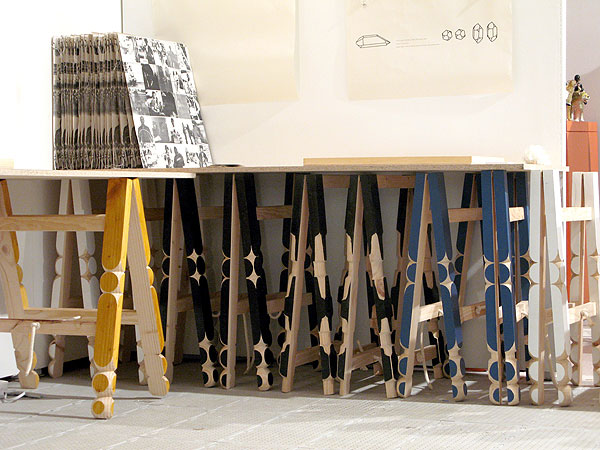
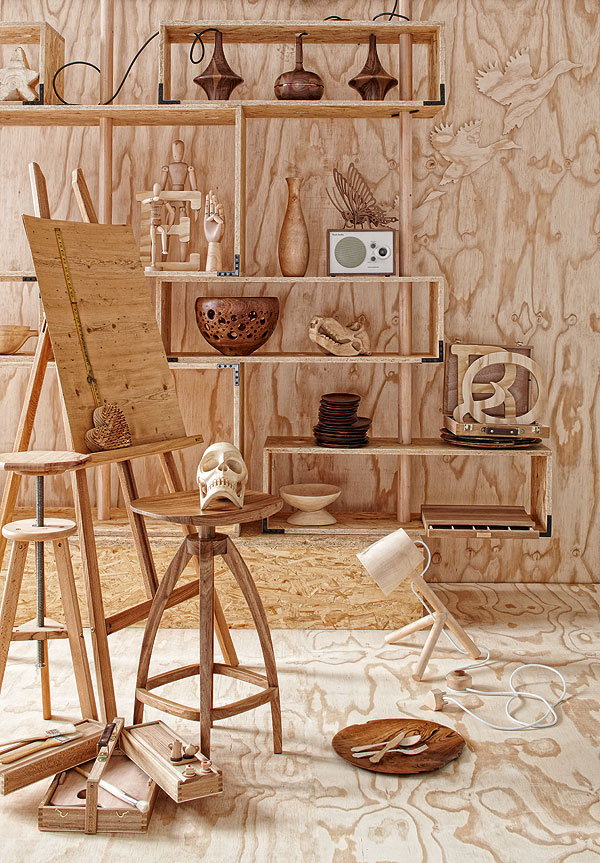
Thingking about wood : The large range of different turned trestle tables made by Thingking. -

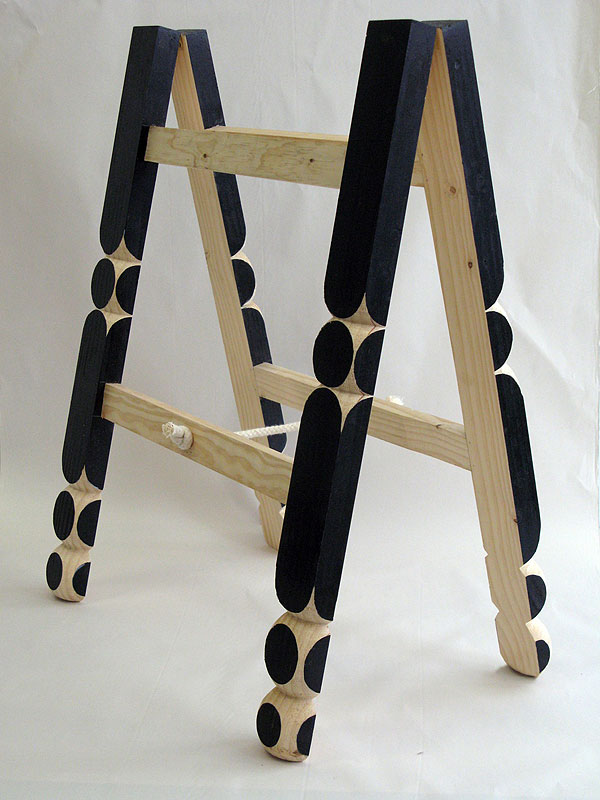
Thingking about wood : A small black trestle. -
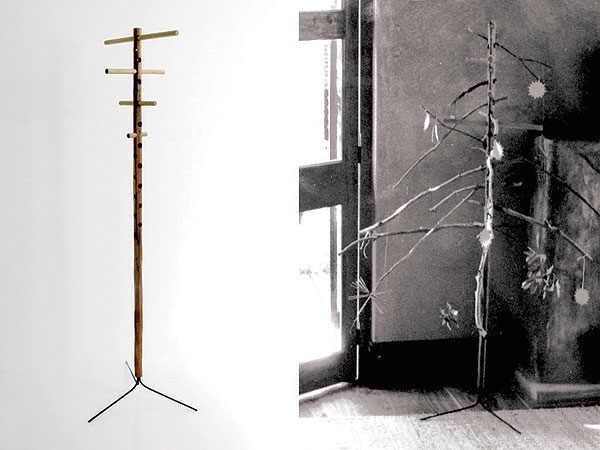
Thingking about wood : A coat hanger that becomes a tree during Christmas because in South Africa we don't wear coats during the year end holidays, so the coat stand can be transformed. -

Thingking about wood : The beautiful beaded box stand Thingking made for VISI.
WORDS: Remy Raitt
Marc Nicolson and Lyall Sprong of Thingking work magic with pine and plywood. Since they started their company in March 2010, we’ve been ardent fans of their work.
The VISI office has been brought to life with a towering “bead-box” stand made by Marc and Lyall. On it, we display inspirational objects, books and magazines. It’s a work of art, displaying boxes strung onto poles to create a novel display space.
The Thingking duo were also the brains behind the beautiful VISI bookends, which formed part of a subscription campaign earlier this year. And, right now, we’re pine-ing for one of their Turned Trestle Tables.
Marc and Lyall describe themselves as a designer-maker consultancy. “We work in things and ideas of expression and problem solving. Our aim is to create work that increasingly reflects a deeper sense of place and understanding,” they say.
VISI’s Remy Raitt spoke to Marc to find out more about their passion for wood and the ideas they bring to life.
Why do you work with wood?
When you choose to work with wood, you’re selecting a material that fulfills a feeling and a purpose. It offers great variety, both in the different types available and in the ways in which it can be worked. Then, of course, there are considerations such as renewability.
Do you approach wood in an environmentally conscious way? If so, how?
We mostly work with pine, which has to be one of the most sustainable materials available. It grows quickly (and locally), has a reasonable life span, is usually Forest Stewardship Council (FSC) certified and has a utilitarian, honest association.
Do you use any special treatments on your wood?
We quite like shellac, which is a resin secreted by the lac bug.
Your Turned Trestle Tables are exquisite and versatile. Can you tell us more about the design and how people have responded?
The response has been good, although we find it always takes a little while for people to pay attention to new things. In terms of the design, a visit to the historical Koopmans De Wet house (in Cape Town) got us thinking about split-turning. We played with the conventional order of the production process and finally arrived at the idea of creating shapes by removing some of the wood while turning it. In producing the first few, Lyall decided to learn how to do the turning himself, and in this sense it was really like trying to make a beautiful mark with a paintbrush, except that he was working with a chisel and lathe.
What else would you love to do with this material?
We like it when chipboard burrs and frays, and are pretty sure we’ll be end up doing something with this at some point.
More information: www.thingking.co.za