-

The remains of the day -

The remains of the day -
The remains of the day -

The remains of the day -
The remains of the day
PHOTOS: Mark Williams | PRODUCTION: Tina-Marie Malherbe | WORDS: Errieda Du Toit
A once dilapidated longhouse on the banks of the Verlorenvlei estuary had serendipity come to its rescue in the form of an architect with a vision.
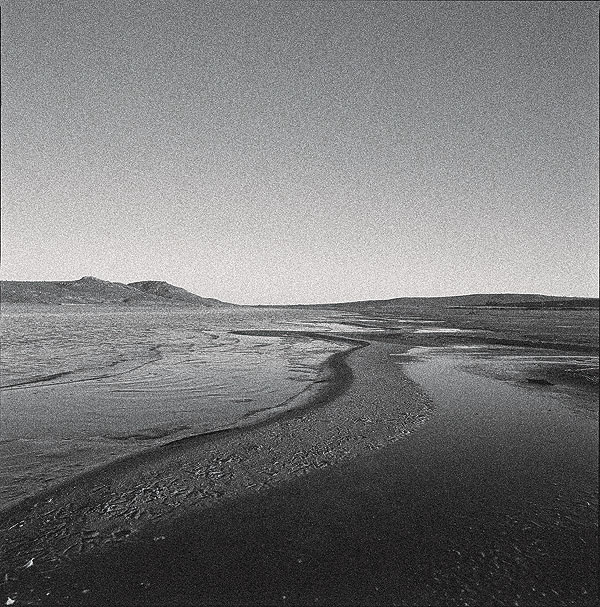
The hand-drawn directions to Uithoek Farm and its longhouse hint at the adventure and romance to come. ‘If you get to this point, you’ve gone too far. Uithoek Farm’s entrance will be marked, probably with a dead horse or cow propped up and painted red, maybe streamers.’ The town names on the map – Elandsbaai, Leipoldtville and Redelinghuys – are all reminiscent of an era long gone.
Uithoek first came to part-owner Stephen Lennard’s attention through a contractor friend who stumbled across the farm – and its decrepit dwellings – while scouting for property in the region. A deal was struck with the owner, but not before Stephen (a partner at the architectural firm of Rudolph, Lennard, Beatty & Associates) assembled a team of friends and co-owners who could help him turn the longhouse and its assortment of outhouses into a livable proposition.
‘We bought Uithoek from Theunis van Litzenborgh, who was born in the longhouse and lived on the farm all his life. Theunis was, and still is, our link to the past. He and his wife, Bessie, still live on the 700-hectare farm as if we weren’t there. Life simply goes on.’
When Stephen took on Uithoek he was already an old hand at building and renovation. ‘In the early days I built a house for myself from scratch, and was then involved with the restoration of Valkenburg Manor House, digging foundations and cutting tree stumps.’
Design past considered
The longhouse and its outbuildings were totally dilapidated. Like archaeologists, the restoration team scrutinised the site for clues to its design past and for things to reuse.
‘We wanted the feel of a personalised, handmade house rather than something that looked overtly renovated by various contractors. The idea was to take what was left of the buildings and restore them using, by and large, methods from the past. If string or leather was used to lash things together, then that’s what we did.’
Although the past was honoured in the building process, old techniques were not slavishly followed, and the restoration of the house unfolded organically. ‘We wanted the space to reflect the essence of the area, which focuses on the simple life of the local fishermen.’
This was achieved by using local labour and materials, with further inspiration provided by Hugh Floyd from the Cape Town Historical Society, who took many photographs of traditional buildings in the area. ‘We used bricks from the collapsed section of the structure to rebuild. New mud bricks were made on site using gravel from the farm mixed with clay from the vlei. For wood we cut down gum trees on the farm as there were no poplars left in the area. A salvaged window provided a pattern that was replicated on doors and windows, keeping it authentic with no mouldings and fancy trimmings.’
The makeover started 15 years ago and was completed in stages. ‘We first needed a workshop area and a place to stay during the restoration,’ says Stephen, ‘so we squatted in one of the outbuildings.’ Theunis and a farmhand became the building team, together with labourers from nearby Doring Bay. More recently, restoration was carried out by Mansoor Samsodien, with whom Stephen has worked over the years.
Born of simplicity and functionality
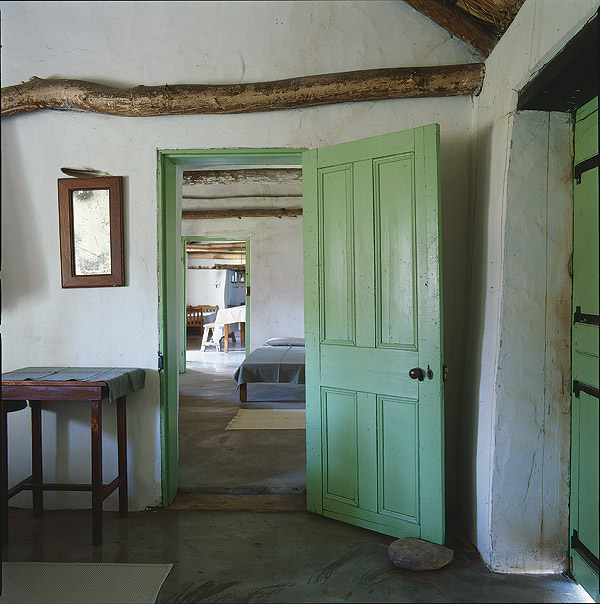
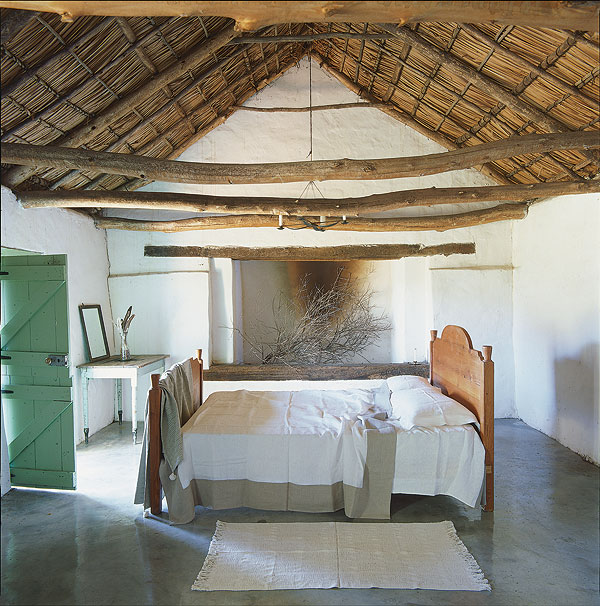
The longhouse vernacular was born of simplicity and functionality, with no room for pretension. Traditionally, one half of the dwelling was used to house people, the other half as a stable for farm animals, with space for an ox-drawn grinding mill. Signs of the threshing floor can be seen still in what is now the main bedroom. Small stalls once used to house newborn baby animals and for storing feed are now bathrooms.
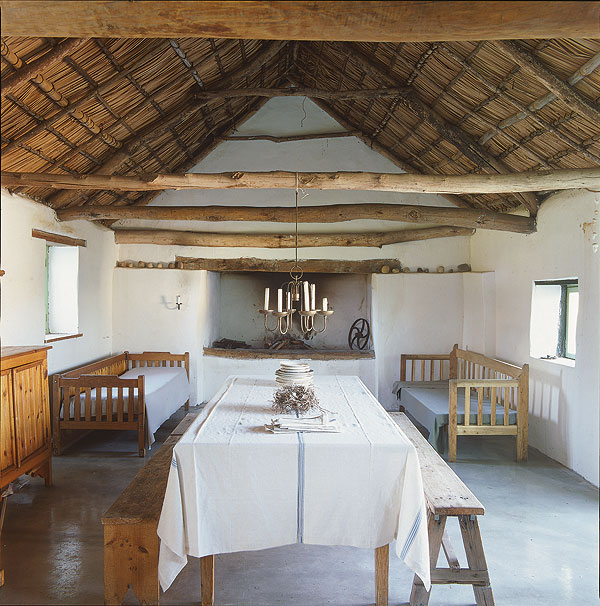
The hearth in the voorhuis – a space that incorporates the kitchen and living room – was totally rebuilt and an enormous fireplace was added to the main bedroom at the far end of the building. Buttresses were incorporated to support the exterior walls and, while not typical of the longhouse style, they’re a pleasing architectural compromise.
In recent years, additions to the property have allowed more guests to enjoy the Uithoek experience. The former workshop is now another holiday house, the milking shed a communal area and the stables a snooker room. And an additional small cottage was built in the longhouse style, with reed ceilings and quaint shuttered windows.
In choosing colours, Stephen was guided by a remnant of dusty green found on a window frame in the rubble. Window shutters and doors now wear coats of Plascon’s Split Pea. The whitewash used for the walls was made by hand, a mix of animal fat, salt and unslaked lime. However, the walls are now maintained with a commercial whitewash product. Cement screeded floors lend a natural feel and are easy to keep clean.
The furnishings throughout are low-key and comfortable, hinting more at a boer-maak-’n-plan aesthetic than a deliberate decor style. Once-forgotten pieces have been salvaged and thrown together in an unforced way; driftwood has been used for towel rails; seed pods fill glass bottles in personalised installations; and twin beds, far from identical, invite tired bodies to rest a while.
Gathering place
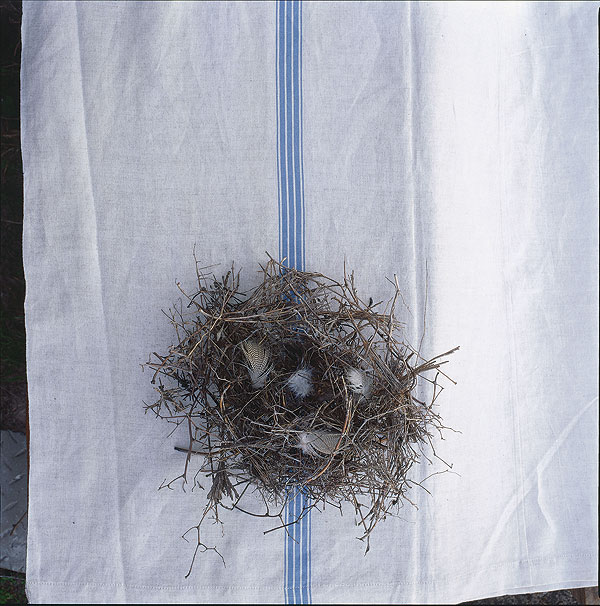
The voorhuis is the gathering place, with mismatched chairs around a long table set with equally mismatched crockery. While electricity is used for the fridges, electric lights are verboten. Plain white candles drip from candelabras and old-fashioned candleholders.
‘Theunis used to call in his mates for weekend entertainment to see the mad Englishmen using expensive candles when fluorescent light is so much cheaper,’ muses Stephen. He admits, however, that the games room in the old shed has a naked lightbulb to illuminate the pool table.
For Sue Mackenzie, Stephen’s partner, the best part of life at the longhouse is sleeping outdoors with the weaver birds under the pergola, safely ensconced beneath a mosquito net, or lying down at the vlei watching for shooting stars with pelicans nearby.
‘The only downside to Uithoek is the dreaded depression that kicks in when you have to return to the city,’ sighs Stephen. ‘Here, we wake up at five to paddle on the vlei in the morning mist, return to the house when the wind comes up to prepare breakfast over the fire. Then it’s off again to catch crayfish and surf. And after our afternoon nap, we might indulge in simple luxuries like a crayfish omelette made from lunch leftovers.’
There’s a lot to learn from the longhouse way of life, he concludes. ‘You can walk outside from every room, which affects your mental state. Compare this with urban life and our fixation on moving directly from the house to an interleading garage, hopping into the car and driving off to the mall. Here, the car is parked far from the house and on your way up the drive, you pick an apricot in the kraal.’
It seems that what was once lost has been rediscovered on the marshy banks of Verlorenvlei.
• Rudolph, Lennard, Beatty & Associates: 021 702 2288
• To rent the Uithoek longhouse or cottage, contact Sue Mackenzie: 021 702 2288, sue@rlb.co.za