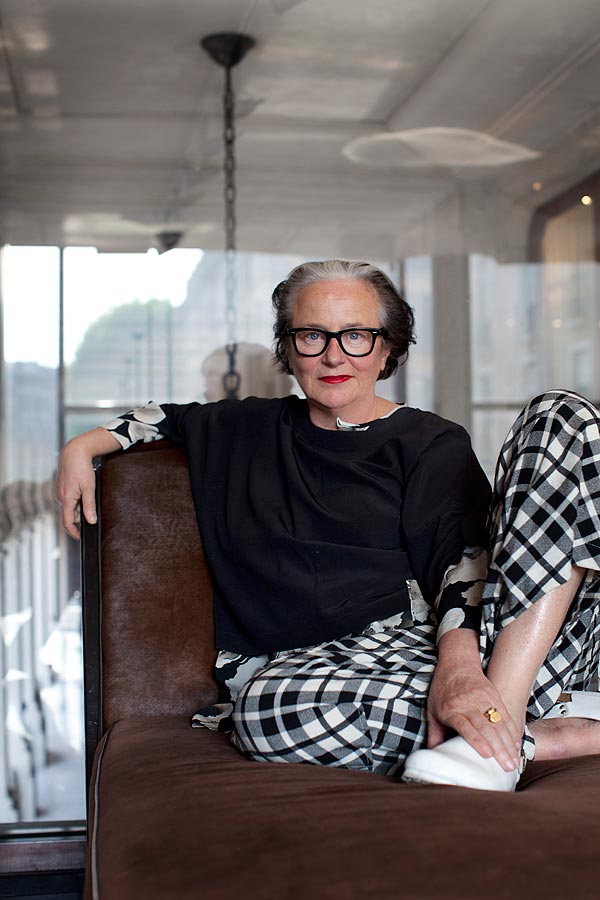
WORDS: Li Edelkoort & Trend Union | PORTRAIT PHOTO: Ruy Teixeira
This year’s Salone del Mobile demonstrated that the influence of the exuberant creativity of recent years has had a lasting influence on the industry. VISI brings you Li Edelkoort’s official Milan 2011 Trends Report.
“The 50th anniversary of Milan’s Salone del Mobile and the Fuori Salone events in the city gave a new and clear message to the visitor.
Many star designers had decided at the same time to decline and not organise a solo exhibition: no Marcel, Job, Jaime, Tord, nor Maarten…
Attention was therefore back where it all started: the industry. Old and noble brands, yet also young and cool new names, each set out to show their new products, designed by these “absent stars” and a multitude of young and often unknown talent.
It became very clear that the influence of the exuberant creativity of recent years and personal expression has had a lasting influence on the industry. In general, much better design was displayed by almost all brands. The mainstream style of furniture and accessories for the home has been upgraded as never before.
Of all designers, it was Patricia Urquiola who was the most prolific and creative. At almost every event and brand in the city, this amazing woman participated with yet another outstanding design. She is without doubt on top of her form.
The most talked about events and exhibits were the Wallpaper show at the Brioni showroom, the Design Academy Eindhoven (of course!), Jerusalem’s Bezalel Academy, our Talking Textiles exhibitions, Rossana Orlandi’s packed space and the multiple exhibits organised by the talented Nina Yashar for Nilufar.” – Li Edelkoort
Several inspired installations made a fresh mark on the contemporary design scene at this year’s Salone Internazionale del Mobile:
A sense of POETRY was felt throughout Milan, with the curiosity and still life trends continuing. An exhibition at Ventura Lambrate called Poetry Happens included Mark Braun’s serene representation of international water bodies found via Google Earth, delicately etching their formations onto glass bottles. An amazing bronze chandelier was also shown by Studio Molen at Ventura Lambrate. Studio Toogood invited food designers Arabeschi to create some magic with dark midnight suppers each night at their Natura Morta show in the Brera.
A narrative and distinctly Italian vein with a surrealist twist was seen at Nilufar Gallery – from the curious furniture by Barnaba Fornasetti to the inlaid geometric moon-rock tables and blown-glass lamps by a young rising star Bethan Laura Wood.
Andrea Branzi was the reference of the week, the master’s work being shown in several locations, but none more beautiful than the elegant Independent: Design Succession exhibition at the Triennale Bovisa, also featuring the work of his contemporaries and organised in collaboration with Niufar.
WOOD, BAMBOO & PULP continued to be major materials of choice at various locations throughout the city. This sustainable thread quietly wove its way through the city’s Fuori Salone events, notably in Gijs Bakker’s selection for Yii at the Triennale and the Design Academy Eindhoven’s impressive exhibition curated by Ilse Crawford.
Wood was even turned into a washable textile by young Academy graduate Lenneke Langenhuijsen, while cork was transformed by several innovative designers for Amorim and Experimenta Design at their Materia exhibition in the Brera.
ECOLOGY influenced many designers to explore natural materials and UNDYED colours, in many cases even with local artisans in the Himalayas or the desert by Palestinian Bedouins. Formafantasma reinvented polymers by using amber from plants as the starting point for a stunning collection of botanically inspired products. Hemp was used by Studio Aisslinger to create a sturdy chair and architectural building units.
The idea of non-dyed yarn continued to gather momentum, such as in a collection of seductive non-dyed wool rugs launched by Nodus. Christien Meindertsma mixed tradition and craft to create a new collection of rural-minded furniture for Thomas Eyck (seen at Rossana Orlandi). Christien is dedicated to becoming a self-sufficient producer now that she is even farming her own raw materials…
A revival of BASKET WEAVING is in the air, with grass and straw being intertwined by several designers. Craft collectives collaborate with young designers to bring a hand-made quality to products, while new ways of knitting cord and crocheting textile emerge.
The use of LEATHER in Milan was an important trend, from fine luxury hides to contemporary gainné furniture by Soojin Kang at the Satellite and the wilder pelts used by the Campanas at Edra. A new collaboration also saw the Brazilian brothers design furniture in ostrich leather for Klein Karoo, South Africa.
RECYCLED MATERIALS were used by young designers, recuperating and reinventing matter in new ways. Colour and folk details were introduced to bring fantasy and style.
PATRICIA URQUIOLA was without doubt the star, both of the Salone and the Fuori Salone, presenting great new work for B&B, Cassina, Moroso, Kartell and a beautiful glass project called All Ambiq, previewing the Glasstress 2011 exhibition that will open during the Venice Biennale later this spring.
The use of MARBLE was another trend (formerly forecast by Trend Union’s Lifestyle Book), reflected in classical designs fit for a contemporary Cleopatra. Among the many marble items showed in Milan were aesthetic podiums and plinths on offer at Marsotto, and a marble interior by architect Marco Ferreri with inbuilt furniture previewed at Nilufar.
For the high-end market, BESPOKE products were highlighted at the Wallpaper exhibition at the Brioni showroom, mainly targeting a male consumer, with artisan aspects embodied by a poetic bedroom in the shaker tradition from John Galvin & NORD Architecture.
NATURAL DISASTERS continue to influence and inspire design. The recent Japanese earthquake and tsunami were an emotional backdrop to a presentation of new furniture by Karimoku. The surrounding photographs by Shin Suzuki were a stirring contrast to the minimal design by Scholten & Baijings, among others.
Eric Klarenbeek showed his new Deluge curtain, an elegant digital print on silk organza, also with extract images of the Japanese disaster. At Established & Sons, the Icelandic volcano that put an abrupt ending to last year’s Salone had an eerie recall in new rugs by Klaus Haapaniemi and Mia Wallenius that incorporated illustration into their weaves.
A mood for soft surrealism was continued throughout Milan with beautiful mirrors seen at Dilmos Gallery and several UMBRELLA SHAPES that popped-up at the fair, highlighted by a narrative new chandelier for Baccarat by Philippe Starck.
One of the highlights of the week was the FUNCTIONAL office cupboard designed by Studio Job for Lensvelt – a pure serial and functional product that was finished with a heavy bronze key, delivering a hybrid of industrial and autonomous design.
The return of TEXTILE in our interiors was forecast in the Talking Textiles initiative by Edelkoort Exhibitions – a major exhibition at Spazio Gianfranco Ferré and an experimental survey of recent graduate talent in Ventura Lambrate.
Other noteworthy textile designs included new cabinets by the Bouroullecs and the Cape New sofa by Konstantin Grcic, both at Established & Sons. At the Edra showroom, the Campanas showed their new chair in a cuddly teddy bear fabric, while downstairs a variety of sofas were upholstered in different tactilities.
More information: www.edelkoort.com