-

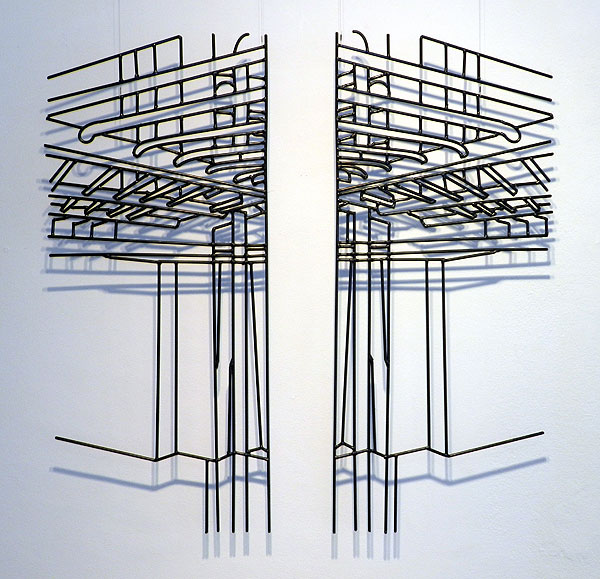
Line and space : "For a while I looked" 3mm wire matt galvanising -
Line and space : "For a while I looked" 3mm wire matt galvanising -

Line and space : "I would often skip the last step (after Escher) II", welded 4mm wire -

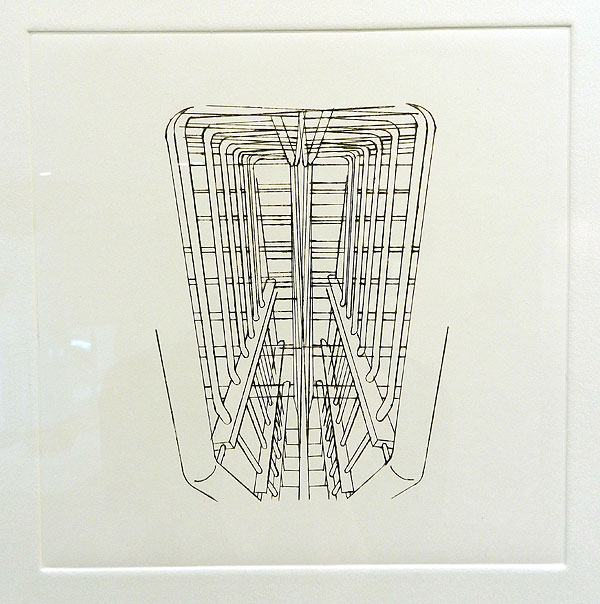
Line and space : Untitled scaffolding prints, each print works in a pair. -

Line and space : Untitled scaffolding prints, each print works in a pair. -

Line and space : Untitled scaffolding prints, each print works in a pair. -

Line and space : Untitled scaffolding prints, each print works in a pair. -

Line and space : "The gap can widen" welded 5mm wire, matt black galvanising -

Line and space : "This gap can widen too" welded 5mm wire, matt black galvanising -

Line and space : "To skip the last step" dry point Perspex engraving -

Line and space : "To skip the last step" dry point Perspex engraving -

Line and space : "To skip the last step" dry point Perspex engraving





WORDS: Remy Raitt
When artist Beth Diane Armstrong’s eyes dart across the room or rest on a huddle of cabinets in the corner she’s not daydreaming or even avoiding eye contact. She’s analysing the line and space that make up the interior.
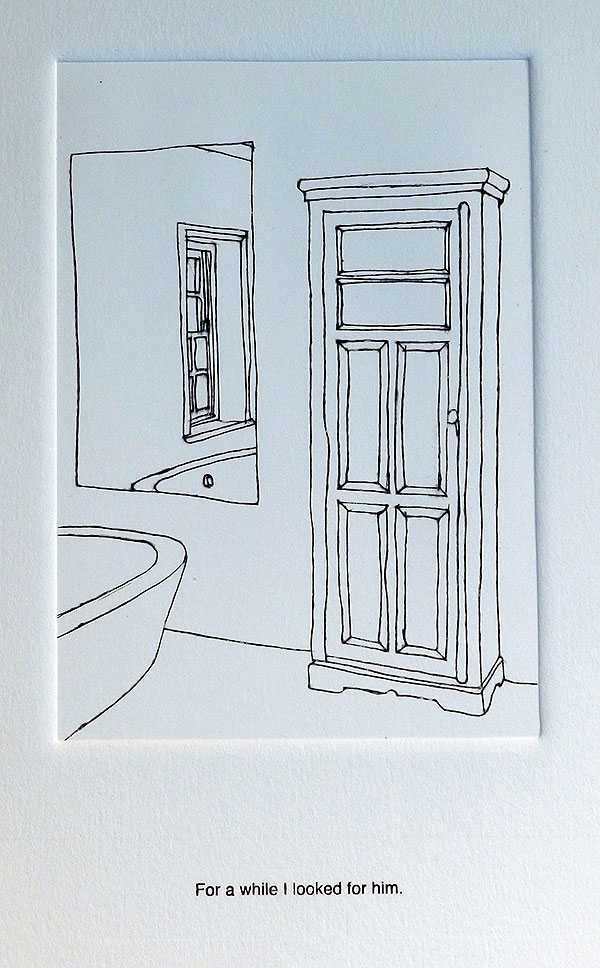
Beth’s latest exhibition, Towards an architecture of loss, overlaps with her last exhibition, To skip the last step, which comprised of 27 engravings and five welded wire and jacaranda wood sculptures. These engravings and sculptures are still on view at Beth’s latest show at iArt Gallery in Cape Town alongside her latest flat wire sculptures and dry-point Perspex engravings.
Although To skip the last step was a more literal documentation of a mourning process, after the artist lost someone close to her, her next instalment is more of an abstract exploration using line to demarcate the space of loss. “I am interested in line in relation to line in various densities and loosenesses,” Beth says.
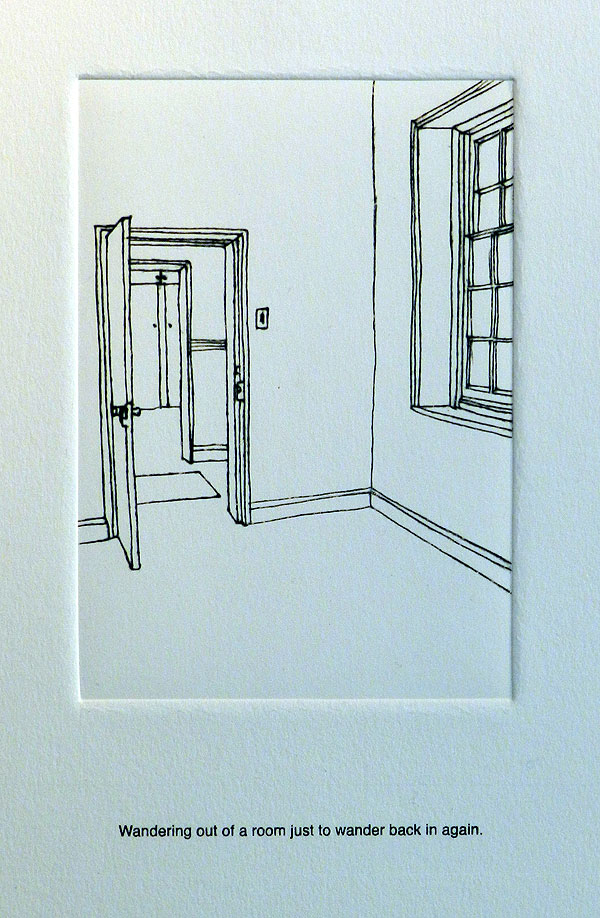
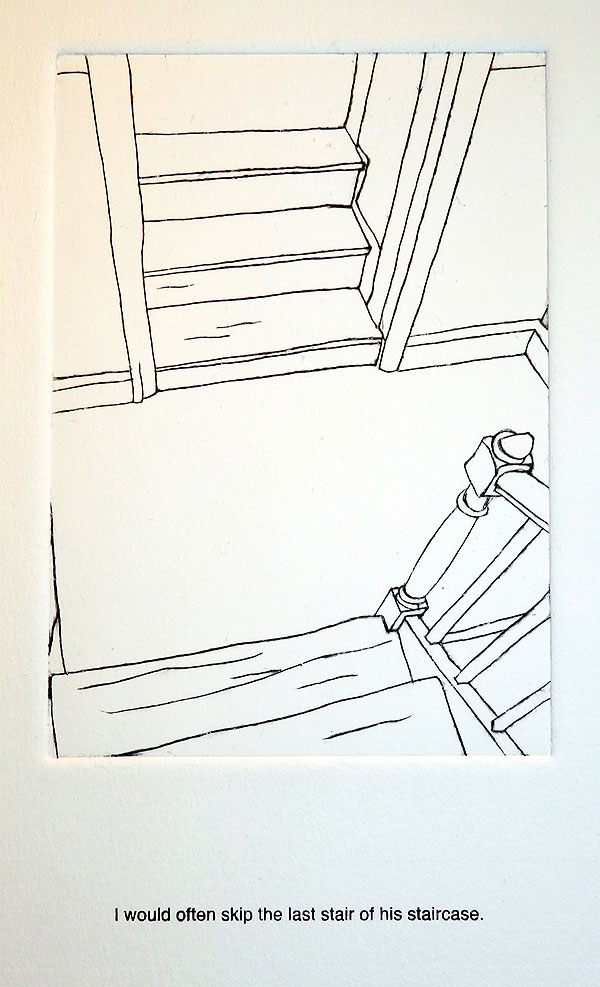
Space and line were both explored through the extremely personal engravings of her previous exhibition, where Beth used line drawings and text to capture certain spaces in the deceased’s home and her immediate reactions to his death. The line drawings are 10x14cm and placed within larger pieces of white paper, which depict the space and emptiness that comes with loss. Also, the small size of the engravings necessitates that viewers come close to the works and really engage with them.
The engravings in To skip the last step seem strangely familiar to the viewer due to the line drawing technique which stylises objects and spaces to their simplest form.
Flights of stairs
In Towards an architecture of loss, the viewer is again confronted with familiar images, particularly those of staircases and scaffolding. Although this study of line and space through staircases was sparked by the studies Beth did of the deceased’s staircase after he passed away, stairways have since become the focal point of her conceptual study. She has sketched other flights of stairs and created flat wire sculptures based on these studies, which are now on show in conjunction with her earlier works.
The theme of loss is still evident in her recent show. “I drew about 60 staircases and overlapped them through a process of play. I enjoy the structures that the overlapping lines form and when I stood back from my work, I saw scaffolding, which is something that is temporary – there to build, repair or clean – which ties in with the idea of loss,” Beth explains.
In these sketches the artist has reduced three-dimensionality to its most basic element – line. She allows for the lines to deconstruct in her working processes, then flips them about, upside down, back to front. That line is then somewhat abstracted, where it’s no longer immediately recognisable as the form it was derived from, encouraging the viewer to look at line before form – something quite counter-intuitive through which Beth invites the audience to see line in relation to line.
“There’s something functional in demarcating and drawing the boundaries around emptiness,” says Beth. “There’s no longer anything that traces the loss, nothing hinges the work on the personal. The staircases have transformed into scaffolding and the scaffoldings have in turn become abstracted forms. What is inside them is nothing. As such, removed from their role as a support structure, they continue to exist instead as phantasmal exoskeletons, a displaced architecture of loss.”
Towards an architecture of loss will not see the end of Beth’s constant probing into the “hidden” world of spatial layout, line and form in their most simple forms. The artist has plans to upscale these projects and explore people’s reactions to the lines and shapes that form the interiors in which they spend their days. So watch this “space”.
More information: www.iart.co.za