-

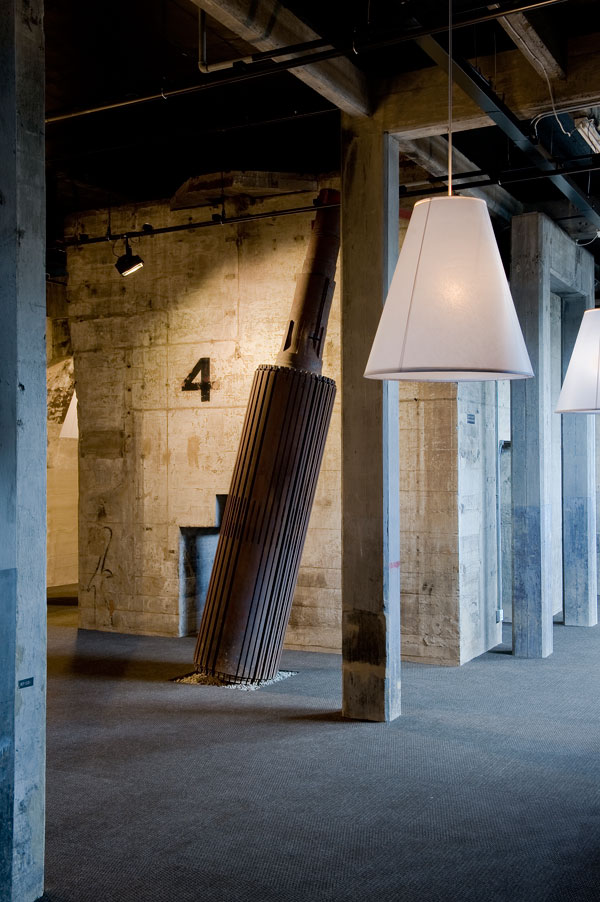
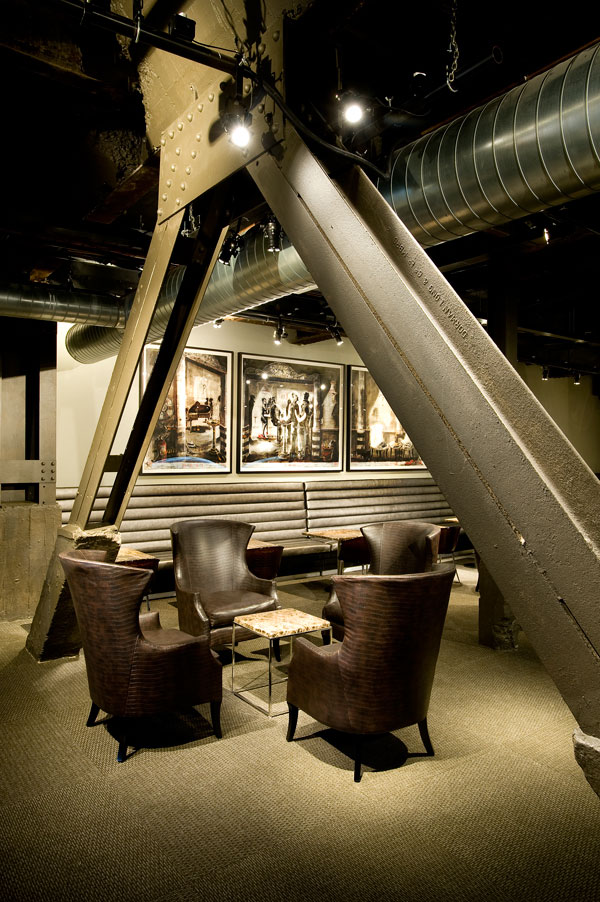
Joburg powerhouse : Dramatic lighting emphasises the structure and remnants of the original function. -
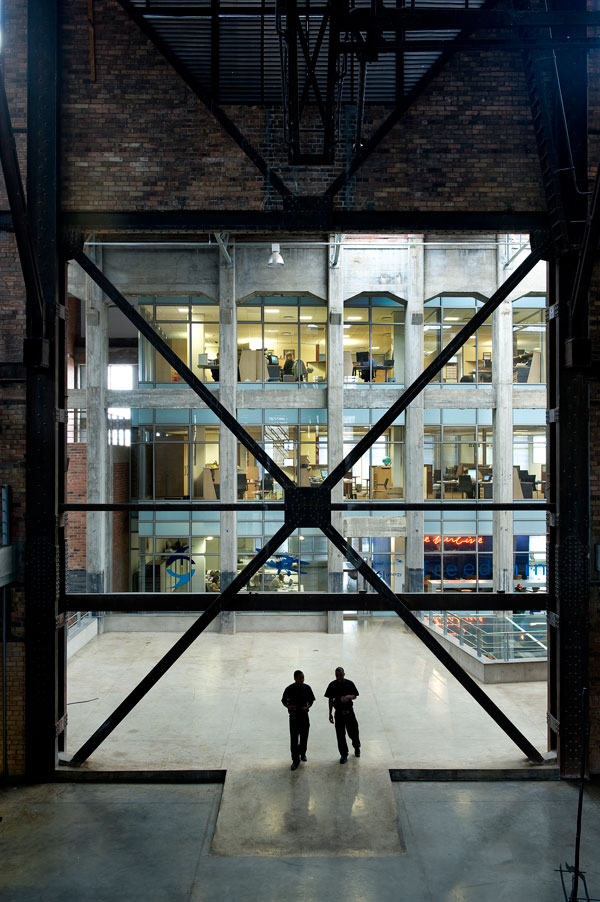
Joburg powerhouse : The cross bracing is a significant element that defines almost every threshold in the building, marking your progression though the space. -
Joburg powerhouse : Industrial sophistication - the conferencing cocktail bar lounge located in the basement under the South Boiler House. -
Joburg powerhouse : The facade of the building has changed little over the past 80 years. The Turbine stands once again as an icon in Newtown and is sure to spark new energy and redevelopment in the area. -
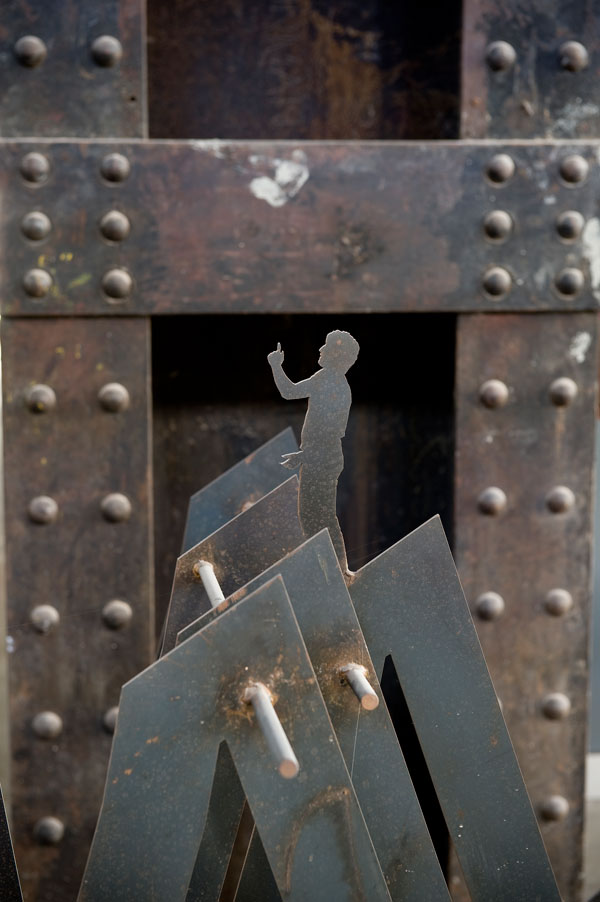
Joburg powerhouse : A detail of the artwork created by Marco Cianfanelli tracking the rise and fall of the gold price. -
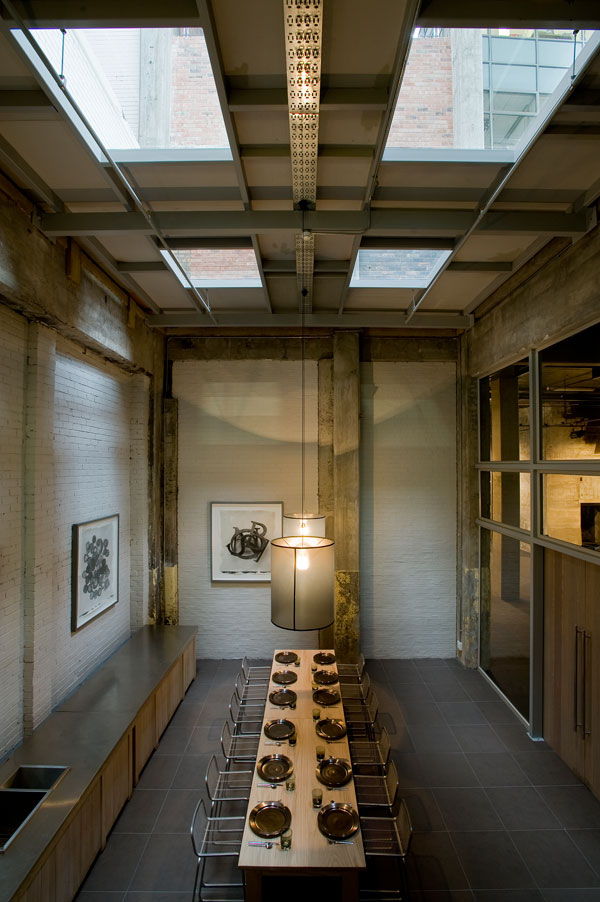
Joburg powerhouse : Natural light plays a vital role in keeping the building sustainable, hence the use of skylights throughout, as seen in this dining room in the conference centre where The Forum takes care of the catering.

PHOTOS: Dook | PRODUCTION: Annemarie Meintjes and Klara van Wyngaarden | WORDS: Alma Viviers
Over the past 80 years Turbine Hall has continually adapted to the ever-changing metropolis that is Johannesburg. In its latest guise it serves as the brand-new office of AngloGold Ashanti.
The story of Turbine Hall is one that photographs alone cannot tell, as it is so inextricably linked to the tale of Newtown and Johannesburg.
The former, on the fringe of the City of Gold’s CBD, developed from brickyard to railway marshalling yard in the early 1900s and was home to working-class people of all races. By 1906, the first forced removals had changed the landscape. A new fresh-produce market, mill and the Jeppe Power Station were erected and the area was named Newtown.
The power station, the last and largest of three steam-driven power stations in the city, was built and extended between 1927 and 1934 to meet the growing city’s ever-increasing electricity demands.
By 1961 it had been decommissioned and the market relocated. Major alterations were conducted on the power station’s North and South Boiler Rooms with a view to operating the turbines as a back-up power supply for the city, while allowing for the possibility of some form of development. As a result, the distinctive concrete cooling towers were imploded in 1985.
Although the turbines were on active back-up duty until 2000, the envisioned development of the rest of the structure never took place. The iconic building became a derelict home to vagrants and, once they had been relocated, was briefly converted by Blue IQ into a venue for underground raves and avant-garde fashion shows.
Leaving the past behind
This former life is hard to imagine when one looks at Turbine Hall now – the gleaming new development that houses AngloGold Ashanti’s head office and an exciting new conference and events venue developed by Tiber Projects and designed by TPS.P Architects.
The project’s principal architect, Guy Steenekamp, explains their conservationist approach: “It would have been criminally irresponsible not to take this view,” he says. “But, to accommodate the offices and required parking, we had to sacrifice the North Boiler House, dismantle and reassemble part of the South Boiler House, and literally create a new building within a building.”
An important aspect of the design was the amazing volume of the original structures. “Although we celebrated the internal volume, it is not only about creating large open spaces,” Guy says. “Big volumes can be boring. In London’s Tate Modern, also a redeveloped power station, the undifferentiated volume is disorientating.” He adds that even when Turbine Hall’s original structure was derelict and half-demolished, it always gave a sense of layered space and the architects therefore wanted to incorporate and amplify this aspect in their design.
Keeping the original look
The choice of materials and detailing was guided by what was already there. Brick, steel and concrete were used but the architects were careful to distinguish between the old and the new. Original steel, for example, was left rusted and unpainted while new steel additions were painted grey. The original structural elements, such as cross bracing and raking beams, were also reinterpreted.
Art forms an important part of the new incarnation. A sculpture of a laser-cut mild-steel graph that tracks the rise and fall of the gold price runs along the central space. Guy’s father, John Steenekamp, created a large-scale collage of found elements from bits and pieces of the existing building that had to be sacrificed during the demolition and construction.
Outside, another of John’s sculptures pays tribute to the labours of mineworkers. On an urban level, the building creates a perimeter to Jeppe Street, which opens up into a green public park.
Turbine Hall also responds to the surrounding buildings in terms of scale. “This is a unique part of town. It is essentially an industrial precinct, which means that the architecture is not homogeneous,” Guy says. “Industrial precincts are about layering and buildings that grow organically over time. We felt it was important to retain this feeling.”
Guy admits that, after working on this once-in-a-lifetime project, he has converted to a more sustainable way of working.
“I used to be one of those brash architects who believed in knocking down buildings,” he confesses. “But working on this project brought home the benefits of reusing existing structures and urban fabric. We do ourselves a major disservice when we don’t recognise the value of our heritage.”
This design has already been awarded several accolades but the true measure of its success will be to see if it can weather another 80 years of the constant flux that this vibrant city demands.
• TPS.P Architects: 011 646 8602, www.tpsp.co.za
• The Forum, Turbine Hall: 011 575 3888, www.theforum.co.za