-

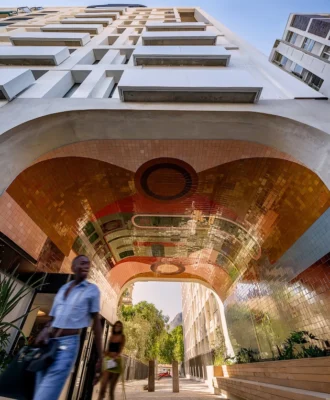
Exterior of the Standard High Line hotel in New York. -
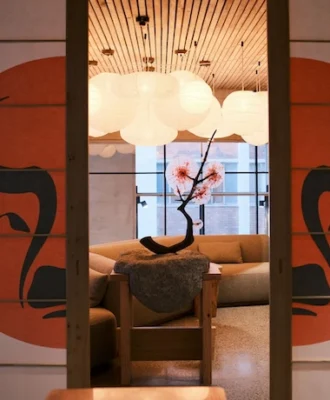
The hotel’s famous Boom Boom Room. -
Los Angeles-based interior designer Martyn Lawrence Bullard exemplifi es this maximalist aesthetic – as can be seen in this room at his home in Hollywood Hills. -
Italian fashion designer Alessandro Michele, now the creative director at Valentino. -
Another room in Martyn Lawrence Bullard’s Hollywood home. -

Dolce&Gabbana Casa presenting its new furniture collection during Milan Design Week 2025. -
Fashionistas at Milan Fashion Week – SS 2025 menswear.


Trends researcher Chris Reid on the rise and rise of flashy style.
WORDS Chris Reid PHOTOS Getty Images, Supplied
Design is tied to life. Sometimes it reflects the mood of the world. Sometimes it reacts to it. And sometimes – when things get especially loud, fast and unfiltered – it becomes a megaphone. That’s the impetus behind Boom Boom: a maximalist aesthetic that’s been grabbing attention across fashion, media and, now, interiors. It’s a sensibility built on contradiction: sexy and silly, trashy and luxe. It’s not subtle – but that’s the point.

The term was introduced by trend forecaster Sean Monahan, who named it after the gold-saturated Boom Boom Room in New York’s Standard High Line hotel. Monahan came to prominence for identifying the “Normcore” movement in 2014, and while that was about being bland, Boom Boom is a “fetishisation of the past” that celebrates two decades of in-your-face glamour leading up to the millennium. It’s about conspicuous displays of wealth we haven’t seen for years, and it’s only gaining momentum.
A reaction to restraint
The Boom Boom sentiment emerges out of a cultural fatigue with curated perfection, but also overlaps with broad social shifts. Economically, we’re in a time of perceived uncertainty for many. In moments like this, style swings towards fl ashy and escapist, signalling resilience through excess.
In clothing, Boom Boom has manifested in a heady mix of satin, velvet, shimmer and texture. It’s an ’80s trashy-fancy homage, presented without a drop of irony – a faux-fur coat thrown over the arm of a rococo armchair. It’s the opposite of quiet luxury, and it doesn’t pretend otherwise – and increasingly, we’re seeing its aesthetic spill over from clothes and social posts into the way people create their spaces.
Echoing the fashion version of the trend, Boom Boom interiors are characterised by an abundance of plush fabric, lacquer and gilt. Surfaces are glossy, silhouettes are exaggerated, and decor is chosen almost solely for how much drama it adds. This approach signals a move away from the self-conscious curation and restraint that’s dominated design for the past few years. It’s more instinctual, even chaotic. In that way, it shares DNA with the current rise of emotive interiors, craft ed not just to look good, but to make you feel something. Except here, the emotion isn’t calm or connection – it’s straight up enjoyment.
The cost of glitz
You can’t talk about a trend like this and not point to the (glitter-covered) elephant in the room. Fast-fashion approaches to style and interiors are already a growing sustainability issue. This is compounded by chasing luxury on a budget, and turning to Temu and Shein to create your very own Boom Boom Room. It can also read as particularly tone-deaf in South Africa, the income disparity in the country being what it is. In that way, it’s not a concept one can trumpet uncritically.
Importantly, however, Monahan never intended Boom Boom to be a prediction for the trajectory of all of mainstream culture. Like Normcore before it, the style is only ever going to be fully embodied by a small subset of society. But the impulse for simple enjoyment can be channelled in any number of ways. Boom Boom might look (and be) superficial at first glance, but its rise says something real about where we are emotionally. In an increasingly anxious world, perhaps some of us want to have fun with design wherever we can, rather than being told restraint is a virtue.
If we’re being honest, there’s probably a little Boom Boom in all of us – whether we want to admit it or not. Who doesn’t want a moment of enjoyment when it feels like the world is constantly on the precipice? Ultimately, this impulse isn’t about abandoning meaning. It’s about holding the meaningful and the messy at the same time. It isn’t a rallying cry to cover every available surface in velvet and lamé – but it is a reminder that curating spaces in which we live, work and play doesn’t always have be to a cerebral exercise. And, perhaps, that design doesn’t always have to be good to be great…
Don’t forget to sign up to our weekly newsletter for the latest architecture and design news.