-

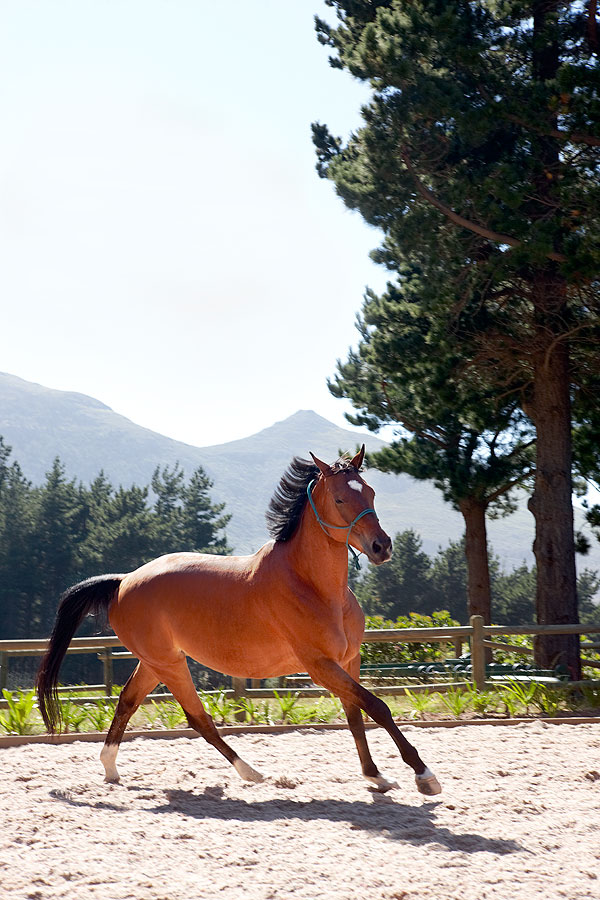
Artist in residence : Rio Grande, Wilma’s prize-winning warmblood in action. -
Artist in residence : “When a piece speaks to me, it is the craziest thing but I just have to have it. I have always bought art because I fell in love with it — the fact that that has become an art collection with value is almost by accident,” explains Wilma. -
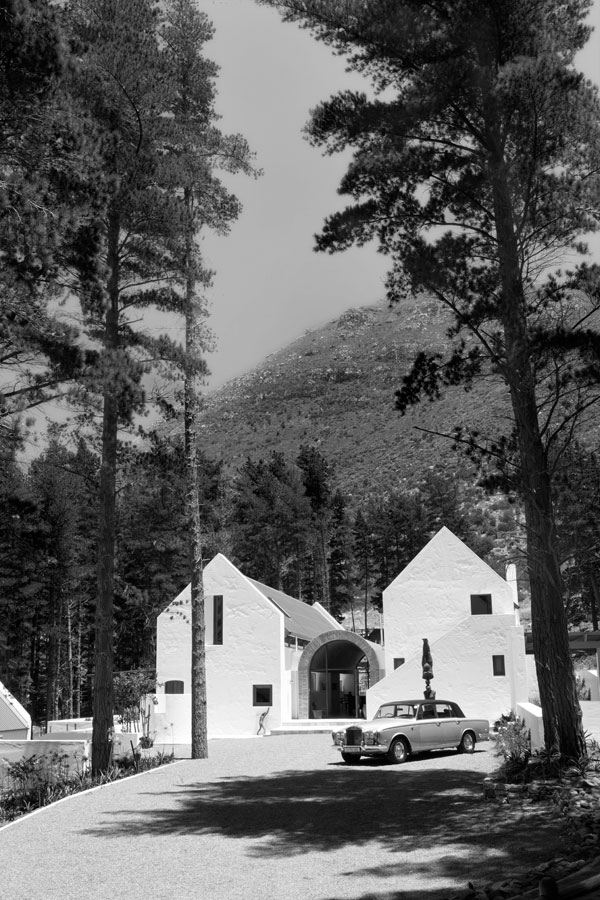
Artist in residence : The werf or forecourt as you come up the driveway. -
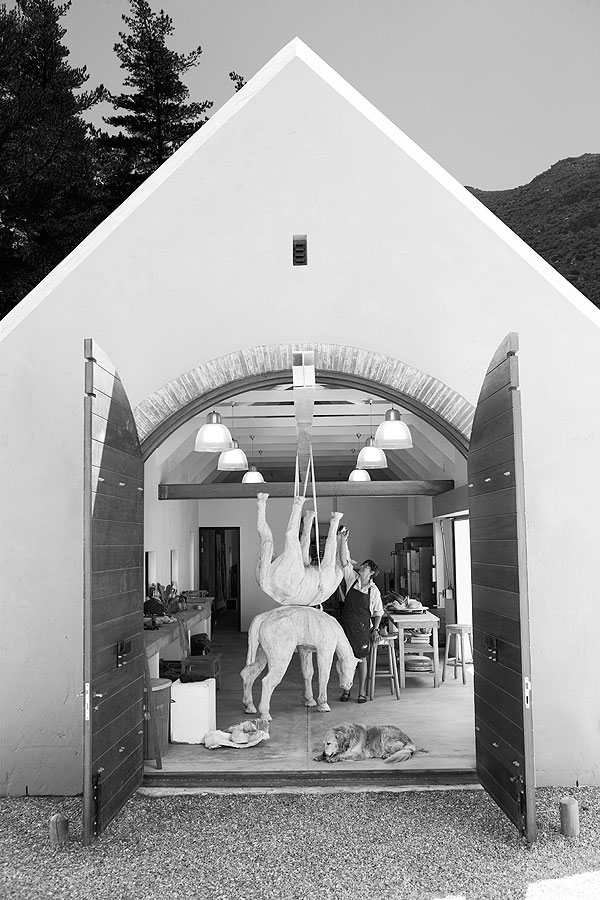
Artist in residence : Special hinges were made for the heavy wooden doors that open onto Wilma’s studio.
PHOTOS: Micky Hoyle | PRODUCTION: Etienne Hanekom | WORDS: Alma Viviers
Renowned artist Wilma Cruise’s new home, De Wildehoek in Noordhoek, is a place where she can live out her passions – for art, dressage and being close to nature.
A born and bred Joburger, Wilma Cruise is somewhat surprised to find herself in Cape Town. “I hated Cape Town,” she exclaims in disbelief. “I used to come down here and feel claustrophobic.”
It wasn’t just the enclosing mountain landscapes that used to make her uncomfortable but also the sleepy conservatism that gave Cape Town the nickname “Slaapstad”. “Cape Town has definitely changed since 1994. It is a much more cosmopolitan city and society – much more open and liberal.”
So how did she end up living here? The congested Johannesburg traffic and air pollution drove the Cruises to look for a rural escape. “We first moved to Midrand 13 years ago for the horses, when it was still countryside, but endless townhouse developments have turned it into this apocalyptic landscape,” says Wilma. “Five-hectare plots that used to have one house and two cars have now become townhouse developments with 72 units and two cars per unit.”
Wilma, who has always wanted a farm and entertained daydreams of becoming a gentleman farmer, started to look for properties around the country, from the Eastern Cape and the Karoo to the Waterberg. “But we had to face facts: my husband John was definitely not going to start working the land, we like being around people and having a Woollies around the corner, and John wanted to be near the ocean.”
They found a compromise in De Goede Hoop Estate in Noordhoek on the Cape Peninsula, where they could have the feeling of the countryside yet have easy access to all the amenities of the city and be close to the ocean. The five-hectare plot, tucked away in a far corner of the equestrian estate, was perfect for Wilma’s three horses, Cara Mine, Gregor and Rio, with space for shady paddocks and plenty of bridle paths for morning rides.
To realise her dream of living in a farm-style barn and fulfil her brief of “radical simplicity”, Wilma commissioned Cape Town architect and urban designer, Martin Kruger.
“I literally found Martin on the internet after a friend recommended that I have a look at his work,” she says. “I liked his designs and, after having visited his Nieuwe Sion farmstead in Franschhoek, his excellent finishes sealed the deal for me. As a sculptor, you are acutely aware of how materials join together, and you know an architect is good when he has the same sensibility.”
De Goede Hoop’s aesthetic code dictated that the house should be in the Cape Dutch style, and Wilma was particularly impressed with Martin’s contemporary interpretation of this vernacular.
“Cape Dutch is actually a misnomer,” says Martin. “If you look at places such as Boschendal and Groot Constantia, you can clearly see the influence of, for example, Italy. I prefer to talk about Cape-style, which refers to elements of the vernacular, like white-limed exteriors, thick walls, spatial planning and the creation of a yard.”
Like a small village, the long, barn-shaped buildings of Wildehoek crowd together among the towering pine trees on the steep slopes of Chapman’s Peak. Rough plastered and painted white, they include a main house, studio, staff quarters and stables, and are set on a series of platforms that colonise the slope.
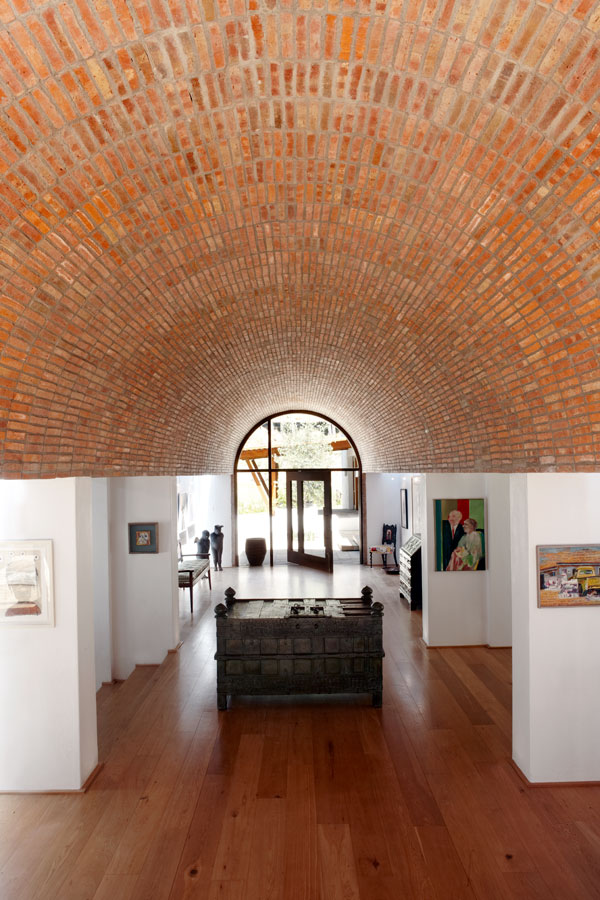
The most striking feature in the arrangement is the entrance hall. This 14-metre-long gallery, glazed on both ends and with a vaulted ceiling in red klompje brick, not only serves as the entrance to the house but also as the connection between the more private barn (with the bedrooms, study and library) and the more public barn (with the kitchen, dining and living spaces).
Spaces between the buildings, many of which are populated with sculptures by Wilma or friends such as Guy du Toit, are equally important – designed as both transitional and functional areas.
The barns and the yard, as well as the use of klompje bricks and vaults, are all recurring elements in Martin’s architectural vocabulary. It’s a style he has been developing in a series of barn houses – first South Winds at Kleinrivier Lagoon, then Nieuwe Sion and now at Wildehoek – and which explores contextual space-making and Cape vernacular architecture.
Both client and architect agree that the design process was an exhilarating one: “Wilma really drove the process; there was this energy that went into it,” Martin recalls.
“I really felt like I was part of the design team; Martin involved me every step of the way,” Wilma concurs. “I can’t think of any stage of the process where there was a point of conflict.”
In fact, the only bone of contention now that Wilma has moved in, is whether she should get rid of a questionable old dark-blue leather set of sofas on the patio. “I love them and what Martin doesn’t understand is that I have three dogs that have the run of the place – I am definitely not buying white canvas no matter how right it is,” she protests.
Their smooth working relationship doesn’t mean everything was plain sailing, however. Not only did it take some convincing to get approval from the estate aesthetic council for a design that steered away from more literal interpretations of Cape Dutch, but once the builders started digging the foundations, they discovered an underground river that meant the house had to be moved 25 metres from the original intended site. As luck would have it, construction also took place during the wettest Cape winter in 56 years.
The whole process, from buying the land to moving in, took seven years. At one stage, Wilma was ready to throw in the towel, but her persistence and patience eventually paid off. To commemorate the wild and tumultuous ride it was to get the house finished, Wilma named it Wildehoek. “My joy, my utter joy, is to wake up in the morning, go for a swim, then a ride, get into the studio and spend the whole day there, walk the dogs in the evening, have a glass of wine and go to bed. It is just so fantastic to be here.”
Martin Kruger Associates, 021 418 0342, www.martin-kruger.com and Wilma Cruise, www.wilmacruise.com, wcruise@global.co.za