-

(silent) Tower of Babel : In the library silver and bronze artefacts and an antique Bible are displayed before a bookcase of leatherbound books. -

(silent) Tower of Babel : The bedroom with its views over the city, Waterkant and Table Mountain, boasts massive 11m long teak beams that had to be lifted onto site by a crane. -
(silent) Tower of Babel : Every step behind the old fig tree holds a marble or stone nandi (holy cow in Hindu mythology). -
(silent) Tower of Babel : The dining room table is set with 144-piece dinner service, made especially for Baroda Palace in Gujarat by Limoges France in Paris and bearing the royal crest in gold. -

(silent) Tower of Babel : The bathroom is a masterpiece in white marble - from the sunken bath, made from one piece of marble, to the mirrored dome, all handmade in the Thar Desert. he large Chinese pot and ladle were used by Buddhist monks while bathing. -
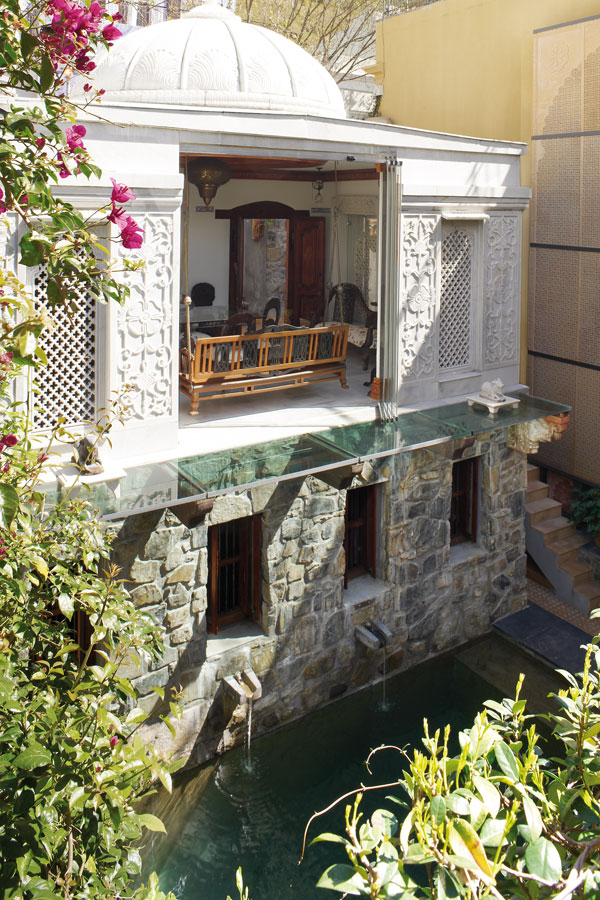
(silent) Tower of Babel : The courtyard with teahouse (on top of guest suite) and the teahouse's floating glass edge.


PHOTOS Greg Cox PRODUCTION Etienne Hanekom WORDS Alma Viviers
Over 20 years ago, two dedicated collectors started working on their “less is a bore” home in Cape Town, where every tiny detail tells the tale of their love for India and old-world craftsmanship.
In a narrow cobbled street on the edge of Cape Town’s inner city rests a home with a history. When it was built for British soldiers in 1830, the waves were still breaking just a few metres from its front door.
Not long after, Lady Anne Barnard would sit here admiring Table Mountain and Robben Island while nibbling on a luscious, sweet fig a slave had picked for her – in all probability from the same tree that stands in the (new) triple-volume glass heart of the home, a brooding old chap that has led a full life.
Then, a decade or two ago, the already illustrious history of the house acquired another, more exotic dimension. Two collectors, both self-confessed city slickers who worked in the fashion industry at the time, came to settle here with their growing collection of Indian antiques.
“In South Africa it is difficult to find a house that hasn’t been fiddled with too much. This house was relatively untouched, with many original features still intact, including the yellowwood beam in the kitchen, the stone wall and the old fig tree. We immediately bought it, even though, in those days, the area was still a ghost town of panel beaters and rusted cars,” explains the one who rises at the crack of dawn to greet the sun and say his pooja (prayer) for loved ones (living and departed) while lighting incense in certain spots around the home.
A year-round space
“Indeed, it was only much later that the fashionable De Waterkant as people now know it and ‘Moffieville’ started mushrooming around us,” says the tall one, a night owl. The two soon realised that it is tricky to find a year-round space for living and entertaining in the Mother City.
“We needed more room – both floor space and volume – and corners for reading or drinking tea, meditating or entertaining. When the runners of the old glass doors starting rusting and the fig tree began to look out of sorts, we decided it’s now or never. We wanted to stay true to the scale of the other historic houses in De Waterkant while trying to reinterpret our travels to India, as well as the feel and intricacies of the palaces and forts of that country. It was no easy task.”
Made in India
They called in architect John Middleton-Simpson, and accompanied him twice to India to perfect their concepts and deal with the heights and volumes. They eventually clad the fig tree in a massive sheet of cotton and rented the house next door so that the renovations could start. The extent of – and dedication to – this two-year project blows the mind.
Almost everything in the house, except the glass panels and the new I-beam steel columns needed for the central space, was shipped from India: basins, Burmese teak floors, marble, crockery, precious artworks, carpets, holy cows, bedding and ceilings.
For the cool, private courtyard, for example, they ordered a marble teahouse with a magnificent dome. It took 60 craftsmen 22 months to carve it by hand in the scorching Thar Desert and the cupola alone weighs in at 13 tons. In Udaipur, they saw an impressive crystal chandelier and borrowed 20 individual pieces from the owners (an aristocratic family) to have their own made by hand. (They thanked the family by replacing a few of the original pieces that had been lost through the years.)
So, in a narrow cobbled street on the southern tip of Africa, everything is a seamless whole, as if it has been here forever, this psalm of praise to the world’s most religiously and culturally diverse nation. Yet the pair object to being called perfectionist collectors with an unflinching eye for detail.
“All these wonderful finds were waiting for us; we didn’t seek them out. Over the years the locals we met, who we now consider friends, realised that we’re not like the Americans, Swiss and Belgians with bags of money who collect treasures as an investment. They now consider us as custodians of precious heirlooms and the owners are happy to part with the pieces, knowing that they’ll be treated with respect. Our dilemma is who will inherit our treasures. Galleries or museums? They’ll alter the soul of the pieces… We’d rather not think about it.”
The two were fascinated by India long before it became a trendy holiday destination, and speak of a “calling” for the place and “love at first sight”. “On my first visit, about 30 years ago, elephants still pulled the baggage wagons at the airport,” reminisces the one who’s visited the country at least 100 times. “Fortunately, I go there at least once a month for work!” (All the treasures from these trips are available at Private Collections.)
“The abject poverty is something else,” interjects the other. But the people live in perfect harmony with their lot. Their spirituality is woven into every aspect of their existence.” He mutters as an aside, “I simply don’t understand why nobody’s done a book on the holy cows of India yet.”
Living with abandon
Here in their city cocoon the two vegetarians and their four dogs live with abandon, surrounded by the fragrance of incense, with respect for silence, space and age-old rituals.
But don’t let the quiet oasis fool you. In this silent temple, you simply need to fall still yourself and you will hear each plate and vase, every book and cushion, every piece of furniture and floor panel, every wooden beam, tapestry, holy cow and former resident tell their story.
And if your ears aren’t attuned enough, then there are the two collectors on hand to interpret the whispers.
Private Collections 021 421 0298