-

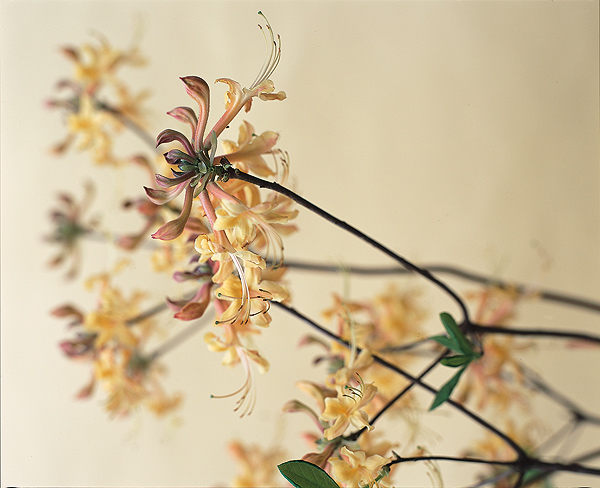
Drops of laughing red : Rhododendron 'Honeysuckle' is an unbelievable hybrid that needs extreme cold to grow and blossom. -

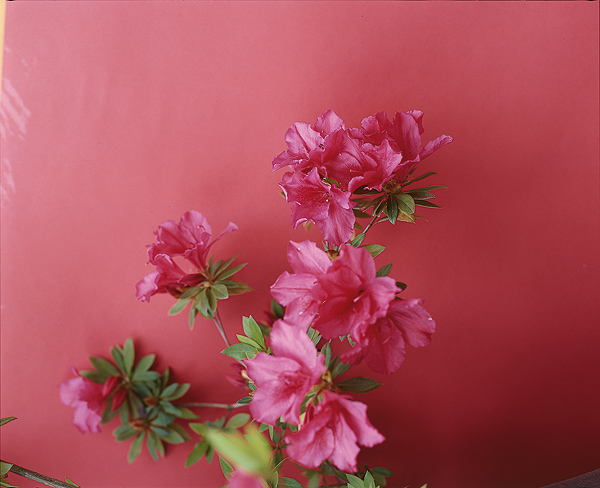
Drops of laughing red : Rhododendron 'Magenta' is one of the most flamboyant hybrids. It grows quick and higher than 3m. 'Magenta' has big single flowers with a bronze undertone. It can handle more sunlight than the others. -
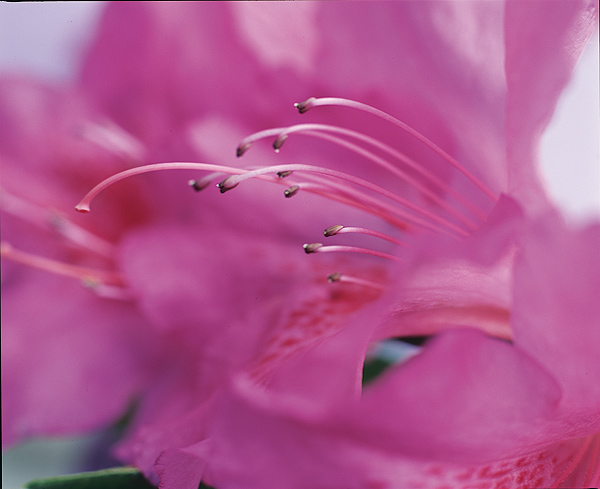
Drops of laughing red : Rhododendron 'Herbert Cerise' blooms late in spring. The leaves are small, the flowers medium size and the plants grow very low and wide. -

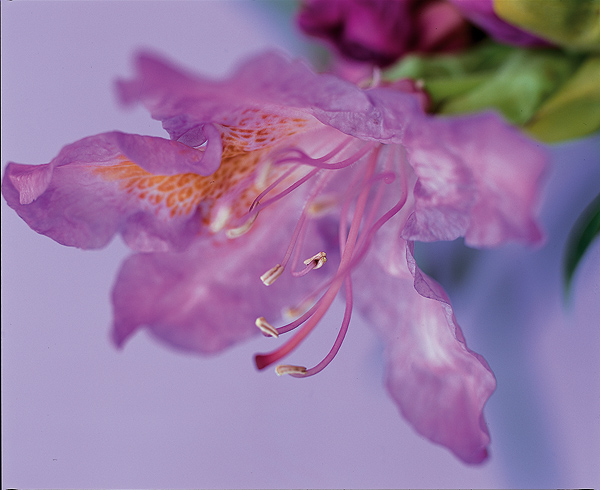
Drops of laughing red : Rhododendron ponticum is one of the rare few species that successfully grows in South Africa. The stems grows to 4m high and carries big purple pink flowers. -
Drops of laughing red : Rhododendron grandiflora 'Alba' is an old favourite. The strong hybrid grows more than 2m high and is easy to grow. The big flowers are light green in the middle. -

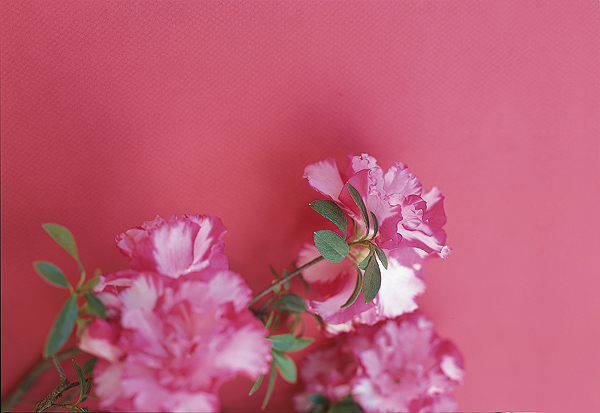
Drops of laughing red : Rhododendron 'Gretel' is a classic favourite. It spreads relatively low, with white double-flowers that is pink around the edges.
PHOTOS: Lien Botha | WORDS: Dave Pepler, Allan Davies
There’s much more to colour than meets the eye, especially when you look closely at azaleas.
Hands are the best way to detect a real gardener: the skin rough as a dog’s paw; the nails ragged. Real gardeners don’t wear gloves. How else can you feel if the warm heart of the compost heap is still beating, or nip the winter grass away from the first leaf of a ranunculus, or hold a child’s hand on a walk around your garden?
Winter-weathered gardeners look differently at the soil, the light, the sky; it was in her mind’s eye that author and gardener Vita Sackville-West transformed the rubbish dump that was Sissinghurst into a dream garden.
For gardens are essentially visions: “But mostly she let things lie, out of respect. Or she would draw a curtain, cunningly, to look out at the spectacle of morning, when all that is most dense becomes most transparent and the world is dependent on the eyes of the beholder. Then Miss Hare’s mouth would grow slack and loving as she formed the solid trunks of gums out of the grey embryos of trees.” In the whole of literature there has never been another gardener quite like Miss Hare, Patrick White’s sublime creation in Riders in the Chariot. Were there azaleas in her garden?
My favourite azaleas are the white ones, probably because white is such an impenetrable colour, difficult to grasp – and to describe. There is a theory that the advancement of a culture can be measured by the number of colours in its vocabulary. The French have 11 compared with the two – black and white – of some less advanced cultures. But we must be careful here, because there are also so-called primitive societies in Africa that have expanded the description of colour seamlessly into rough, smooth, dull, hard, soft, showy, laughing. To the familiar concepts of tint, brightness and saturation the Filipinos have added a fourth parameter – humid or dry.
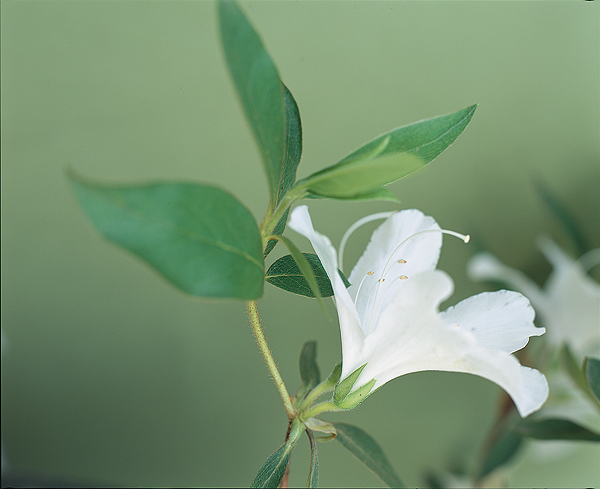
Armed with this new insight, we can look afresh at azaleas. Perhaps pink or mauve should become softly laughing pink or mauve? Can white only be, as in Latin, albus (matte white) or candidus (shiny white); or more – dull, damp, matte white? And how do you describe those delicate speckles in the throat of the white azalea trumpet? Drops of laughing red? We have such a wealth of words, especially if we draw on nature, that we can create an exhilarating new colour palette. So shall we begin with azaleas?
Azaleas are universal garden plants that are as well-known as roses: Rhododendron – rhodos (rose) and dendron (tree). But the flowers challenge the eye because their colour, unlike that of the rose, is merely an impression. To describe them is another challenge, even to our newly acquired palette. Study them intensely – and perhaps you can become a colour.
Azaleas: Where they grow
The huge Rhododendron genus embraces some 800 species and thousands of hybrids. These magnificent shrubs grow metres tall and bear sumptuous flowers, usually in tight, ruffled clusters, although some have a bell-like, more open growth habit. Most rhododendrons are native to the great mountain slopes and forests of Asia – the Himalayas, Nepal, Kashmir, Manipur, Bhutan, China, Japan. The names, exotic as the flowers themselves, send a clear message: these are plants that require extreme cold and year-round moisture to achieve their full beauty and so are not generally suited to South African conditions. However, they have been grown with a degree of success in the KwaZulu-Natal Midlands, the escarpment of Limpopo, Hogsback in the Eastern Cape, and in other damp, chilly corners of the country.
The smaller shrubs commonly known as Azalea are also, strictly speaking, rhododendrons, but it is really only botanists who refer to them as such. There are two basic types: evergreen and deciduous.
Evergreen azaleas are the easiest to grow in South Africa’s climate and many beautiful hybrids are available. They fall into about 14 groups with different growth habits, leaf and flower size and varying degrees of drought hardiness, but all are frost resistant. Flower colour is essentially pink and white, ranging from palest baby pink to rich cherry, bright coral and magenta. There are endless attractive shadings in blotched or darker edged petals and single, semi-double and double flowers. Plants may be compact and less than 1m high, or able to grow to 2m tall. It is best to buy them from a specialist nursery where you can obtain expert advice.
Deciduous azaleas flower without their leaves and are spectacular. They come in a wonderful range of oranges and yellows (as well as the pinks of some of the evergreens), and are often sweetly fragrant. But they are more difficult to grow than the evergreens, requiring conditions similar to rhododendrons. In South Africa, they are really for the expert devotee only, and so are not widely available.
Growing advice
• Azaleas need well-drained, acidic soil, a cool root run and plenty of water throughout the year.
• Some sun is necessary, especially in summer when bud formation takes place. Dappled shade or morning sun is good. Avoid afternoon sun or complete shade.
• The roots are shallow, so never plant around them and disturb the soil as little as possible.
• A thick mulch is essential to keep the roots cool. Pine needles or bark are acidic and therefore the best choice.
• Feed regularly with a slow-release granular or liquid fertiliser specially formulated for acid-loving plants.
• Prune after flowering by snipping off spent flowering tips. Old woody plants will respond well to severe pruning after flowering.
• If you have naturally acidic soil and plenty of water, go ahead and plant an azalea garden, otherwise it is best to stick to containers. Azaleas (especially the larger hybrids) make wonderful patio plants.
• Avoid mushroom compost, which is not acidic enough.
• Water with rainwater if possible, especially in hard-water regions, such as Gauteng.
• Evergreen azaleas may be propagated from semi-hardwood or tip cuttings. Deciduous azaleas are far trickier and are best layered (this means pegging a branch to the ground and encouraging it to take root where it touches).
More information:
• Pieter du Toit from Pick-a-Leaf Nursery, Western Cape: 082 451 1066
• Laurie Railton from Sandford Heights Nursery, Magoebaskloof, Limpopo: 083 636 6026.