WORDS: Daniel Scheffler
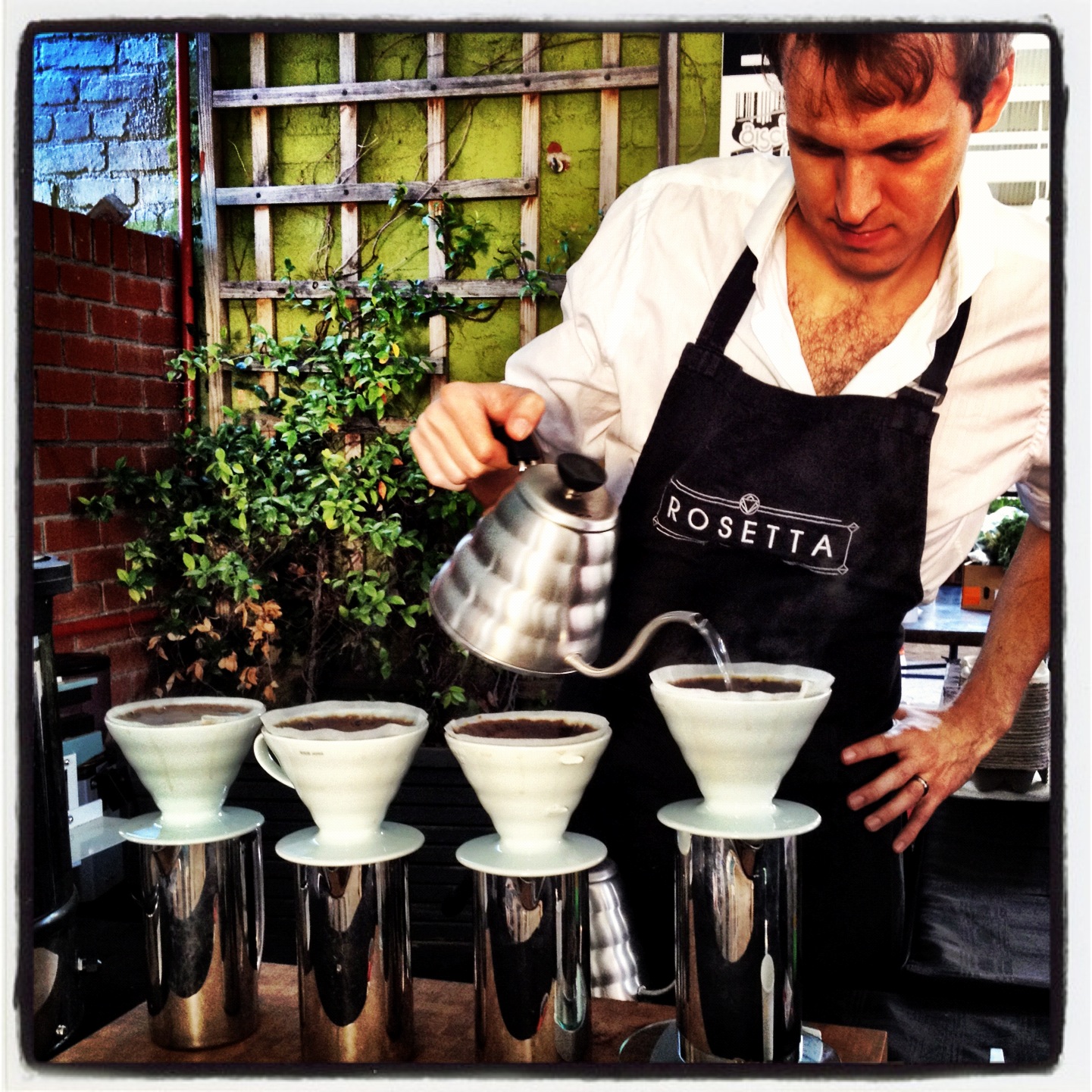
Daniel Scheffler chats with Jono LeFeuvre from Rosetta Roastery, about the prevailing cafe culture in South Africa, the local coffee culture, what coffee design means for flavour, branding and spaces.
Jono LeFeuvre, from Rosetta Roastery in Cape Town, talks avidly about how roasters all scoured the globes for a unique flavour profile produced by Mother Nature herself. No blending or roasting flavours into oblivion, but rather seeking out what only nature can produce (a combination of the seed, soil, and climate) and then roasting coffees lightly so as to let the “natural potential” of the bean shine as brightly as possible.
But as is always the case with man, once he has explored all he can explore, his next instinct is to conquer, adjust, shape, and sculpt what he finds to make it fit a particular box. Specialty coffee follows the same progression. A new wave of coffee producers are beginning to produce what has been termed ‘designer coffee’ where the final flavour profile is carefully sculpted by having roasters and buyers intervene in every step of the process.
LeFeuvre here explains the five main areas of coffee trends.
1. Starting with the seed:
The old school saw farmers planting whatever they wanted, harvesting it however they wanted and then waiting for someone to buy their crops. That ship has sailed. Now specific seed varietals are being chosen according to their characteristic flavour profiles and farmed, harvested and sold as single-varietal lots, carefully monitored by farmer and buyer alike. Labs are even producing hybrid beans that hold the best properties of a number of naturally occurring beans in order to produce “rock star varietals” that cause waves of excitement at coffee auctions around the world. Examples of these are beans like the Pacamaras (a hybrid of the Pacamaras and Maragogipe beans) or Geisha (not a hybridised bean, but still carefully sought out and sold as a single-varietal crop).
2. Affecting harvesting and processing:
Coffee buyers are also beginning to place demands on farmers to process coffees in particular ways (washed, unwashed, semi-washed) in order to attain certain flavour notes, whereas beforehand there was generally only one way of processing coffee in most regions (fully washed), unless environmental constraints – like water shortages in Ethiopia for example – dictated otherwise. Coffee buyers will now use the crucial washing stage as another node of influence to design their ultimate coffee flavour profile. Central American growers and harvesters (who generally have access to a little more technology and up-to-date machinery than their African counterparts) have taken processing techniques once deemed “only fit for the 3rd world” and have been using these techniques – but under far stricter quality control – to reap all the benefits of these processing methods, without any of the drawbacks
3. Roasting through a lens:
A coffee roaster, like a photographer using a carefully chosen filter on his camera lens, can use time and temperature to cause some flavours to shine more brightly, or to mute acidity that may be out of balance. Following the ways that both perceivable acidity and natural sugars change as temperatures climb and moisture levels drop, a roaster can choose how to present the bean he has been given. Guys like Willem Boot (a master Dutch roaster running a school in San Francisco) have given themselves the task of trying to remove the acidity from Ethiopian coffees, something that the American market tends to shy away from even though this acidity is exactly what made those Ethiopian coffees famous in the first place. So through a very particular roast profile, roasters are seeking to completely reinterpret particular bean types or single origin coffees.
4. Editing the coffee story:
In the big drive for “transparency” and “direct trade”, roasters and coffee sellers have done their best to throw as much information at a customer as possible, often without much thought as to whether it is relevant or not. From altitude to seed type, to origin, to soil type, to processing, to the farmer’s name, to the farmer’s donkey’s name, the trend has been for data quantity, rather than quality. There is no editing in the way roasters seek to tell each coffee’s story, which generally makes for a rambling, often boring narrative. At Rosetta they do their best to only communicate on multiple levels – each level crafted to just how interested a customer may be. The casual drinker needs to know nothing more than the name of the coffee, but the aficionado who insists on knowing origin, altitude, processing and varietal need only click once to have all that information in front of them. Jon laughs and acknowledges that: “We know this information is important… but then so is the national budget speech. Not all of us want to sit through that either.”
5. Coffee in context:
When it comes to presenting a coffee through its packaging, the trend is to max out on all the coffee iconography and imagery, without thought as to whether it looks good or not. Stylized beans, steaming cups, poor farmers, ripe cherries on the tree, ripe cherries in the hands of a farmer, coffee sacks in the jungle, coffee sacks in the roaster, coffee sacks on your tables, couches, counters, or lamp shades. “It’s almost as if roasters are afraid that, if they don’t include these elements, customers will think they don’t take coffee seriously,” says Jono.
Rosetta has a different take – they see coffee as an element cemented firmly within the busy urbanite’s daily schedule. It is one element within a myriad of signifiers and identity-formers that make up what the individual hopes to project to the world. And as such, it needs to fit into that world, rather than be an ornament on the mantle piece. Jono believes that packaging design needs to be “the wristwatch that finishes off an outfit, not the African tribal mask that hangs above your mantelpiece.” The coffee you drink says as much about you as the clothing brands you buy, and therefore needs to remain current, while still maintaining quality and timelessness. The aesthetic Rosetta has chosen talks of a classic process that has been profoundly modernised, and while they are intensely passionate about coffee you won’t find a single visual reference to any part of a cup, bean, sack, or farmer. The aesthetic and the product are separate but inextricably linked – like the food served at a restaurant, and the ambience crafted within. The ambience doesn’t change the quality of the food, but without it, the food cannot always be appreciated for what it is. They think coffee and it’s packaging have a similar relationship.
The expert:
Jono LeFeuvre, Rosetta Roastery, jono@rosettaroastery.com
Follow @RosettaRoastery and @danielscheffler on twitter