WORDS: Stephen Hobbs
Even international design bible WallPaper is in awe of this Joburg artist’s seductive geometric paintings.
Visual artist Mark Erasmus is the third generation in a family of paint specialists.
From his grandfather’s early “recipe” book carefully stored in his paint supply shop, to a collection of trade-standard chemical compositions for particular paint types, viscosities and colours, the world of Mark’s production unfolds.
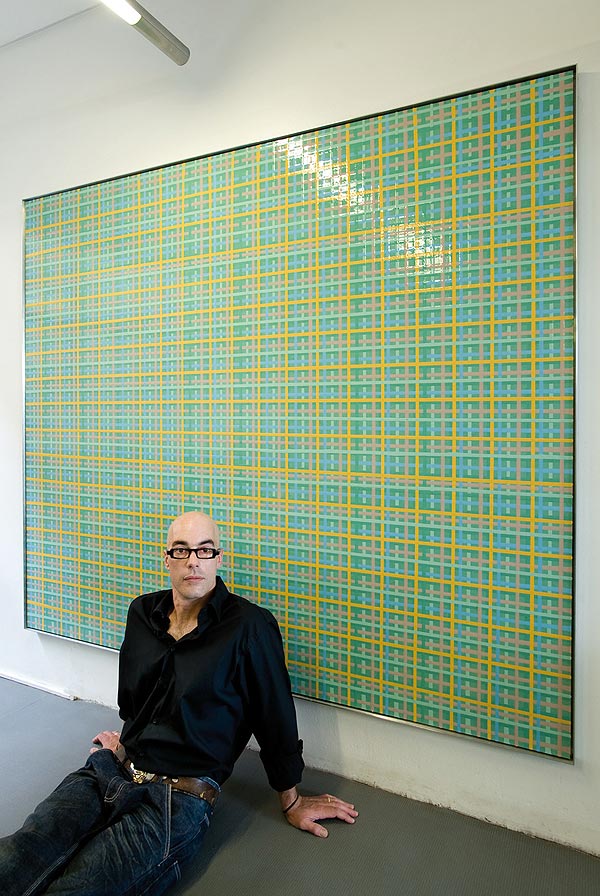
A studio visit entails winding one’s way through this shop into a back room to find Mark with a dripping brush poised in his hand at the top edge of an MDF board. From this position he carefully builds up a small pool of water-based acrylic paint on a surface no more than 5mm wide.
Gravity takes hold of the spill and a perfectly controlled liquid line creeps slowly down the face of the board. The line is concluded at the opposite end in a stalactite-like droplet. Upon drying, this process is repeated as the board is rotated until covered with an elaborate grid of interlocking and overlapping lines.
Mark draws his inspiration from the perceived madness and sensitivity to colouration found in Francis Bacon’s work and the paint-dripping machines of American multimedia artist Roxy Paine. He creates and occupies a world where a technically precise knowledge of the composition of acrylic paint and colour theory coexists with a method of image production that relies on order and chaos to achieve aesthetic perfection.
Refreshing attitude
A chance discussion with Mark about his work invariably requires particular attention from the listener, for he is as demanding of your attention as he is of his own artistic objectives. In the art world such an attitude is refreshing, for few practitioners are as in command of – and knowledgeable about – the inherent mechanics and materiality of their production.
In this sense, a finer understanding of Mark’s work may inspire you to pursue your own interests with similar passion.
It is important to state here that an artist wants his or her work to be properly read and considered. Part of this involves looking carefully at how the artwork is assembled both formally and conceptually. Yet there is a tendency for Mark’s work to be considered as decor. However, while the latter is often just a prop, one of Mark’s paintings almost always has a forceful aesthetic presence.
In some circles of the art world it is maintained that painting is dead, that it has little to offer given centuries of oversaturation of the medium and perhaps that, in the digital age, it is an outmoded art form.
Yet where Mark’s work is concerned, one might argue that the artist’s scientific approach to his medium’s capabilities offers a superbly pure interrogation of form – a distinctly apolitical stance in a country where so much of our contemporary art is subsumed by social commentary.
• Mark Erasmus: colourlibrary@gmail.com