-

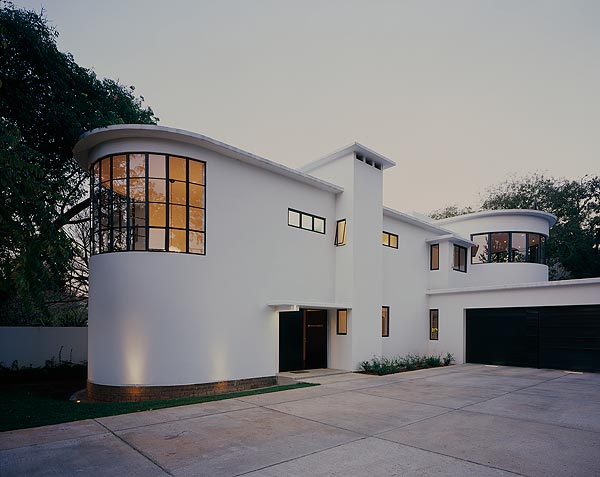
Modern Modernism : The new section of the house — the right-hand half of the building on this photograph — was designed to complement the old structure. Hence the use of the curved wall and steel or aluminium window frames throughout the renovation. -

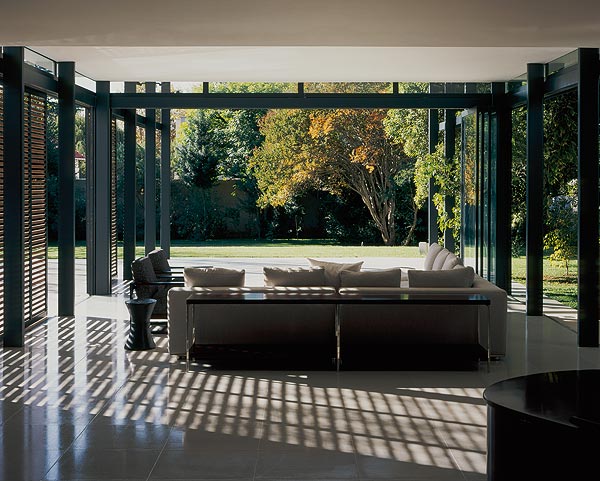
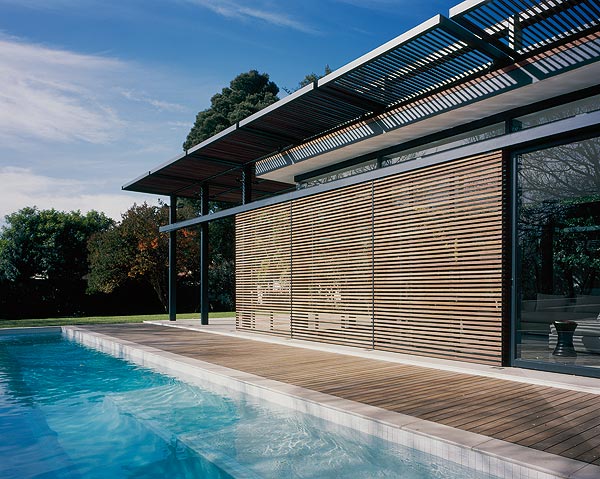
Modern Modernism : The louvres on the sunny side of the lounge have been set at the exact degree so as to optimise sunlight in winter and to block it out in summer. -

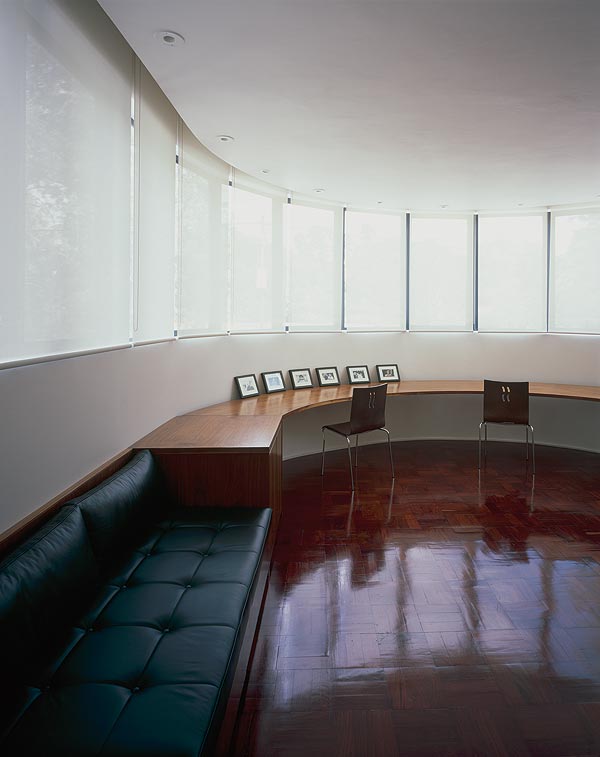
Modern Modernism : The study, upstairs in the new section of the house, is curved to mirror the western wing and, like the downstairs living areas, has parquet flooring. The floating desk along the southern wall makes for a dramatic yet practical effect. -

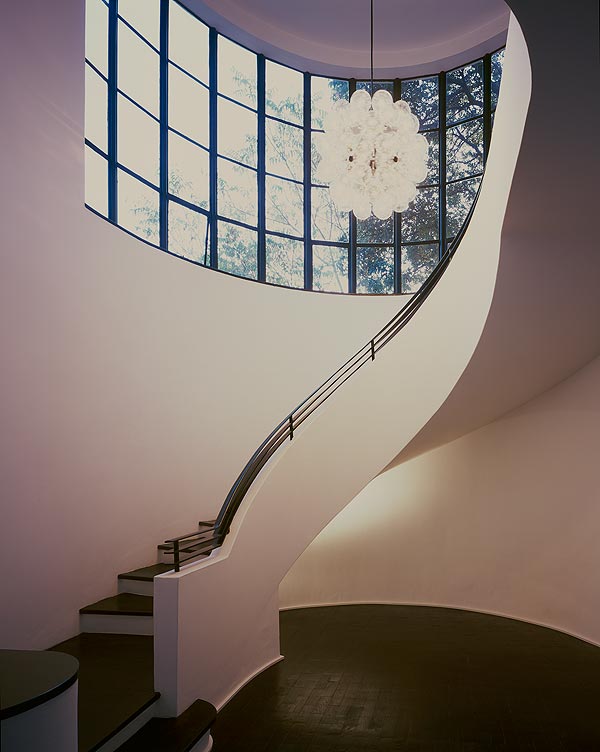
Modern Modernism : The sweeping staircase with its steel rail “sold” the house to its new owners. They kept the steel windows throughout the house to maintain its authentic Modernist feel but contributed their own contemporary furnishings, such as the Flos chandelier. -
Modern Modernism : The new lounge is a warm indoor area when utilised as part of the house and can also be a sunny entertainment area when the pool is being used. -

Modern Modernism : Wooden shutters separate the lounge and entertainment area when the pool is not in use. The shutters can be pushed away into a special holding area when they are not required. -

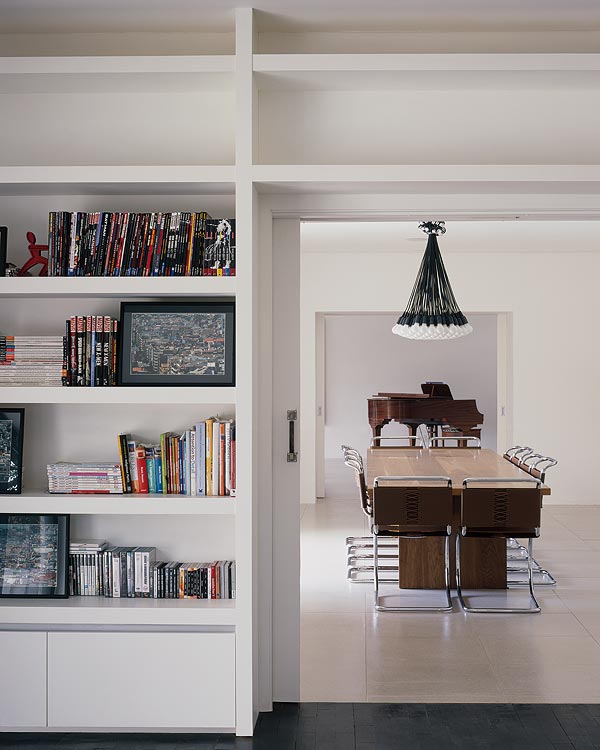
Modern Modernism : The old lounge is now a TV room, separated from the dining room by original sliding doors. Mies van der Rohe chairs and a modern naked-bulb chandelier add a stylish retro touch to the house.

PHOTOS: Tristan McLaren | WORDS: Jacqueline Myburgh Chemaly
A 1930s home in Johannesburg has been renovated with painstaking reference to its original Bauhaus form.
In a world where everything seems possible, it must take exceptional restraint to do only the necessary when it comes to renovating a house. Such was the discipline exercised by Johannesburg architect, Enrico Daffonchio, when it came to almost doubling the size of a Modern-era home in one of Johannesburg’s oldest suburbs.
Designed in the 1930s by Bauhaus architect Douglass Cowin, this double-storey house is a dramatic example of the Modern movement of that time. The house is a rare find in Johannesburg as not many homes were designed by the Modern architects, who were rather preoccupied with commercial and industrial designs.
In his renovation, Daffonchio was comfortable adhering to the principles of the Modern style, since he had studied the Bauhaus movement, and specifically Cowin’s work, while at university in Italy.
The perfect simplicity pf minimalism
Daffonchio, who now practises in Johannesburg, has made the Modern rules of design his own and the simplicity and honesty of Bauhaus are evident in much of his work.
However, he is the first to acknowledge that the digital age has made architectural feats possible that would never have been imagined in the past.
“Fast computers and software made a building such as the Guggenheim Museum at Bilbao possible. Who knows where we will be in 10 years’ time?”
But more of a modern Modernist himself, Daffonchio prefers to stick to the perfect simplicity of minimalism, designing spaces that are practical and that work.
“It is a less-is-more, rational, logical style – an extremely honest architecture. All structure and material is exposed. It’s what I subscribe to in my personal style of design: I like exposing the structure and materials, and use no cladding and as little paint as possible.”
This was music to the ears of his clients, who wanted their Bauhaus gem to be enlarged but to remain simple and functional. In the 1920s and 1930s, the Modern movement was a response to post-war economic realities as well as the excesses of styles such as Art Nouveau. In 2008, the new luxury is again to move away from embellishments towards the understated, pure form and simplicity.
“What is important is that the main shell of a house must be calming,” says Daffonchio. “That’s where I believe in keeping things simple and understated.”
Sensory experience
Daffonchio says he believes experiencing a house should be like reading a text where different things happen as you move through the building.
“Here, you arrive and are greeted by a hard facade. It’s closed and intimidating. But as soon as you step inside, the soaring staircase offers an uplifting contrast. The long passage, with a window and the garden at the end, draws you into the cool and calm living areas. From the dining room, a large square window looks out onto an illuminated sheet of water, the pool, to dramatic effect. The lounge, surrounded by nature and uplifted with light and music, is the most calming room in the house.”
So, what may look like an exercise in effortless simplicity, with barely an embellishment, is in fact a sensory experience that has been carefully considered from start to finish.
Daffonchio has made technical additions that remain true to the Modern ideal of everything in a building being entirely functional. For example, the climate in the glass-enclosed lounge alongside the pool is controlled by louvres that are set at a 46-degree angle, allowing maximum sun in winter and minimal sun in summer. The chimney flue from the braai was extended to beyond the height of the top-floor study, thereby taking the smoke far away from the windows. Its height has become a dramatic feature of the house.
Inside, the owners have kept furnishings simple, with a focus on collectable modern art and furniture pieces true to the Modern era and respectful of the Bauhaus style. The palette is a cool black and white, with parquet flooring stained black to pick up the colour of the steel windows. A Flos chandelier in the hall lights the sweeping staircase and double-volume window, which is what sold the house to the new owners. In the dining room, Mies van der Rohe chairs are a nod to one of the masters of that era, and the multiple-bulb chandelier is a dramatic centrepiece.
A home filled with light
The owners insisted on as much as possible of the old house being retained and mirrored in the additions. Original details such as sliding doors, door handles, fireplaces and the red steel pipe on the exterior balcony are all still in place.
The simplicity of the Modern architecture has also made it easy for the owners to give their home the personality that they choose. The design does not dominate and instead it is art, books, music and a sense of calm that greet you when you step inside.
“We wanted this to be a home filled with light and where things worked. We wanted a place that was going to be inviting to our friends – a place that we would all enjoy.” They certainly got what they wanted.
• Enrico Daffonchio: 011 447 8118, sadac@iafrica.com