-

A space odyssey -

A space odyssey -
A space odyssey -
A space odyssey -
A space odyssey -
A space odyssey -
A space odyssey -
A space odyssey




PHOTOS: Adriaan Oosthuizen | PRODUCTION: Sumien Brink | WORDS: Izelle Venter
A tenacious house-hunting magazine editor and her art-dealer husband with big dreams of finding a place to call home discovered it in the most unexpected of places.
Pay off your own bond rather than someone else’s: I have always steadfastly believed in this old axiom of property ownership. Move to Cape Town, however, and your iron-clad principles begin to melt.
Sunday after Sunday, I and my newish boyfriend (now husband) would trawl the City Bowl show houses. At six o’clock we would stumble home and collapse on the sofas in our rented apartment, exhausted and fretful, for all the world as though we had received calamitous news.
Then one Sunday in December, Father Christmas came early. We had followed the signs through the lower end of Gardens, finally ending up (with some disappointment) outside an office block. We parked and decided wearily to have a look.
And then the miracle: within seconds we were in love. The potential promised by the newspaper advertisement actually existed. Even more important, my better half didn’t look as though he was about to bolt. Picking up the spec sheet with sweaty palms, we were amazed to see that the price was just about affordable.
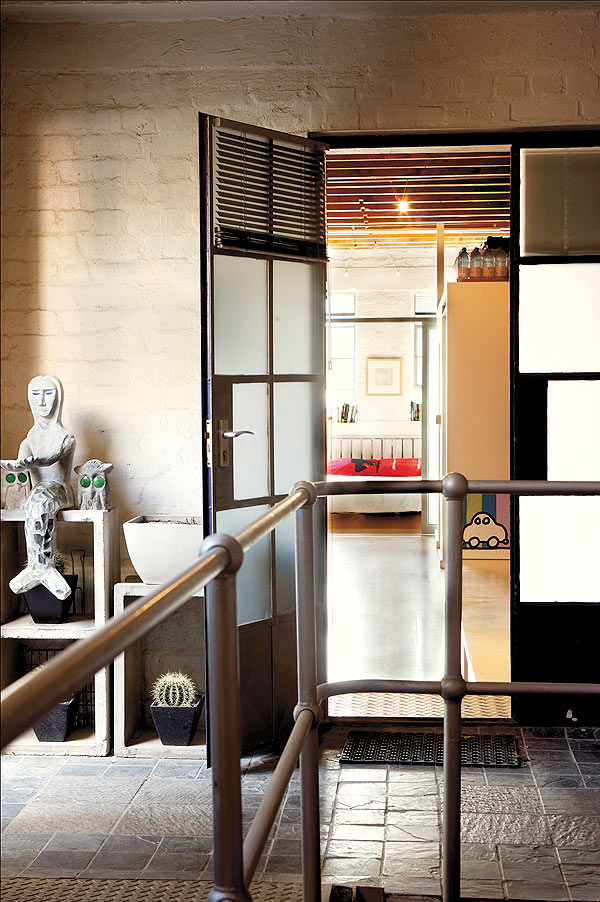
What we bought was, in fact, nothing more than one fairly big room. A shell of about 68m2 in an office block, with water laid on, an electricity board, the most beautiful wooden roof beams and the reddest of brick walls.
Making space
Our niggling anxiety that we could not count a dentist among our circle of friends vanished with the realisation that we did, however, know an architect. Evenings were spent with architect Philippe Fouché, and we decided together that there were three things that Number 5 Het Atelier had to have: open space, plenty of natural light and masses of storage space.
Together with our wonderful builders, Hands On Creative Building and Management (good builders are not, as we happily discovered, only a figment of the imagination), our empty room was transformed into our own little piece of New York – modern and clever, but also generous and warm-hearted.
We wrestled for a while with the idea of building a separate bedroom but soon realised that this would completely destroy the sense of space; as Philippe wisely advised us, the smaller the area the bigger it must feel. As a result, the bedroom is part of the rest of the house – when you sleep the whole studio becomes your bedroom. Sliding doors close it off when you entertain and your guests don’t have to stare at your pillows.
Incorporating the bedroom as part of the living space also sorted out the issue of natural light. Instead of a roof-height wall between the main space and the bedroom, where the light streams in, we installed a sliding glass door that extends to about a metre below roof height.
Now, when the door is closed the light slips over and through the glass panels. When open, the door slides cleverly out of the way behind the bathroom wall. We also had to think of other ways to bounce light into the space. Our solution was simple: white. We made the kitchen white, the shelving units white, and any plastered walls snow white. The laminated flooring is a pale neutral shade.
It takes time and patience
Every inch of space not required for furniture or access has been given over to storage. In such a small space it’s impossible to live surrounded by everything you own all of the time: if you buy a new salad bowl, the old one must be packed away.
Amazingly, we have about as much storage space as a house three times the size. Philippe has, for example, designed the built-in bathroom ceiling to be much lower than the roof, which frees up about 10m3 for all the things we don’t need every day, stored in plastic boxes bought from street vendors. In addition, deep drawers under the bookshelf and in the functional kitchen and the tall bedroom cupboards provide more than enough space for our collection of things.
One day a client of my husband – a German artist I had never met – came to see him at home. After disappearing into the bathroom he shouted out: ‘Now I know why you didn’t invite me to your wedding. Your wife is a midget!’
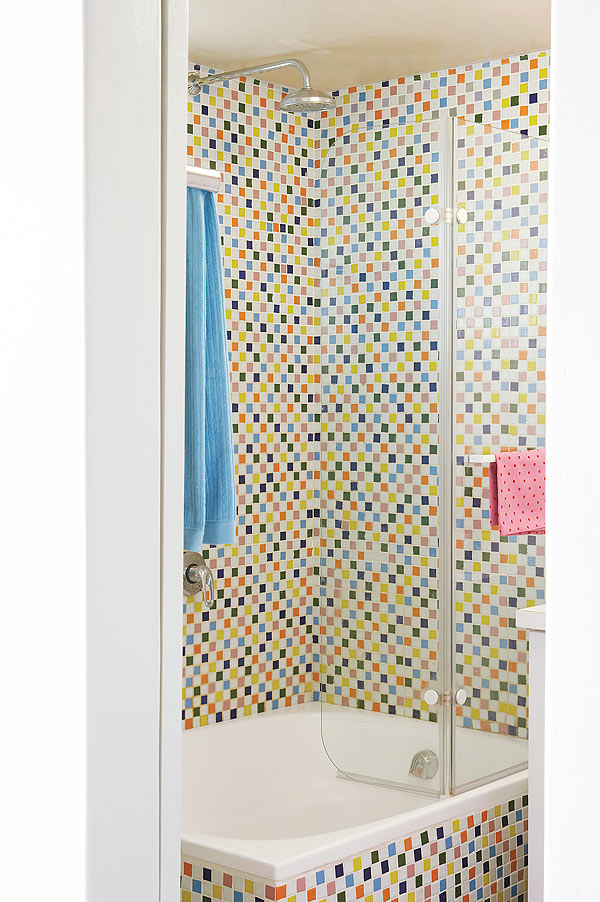
This observation was a response to our tiny bath, a little square thing in which the only possible position you can adopt is sitting upright and cross-legged. Usually when dealing with a minuscule space a bath can’t even be a consideration, but it was good news when Hands On came up with this ingenious solution.
A lesson we learnt hard and fast is that finding well-designed products for small spaces is not easy. It takes time and patience. That said, you should never underestimate the potential a small space holds – all you need is imagination and creativity.
The only things we really don’t have room for are the grandchildren twinkling in our parents’ eyes. Some days we wonder if we’ll ever be able to exchange Number 5 Het Atelier for a family because it is our little nest, and we love its snugness.
Think symmetry
The success of Philippe’s design rested on everything being in line. For example, the kitchen cupboards against one wall had to be aligned with the bathroom roof lines at the opposite end of the room. The bedroom cupboards were also placed to visually align with the kitchen cupboards.
It was important that everything be at the same height. From our personal experience, however, it seems that every manufacturer in South Africa deliberately chooses a different standard height and if you want to order just one centimetre longer or shorter than the standard size, the price increases dramatically (sometimes it even doubles). To get everything in alignment was a huge and important lesson.
Be aware, very aware, of each manufacturer’s standard sizes – you may have to take steps to create an illusion that various elements are in line when they are not. We had a particularly bad moment when the bedroom cupboards, the frame of the sliding door and the kitchen cupboards on the left side were put together. All three were different heights. The design was spoilt and the whole thing looked lopsided.
The solution? To order a low kitchen cupboard that was not a standard size and place it on top of the highest kitchen cupboard. The result took the kitchen units to the same height as the door frame and disguised the lower line of the bedroom cupboards. Because it was a small unit, it didn’t cost an arm and a leg either.
Philippe Fouché: 082 376 9583
Hands On Creative Building and Management: 083 277 3166
Homestyle Kitchen: 021 461 0690