-

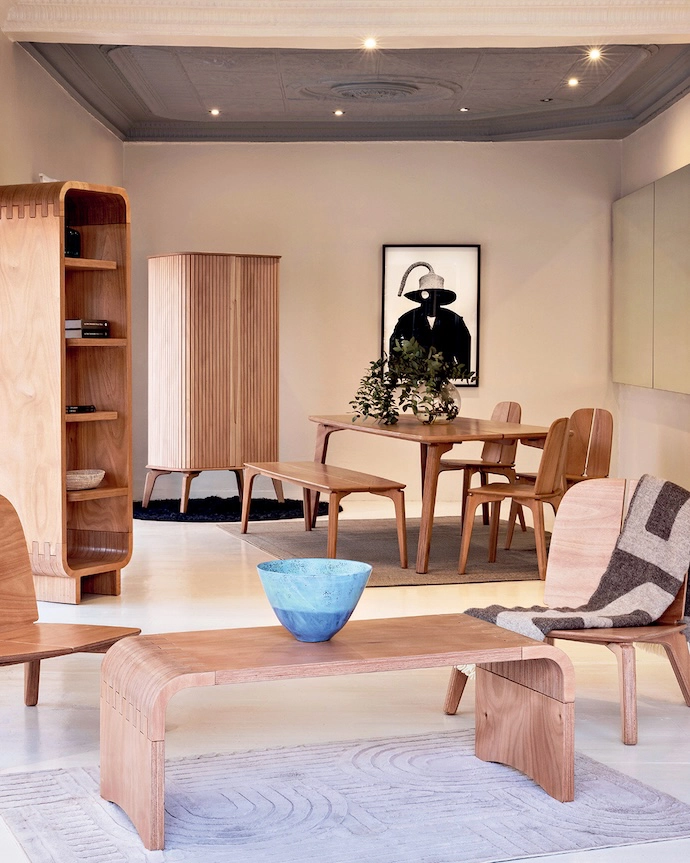
Inside Dwela’s new showroom, featuring the Shallal coffee table, Bawa occasional chairs and Shallal bookshelf. In the back are the Bawa dining table, bench and dining chairs, alongside a Bawa drinks cabinet. -
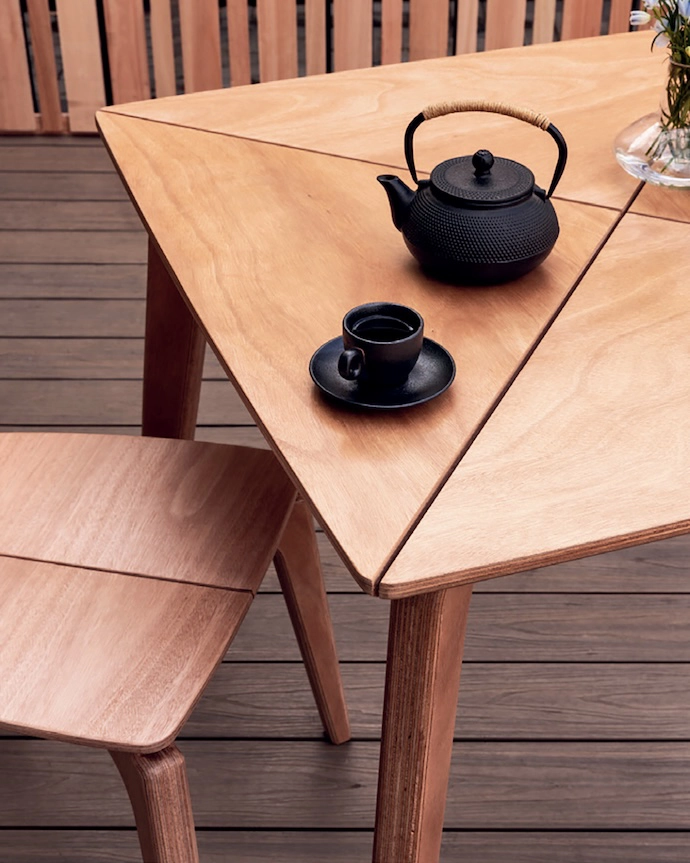
The four-quadrant Bawa café table, designed for outdoor spaces and cafés. -
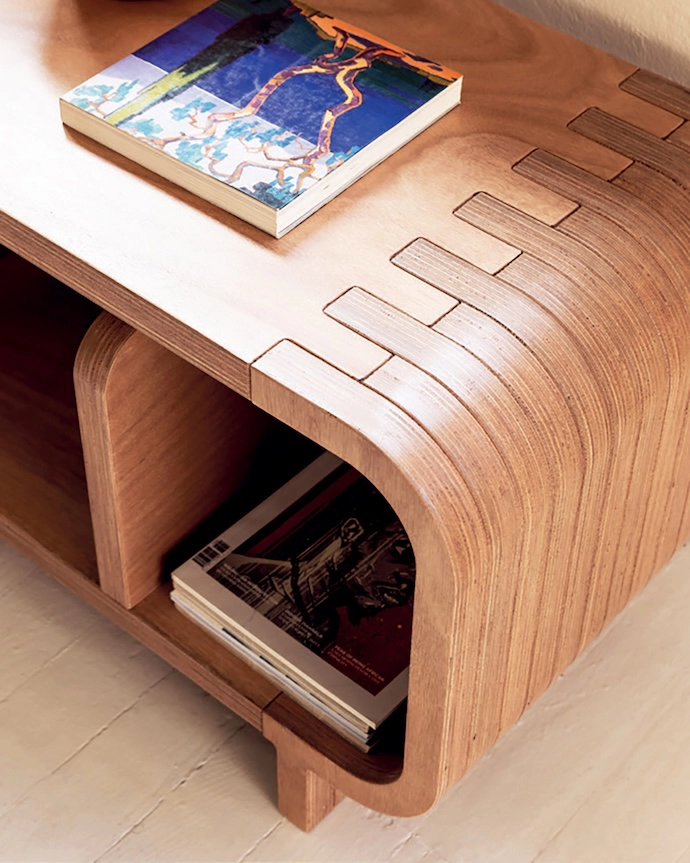
The Shallal media and display unit. -
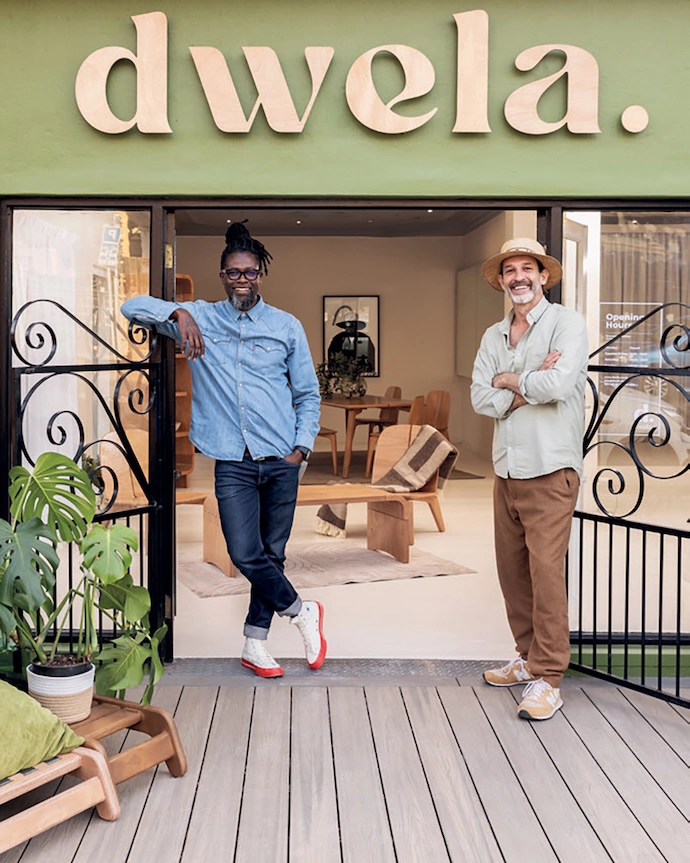
Joey and Stephen outside their showroom in Parkhurst.
As local furniture brand Daily evolves into Dwela, founder Joey Khuvutlu and creative partner Stephen Wilson discuss the Bawa Collection, a new Parkhurst showroon and the ideas behind their partnership.
WORDS Jo Buitendach PHOTOS Supplied
What happens when two of South Africa’s furniture design powerhouses join forces?
In many ways, Joey Khuvutlu and Stephen Wilson couldn’t come from more different worlds. Joey spent two decades in advertising, building brands, running agencies and nurturing an entrepreneurial streak that eventually led him to launch furniture brand Daily in 2023. Stephen’s path was rooted in craft, from early experiments with papermaking and picture-framing to woodworking, before co-founding Houtlander with Phillip Hollander and helping to shape it into one of South Africa’s most admired furniture brands. More recently, he founded Always Welcome, a collective showcasing the continent’s significant design brands.
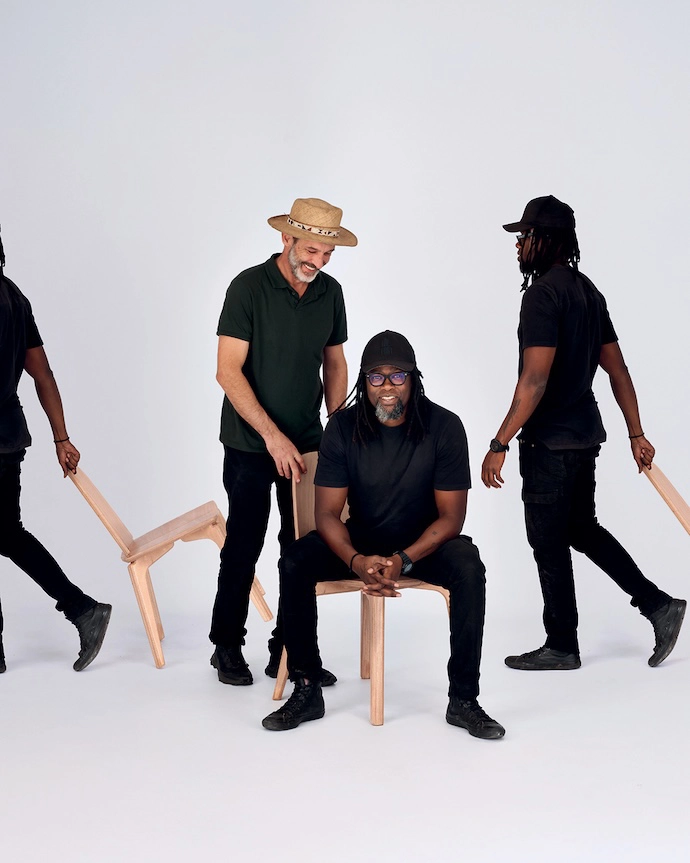
Yet despite their backgrounds, the pair share a remarkably similar outlook. Both are drawn to honest materials, purposeful design and creating meaningful employment. It’s a meeting of entrepreneurial energy and deep craftsmanship, of strategic thinking and making by hand. And as Daily transitions to Dwela, Joey and Stephen have joined forces to create the Bawa Collection, bringing together their complementary skills and shared outlook. We sat down with them to discuss collaboration, process, the thinking behind the collection, and the brand’s next chapter.
THE CONNECTION
Joey: “Stephen and I connected through Phillip Hollander of Houtlander. I met Phillip about a year ago at Cape Town Furniture Week, and we’ve stayed in touch since. He’s been incredibly open with his knowledge and generous with his time. After two-and-a-half years of building Daily, I’d reached a point where I felt I needed more experience around me. Initially, I was looking for technical expertise, someone with a deep understanding of woodworking and manufacturing. I reached out to Phillip to see if he knew anyone who might be interested in getting involved. About a month later, he called and said, ‘My former business partner, Stephen, is looking for a new project.’ That’s how the conversation started.”
THE SHARED VALUES
Stephen: “What Phillip described to me was someone who was incredibly grounded and had built a brand with enormous potential. He felt the skills and experience I could bring might help take the business further, which immediately interested me.
“But when Joey and I started talking, it quickly became clear that we shared a similar outlook. Beyond furniture and design, we both care about doing work that’s meaningful, creating opportunities, and building businesses that have a positive impact. I think the deepest thing we share is empathy. Design should serve people, and to do that, you need to understand what people need, what they value, how they live. I saw in Joey a genuine empathy for his community and a desire to create opportunities for people who are left behind. That shared outlook is something we connected on very quickly.”
THE DWELA REBRAND
Joey: “If you look at our work over the past three years, you’d recognise a distinct Daily language. But what we are doing now feels far more crystallised. We’ve spent the last few years learning, experimenting and refining our ideas, and we’ve reached a point where there’s much greater clarity around who we are, what we stand for and the kind of products we want to create.
“That’s why the evolution from Daily to Dwela feels right. It’s not a complete departure; it’s a more assured expression of our values and design language.
“The name itself is rooted in the idea that we’re all dwellers. City dwellers, apartment dwellers, house dwellers – wherever you live, and whatever that looks like. The spaces we inhabit shape how we live and feel. Dwela exists for those spaces: design-led products of lasting quality, made for everyday life.”
THE BAWA COLLECTION
Joey: “The Bawa Collection began with the Bawa diner. Its origins lie in a study of traditional African ceremonial chief chairs, where simple timber elements are combined to create visually striking yet ergonomic forms. Rather than relying on carving, these designs use construction to achieve strength, presence and comfort. This thinking was ideally suited to Okoumé plywood, which is our primary material. Working with flat sheets rather than sculpted forms, we developed a split-panel technique that transforms planar surfaces into comfortable silhouettes. By working with the nature of the material, rather than against it, we are able to create furniture that is both contemporary and ergonomically refined.”
Stephen: “What began as a single chair evolved into a design language. The split-panel construction became the genesis of the Bawa Collection, finding expression across the dining chair, an occasional chair, a bench, tables… Each piece is a modern interpretation of indigenous design thinking – simple in construction, distinctive in character, and made to endure.”
WHAT AFRO-MODERNIST MEANS
Stephen: “The keywords are African and Modernist. We work with African timber, combining African references with the clarity and restraint of Modernist design to make contemporary furniture that’s rooted in culture.”
Joey: “For me, great furniture oft en sits between nostalgia and contemporary life. Many people look at our furniture and immediately feel a connection to it, even if they can’t always explain why. I think that is especially true for many Africans, who recognise references and influences that feel familiar.
“Much of that comes from lived experience. I grew up around furniture that was lower to the ground, softer in form, often handmade. Those influences continue to shape how I think about design. You’ll see references throughout the collection, from the rounded forms to the way certain legs flare out almost like the base of a drum. At the same time, I’m heavily influenced by Modernist design, so the collection becomes a conversation between the two worlds.
“We’re not interested in making furniture that’s intimidating. We want it to be thoughtful and well designed – but also warm, familiar and easy to live with.”
THE NEW SHOWROOM
Joey: “We started as an online-first brand because digital lowers the barriers to entry for emerging businesses, and allows you to build a community before investing in physical retail. That approach served us well. As we’ve grown, though, we’ve seen just how important a physical space is. Furniture is personal, and many people want to touch, feel and experience a piece before deciding how it will fit into the spaces where they live, rest, relax and connect. Those are meaningful decisions – and a showroom helps to build both confidence and connection.
“Our evolution from Daily to Dwela marked the right moment to expand the experience into a permanent showroom. It’s a natural next step in our growth – and with our community behind us, we’re planning to open in a second location before the end of 2026.”
Stephen: “Our showroom came about because we wanted a space into which we could invite our clients to experience the new collection, see the materials we work with and understand the services we’re now able to offer because of the systems we’ve built. Having a dedicated showroom finally gives us a venue to connect properly.” dwela.co.za | @dwela_
Don’t forget to sign up to our weekly newsletter for the latest architecture and design news.