-

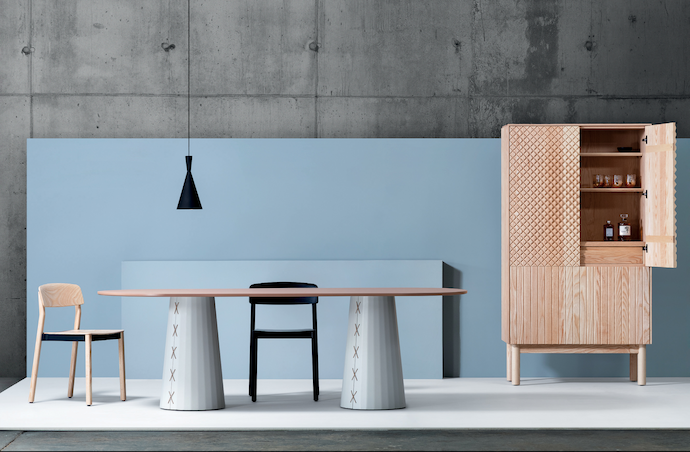
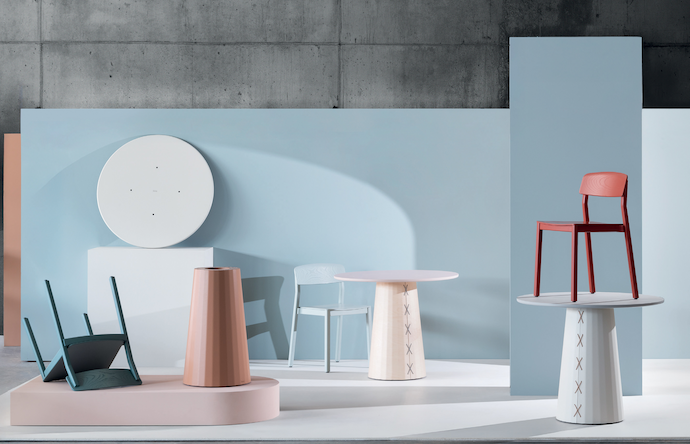
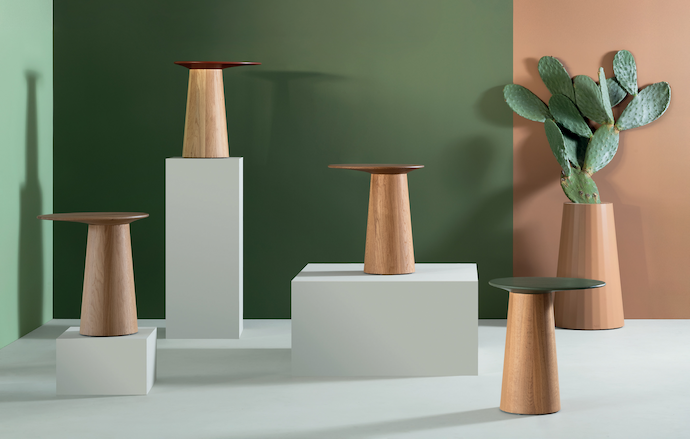
Kino’s Stitch table with its eponymous detail that emphasises the joint line detail instead of trying to hide it, and the Heildronk Kas with its unique carving pattern. -

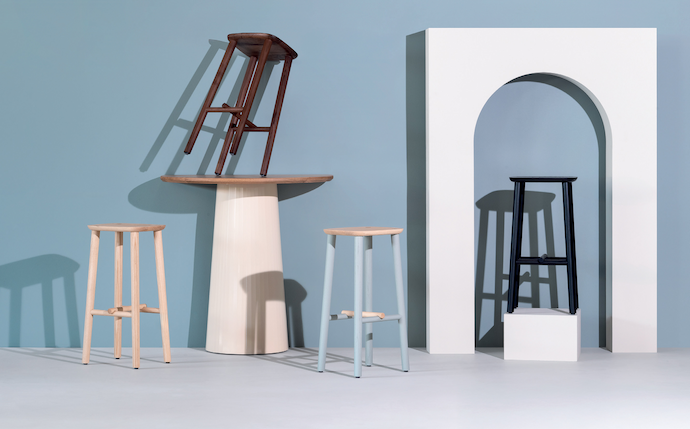
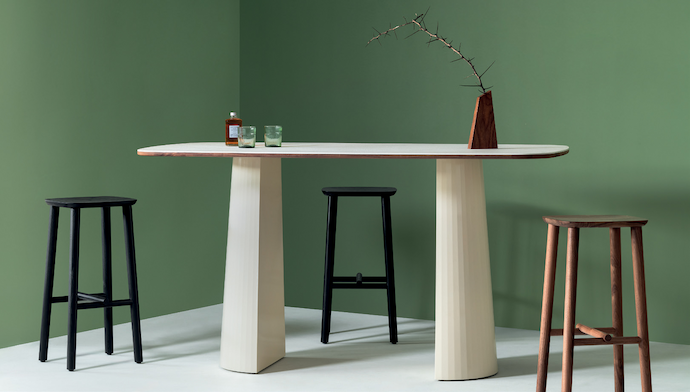
The barstools are part of the Stok collection and the table is from the Stam collection. -

Kino founders Anton Louw (left) and Nico Hendriksz. -

More colourways and variations in the Stok and Stam collections. -

Various colourways of the linoleum-topped Stitch table, along with Kino’s stackable dining chair. -

Colourway options on the Litzia sidetable. -

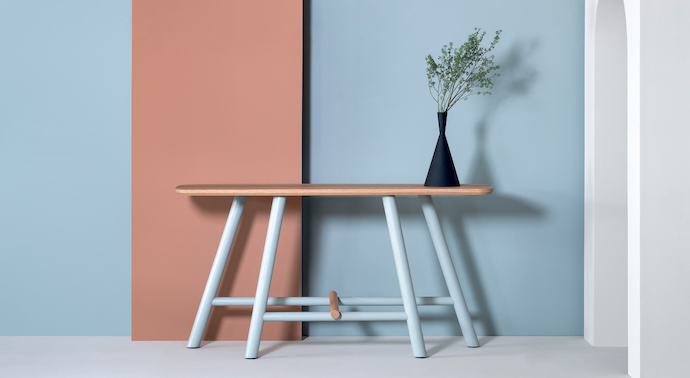
The Stok console table is available in Ash (natural or colour), Oak and American Walnut finishes, as well as two-tone options.
Nico Hendriksz and Anton Louw, founders of furniture studio Kino, provide some insights into their design approach, aesthetic and understanding of materials, and how these all tie into their production capabilities.
WORDS Steve Smith PHOTOS Paris Brummer
Since their breakout moment at 100% Design in 2017, we’ve been fans of this Cape Town-based duo and their work. And aft er seeing the Stitch table at last year’s Decorex/100% Design, it was high time we sat down with Nico Hendriksz and Anton Louw to find out more about their design approach and aesthetic.
Built on a foundation of childhood play with LEGO and Meccano, excelling at technical drawing at school, and degrees in industrial design from Cape Peninsula University of Technology, Kino was born in 2017. This is the story behind it.
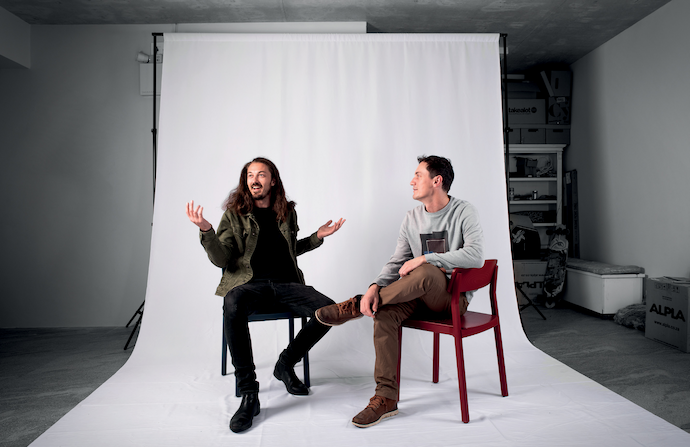
“Our design style has always been crisp and clean – minimal in nature, with subtle and considered detailing. While people often associate our pieces with Scandinavian or Japanese influences, that’s never been a conscious decision, but simply our natural expression.
“Lately, we’ve been really excited by colour, bringing in bolder elements while still celebrating the natural beauty of timber. Furniture needs to be inviting to touch, so we pay close attention to things like surface finishes, soft curves and tactile detailing.
“Our pieces don’t rely on decoration to make a statement. The designs are strong and self-assured, but still subtle enough to work in various spaces. This minimal approach is evident in our recent photoshoot, where the simplicity and integrity of each piece take centre stage.”
“Good design is the ability to combine considered shape and materials to create a product that’s beautiful and functional, and has a long lifespan. This is the benefit of having design and production under the same roof. It automatically instils an understanding of production, and material knowledge. We can design a product already knowing it will work, and how to manufacture it.
“Design is repeatability – to be able to make a product over and over, at the same or improved quality. Repeating the process helps us make production more efficient, and gives us an opportunity to iron out the making process and find better ways to achieve the desired result.
“The Kino dining chair and our new Stok barstool are good examples of this. Seating is designed according to ergonomics and standard dimensions, and we therefore rarely receive requests for custom sizing. This allows us to build jigs for repeating processes with absolute consistency and accuracy.
“Good design doesn’t have to be expensive. One of our goals is to combine quality with affordability through design, material choices and production methods, and to make quality products accessible to a larger audience. Take the Stitch dining table, for example: it’s designed with efficient production methods in mind, as well as considered material choices, to create something that’s beautiful, functional, cost-effective and at a level of quality that customers expect from a Kino furniture piece.
“Sustainability is also a principle that pulls through in our product design and material considerations. We’re happy that our hardwoods are sustainably sourced from well-managed forests. It gives us comfort to know that timber is an inherently carbon- negative material – a tree’s purpose is to absorb carbon dioxide from the air, and to store it. This storage off sets the carbon emissions associated with timber production and processing, which results in a net-negative carbon footprint.”
“We have always been very much inspired by production processes. The Heildronk Kas and Litzia sidetables are examples of this. The production process inspired the design of these products, instead of the other way around. The conventional route would be to design a product, then figure out how to make it. With the Heildronk Kas, the first inspiration was the process of creating the pyramid-shaped carving pattern. We then designed a product to showcase this – and it soon became the signature design element of the entire Heildronk collection.
“Material knowledge is key to our inspiration. We still learn new things every day, whether it is about materials, production processes or tech, or even on a soft ware level. This inspires us to find new ways of using these materials and processes in furniture design. Only when you fully understand a material can you design with confidence, and identify which limits you can push.
“Design is a natural process. It doesn’t ever feel as though we force the design thinking, and there is definitely a synergy between us. We share a similar feeling when we discuss a new design, and can usually agree on what is hot and what is not without hesitation.
“New products are often inspired by a client request or a need for a product that’s not necessarily in our catalogue. Variations of existing products also inspire new developments.”
“It is difficult to pinpoint specific influences, but we have a few favourite designers. We frequently come across a product we like, in a magazine or online, and it just so happens to be by the same designers. Patricia Urquiola comes to mind here, as well as Ronan and Erwan Bouroullec. It’s inspiring to see Patricia successfully design for different brands in multiple materials, from wood to upholstery and glass, and work on new material developments such as Cimento.
“The Haas Brothers are also a favourite because of their originality and wacky style, expressed in highest-quality materials and sculptural processes.”
“There are always ideas in the pipeline, and in the mind. These ideas can linger for months – sometimes years! – before reaching the factory floor. New designs that have worked their way to the foreground include a fully upholstered dining chair. We currently only have one chair in our catalogue, and even though the Kino dining chair is incredibly comfortable for a solid hardwood seat, we get requests for a fully upholstered version. We’re also working on further developments of our popular Stam dining table, including a timber base version and an outdoor version.
“Working with wood as a raw material inevitably results in smaller ‘off cuts’. We are therefore working on a range of smalls to utilise this material more fully and minimise waste. As a bonus, small products are a great way of training new employees to work with wood, without much risk of making expensive mistakes.
“Wood remains our core material and our expertise. However, more and more, we find ourselves becoming a multi-material brand, always on the lookout to select the material best suited to a product and its application. Along with the recent introduction of linoleum, we also have products that include glass, porcelain, aluminium, steel, brass and upholstered components.
“We remain curious, and we hope to add lighting to our product catalogue in the near future.” kino.co.za | @kinofurniture
Don’t forget to sign up to our weekly newsletter for the latest architecture and design news.