-

D810 -

D810 -
D810 -
D810 -
D810 -
D810
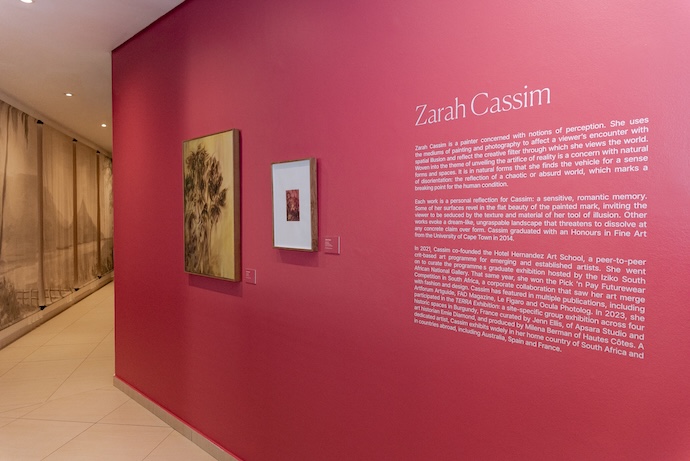
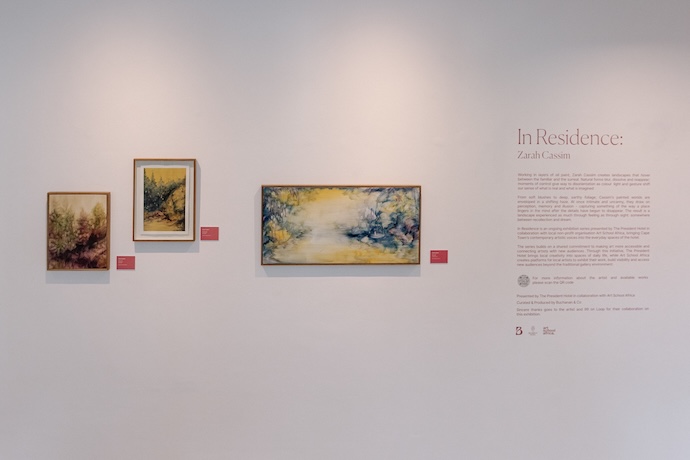
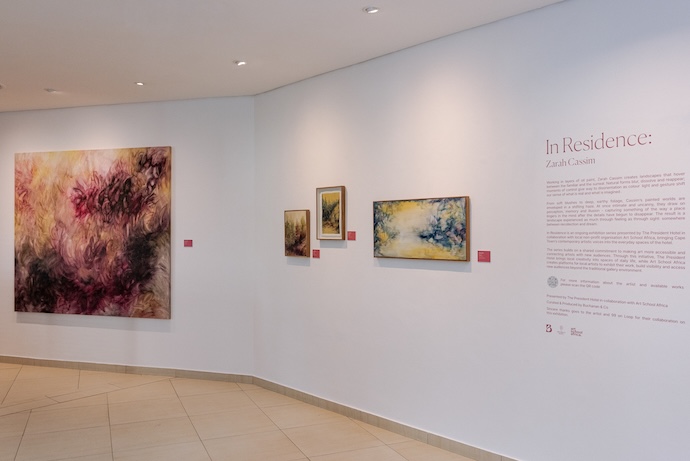
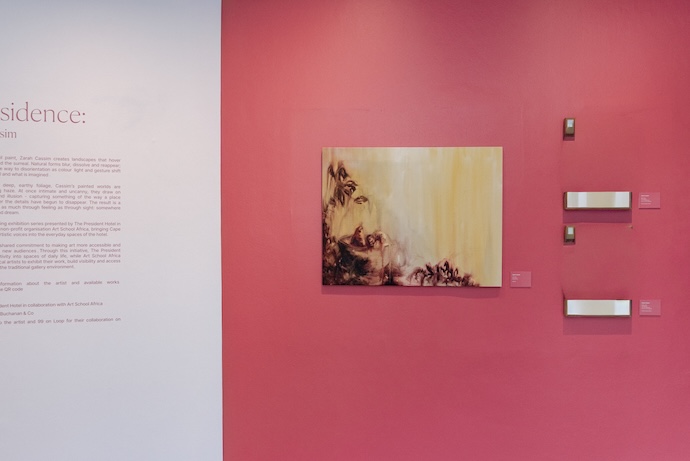
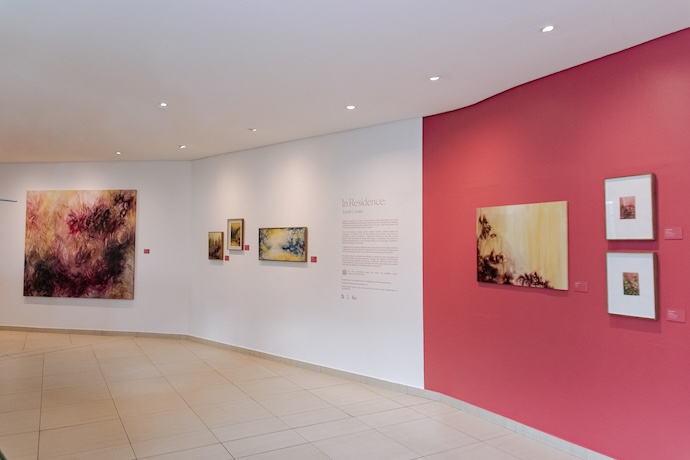
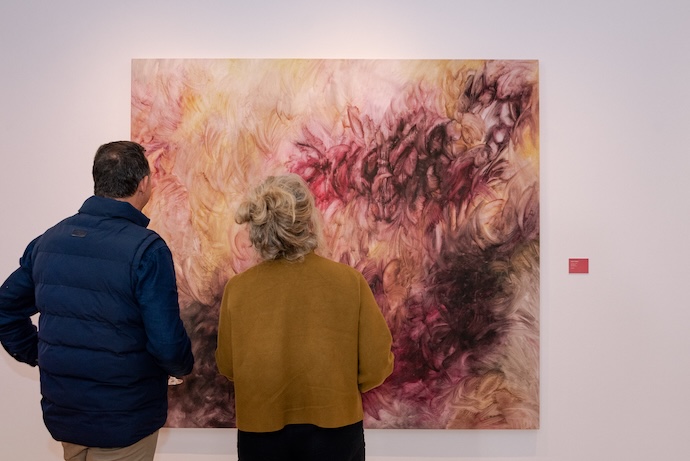
In Residence, an exhibition series presented by The President Hotel in collaboration with Art School Africa, features artist Zarah Cassim and her landscapes that hover between the familiar and the surreal.
WORDS & INTERVIEW Palesa Mohola PHOTOS Nicole Landman
The President Hotel – set between the ocean and the slopes of Lion’s Head in Bantry Bay – holds a distinct place in the city’s hospitality landscape, shaped by a deep commitment to locally made furniture, natural materials and a curated selection of South African art.
It is this dedication to South African art that finds its fullest expression in In Residence, an ongoing exhibition series presented by The President Hotel in collaboration with local non-profit organisation Art School Africa, bringing Cape Town’s contemporary artistic voices into the everyday spaces of the hotel.
One of those voices is Zarah Cassim, a painter who works primarily in layers of oil paint and creates dream-like, surreal landscapes. Based in both Paris and Cape Town, she is a graduate of the University of Cape Town, where she completed an Honours in Fine Art in 2014, and the co-founder of Hotel Hernandez Art School. Her striking work has been exhibited across South Africa as well as internationally.
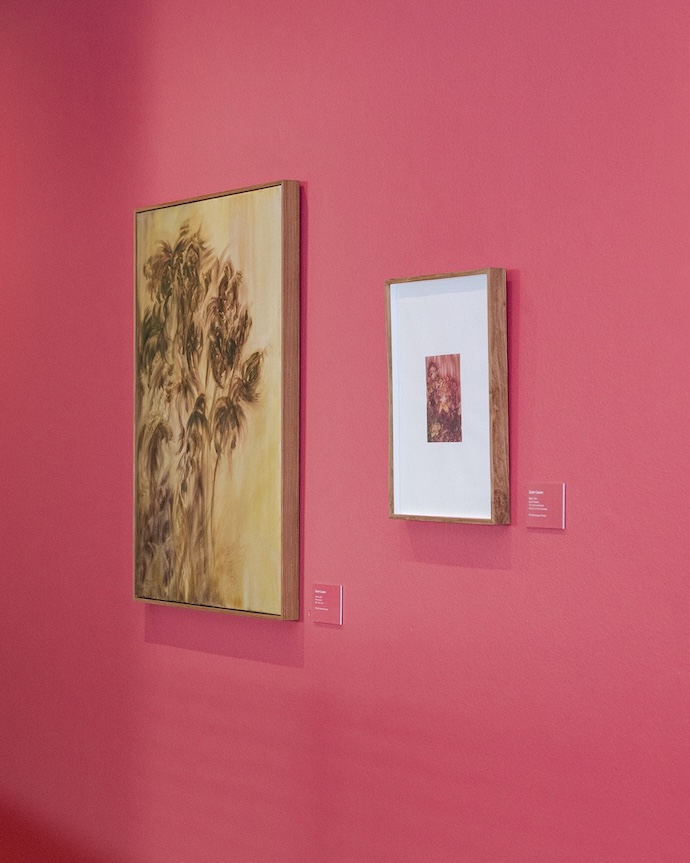
Zarah breaks down the creative process behind her work currently on show at The President Hotel.
Can you walk us through your creative process – from the initial idea to the finished work?
“I allow the painting to guide me. I often start with a colour and an abstract shape and build upon that, rather than beginning with a fixed idea of what the painting should become. Lately, I’ve also been allowing my children to collaborate on my works. They use my brushes and create images and marks on the canvas that I then work from and work into. I love the sense of freedom in this process, and seeing the dynamic way that one mark can inform the next and ultimately shape the final image.”
Memory and perception seem central to your practice – the way places linger long after their details have faded. How did this interest first develop, and are any of the works in this exhibition rooted in a specific memory or place?
“I’ve always felt that reality exists in multiple layers, and that perception plays a huge role in shaping our experience of it. I’m interested in becoming aware of those layers and questioning what we consider real and what we consider surreal. My works exist somewhere between a dream and reality. What feels like a dream to one person could be another person’s reality. It’s all connected to perception and to that very thin line between reality and illusion.
“The works aren’t necessarily rooted in one specific memory or place. They are more like fragments of memories and impressions that have been absorbed and reassembled.”
How does the natural landscape influence your work? Do you paint from observation, from memory, or somewhere in between?
“For the past few years, I’ve been travelling a lot and living between France, Spain and South Africa. The changing landscapes definitely enter my work on a subconscious level. I imagine spaces rather than painting specific places. Landscapes become blurred, and moments and imagery from one country find ways to collaborate and collide in a kind of subconscious collage. I’ve found similarities between certain spaces, and because I don’t work from photographs but from memory, I think there is a definite layered montage of places within my mind.”
What first inspired you to create for this exhibition, and what do you hope it communicates to those who encounter it?
“I think the work grew quite organically from the period of my life that I’m in now. Living between different countries, moving between familiar and unfamiliar landscapes, and experiencing life with my children has made me very aware of how much our surroundings and experiences shape the way we see the world. I wasn’t trying to create a particular narrative with this body of work. I wanted to follow the paintings and allow them to become their own spaces. I hope that when someone encounters the work, they can bring their own memories and perceptions into it. I like the idea that a painting can feel familiar without the viewer necessarily knowing why – that it can evoke a place, a feeling or a memory that belongs entirely to them.”
This exhibition spans oil on canvas, board and Fabriano paper. How does your choice of surface affect the work, and do you find yourself drawn to a particular medium?
“The surface definitely changes the way I work. Canvas gives me a sense of freedom and allows me to work quite physically, building up layers and marks. Board feels more contained and immediate, while paper has a delicacy that changes the relationship between the mark and the surface. I don’t necessarily choose the surface before I begin. Sometimes the material itself dictates how the work develops. I’m particularly drawn to the physicality of oil paint – the way it can be layered, scraped back and reworked. I enjoy that tension between control and unpredictability.”
The exhibition moves between large-scale works like The Dance I and more intimate pieces such as Sherbet, Berry and Bleed. How does scale shape the way you approach a painting?
“Scale changes the physical relationship I have with the painting. With a large work, I become much more immersed in it. I’m moving around it, stepping back and coming close again, and the marks become more physical and instinctive. The smaller works feel more intimate. There is a different kind of concentration involved, and I find myself noticing smaller gestures and details. I like having both within a body of work because they create different ways of entering the paintings. Some works ask you to step into them, while others ask you to come closer.”
What does it mean to you to have your work presented as part of the In Residence series?
“I really like the idea of the work being shown within a lived environment rather than being completely separated from everyday life. It feels appropriate to my practice because my paintings are connected to lived experience, memory and the spaces we inhabit. There is also an intimacy to In Residence. The work becomes part of an environment rather than something distant or untouchable, and I think that changes the way you encounter it.”
In Residence brings art into everyday spaces beyond the traditional gallery. Why is that kind of accessibility important to you, and how do you think it changes the way people experience art?
“I like the idea of encountering art unexpectedly, within a space that has its own sense of life and personality. It can make the experience feel more intuitive and personal. Art doesn’t have to feel distant or exclusive – sometimes the most meaningful connection happens when you simply come across a work and it speaks to you.”
You’ve exhibited in Australia, Spain and France, among other places. How has showing your work internationally shaped or challenged your practice?
“Moving between different countries has definitely influenced my work. Each place has its own visual language, landscapes, light and atmosphere, and I think all of those things find their way into my paintings, even when I’m not consciously thinking about them. Showing internationally has also made me more aware of how differently a work can be perceived depending on where it is seen and who is looking at it. That connects closely to my interest in perception – the painting remains the same, but the experience of it can change completely.”
In Residence, the exhibition series featuring Zarah’s work, will be on show until 11 January 2027 at The President Hotel. presidenthotel.co.za | artschoolafrica.com | @zarahcassim
Don’t forget to sign up to our weekly newsletter for the latest architecture and design news.