PROMOTION
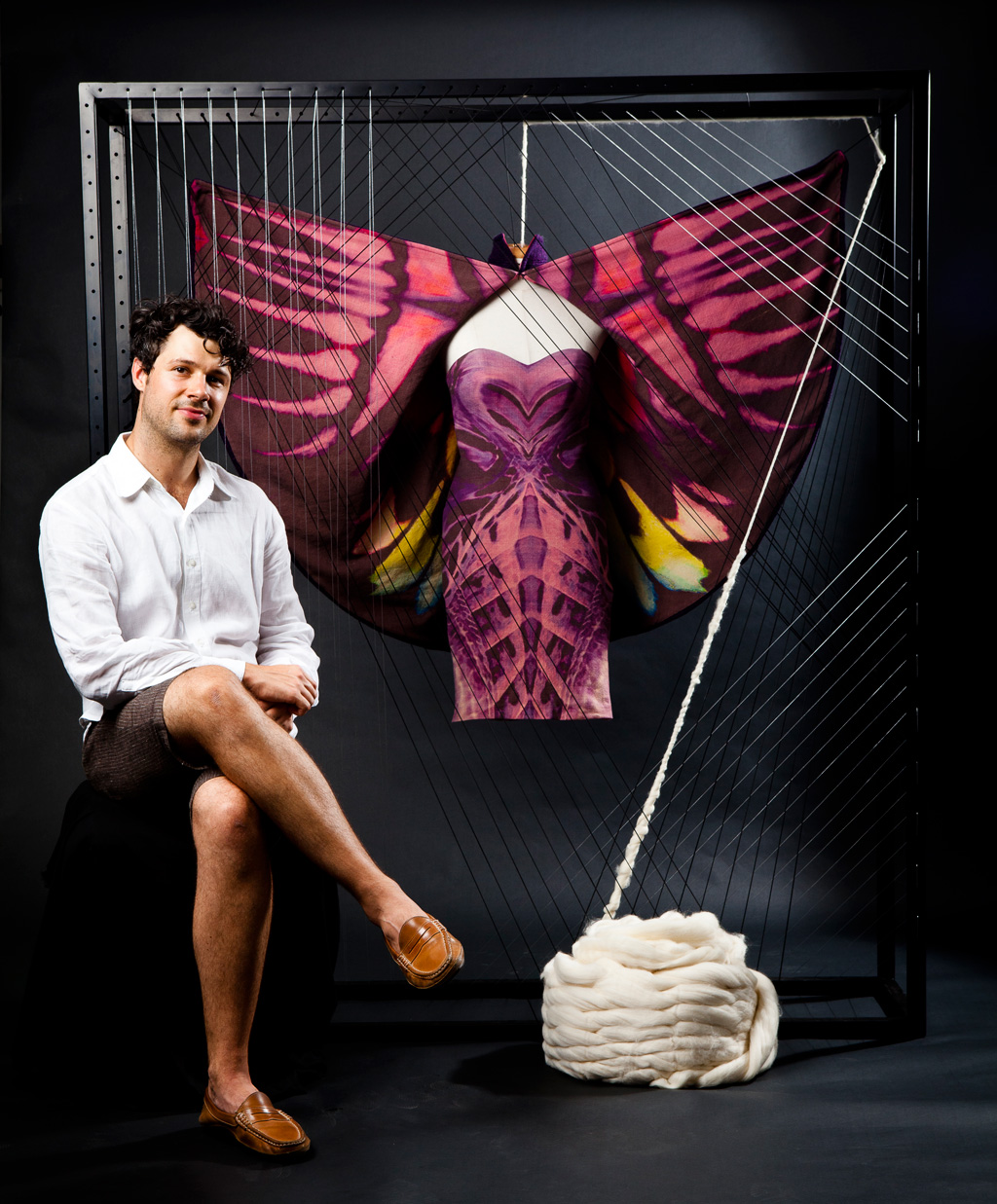
Merino can create the warm wooly sweaters we all know and love, but it can also be used to create sleek suiting and fine haute couture garments, like the one created by Hendrik Vermeulen for Cape Wools. We chatted to Hendrik to find out about this unique garment, and why he likes to work with wool.
What attracts you to working with Merino?
The Merino wool is a natural and self-sustainable textile fiber with unique properties. Contrary to popular belief, wool (if treated accordingly) isn’t scratchy and a lightweight kind is called “cool wool” and can be worn in summer.
What inspired you to try printing onto Merino?
We already had a great success with our custom printing on silks, something we have developed in collaboration with ArtLab at the Biscuit Mill. We then naturally tried and applied our knowledge into wool printing as a way to push the boundaries a bit further.
What difficulties did you encounter in the printing process?
The major difficulty was that the piece of woolen fabric we’ve been offered by the Cape Wools was one of the last pieces produced in the country with 100% South African Merino wool. The piece was therefore more than a decade old and had been affected in some places by humidity making it a challenge for the dye to get absorbed by the fabric. Another difficulty encountered was that the printing machine used for the job has very sensitive printing heads, which got stuck in the wool fibers making it quite demanding to keep clean during the printing process, but the ArtLab’s team was up to the challenge and delivered exceptional results.
The print used on the Merino dress and cape is part of your current collection. What inspired the print design and the process of printing onto fabric?
Even though the print used on the Merino dress and cape has the same source of inspiration (nature) as our Spring/Summer 2015 collection, the installation was particularly conceptualised to symbolise the rebirth of the wool industry in South Africa from a cocoon state to a fully developed moth/butterfly rich of vibrant colours (something difficult to achieve on such a medium). The installation shows a moth/butterfly being still entangled in some difficulties before being able to take its flight.
What does the future hold for Merino in the South African design and fashion industries?
Provided that a niche production of 100% South African Merino wool is achieved in a near future, the prospects look great, offering the fashion industry an extraordinary material while opening new possibilities for job creation and development in rural areas where the need for support is greatly needed.
Cape Wools SA, 082 870 6497, merino@capewools.co.za, capewools.co.za
Hendrik Vermeulen, 79 Hout Lane (corner of Bree Street), Cape Town, 021 424 1686, info@hendrikvermeulen.com, hendrikvermeulen.com