-

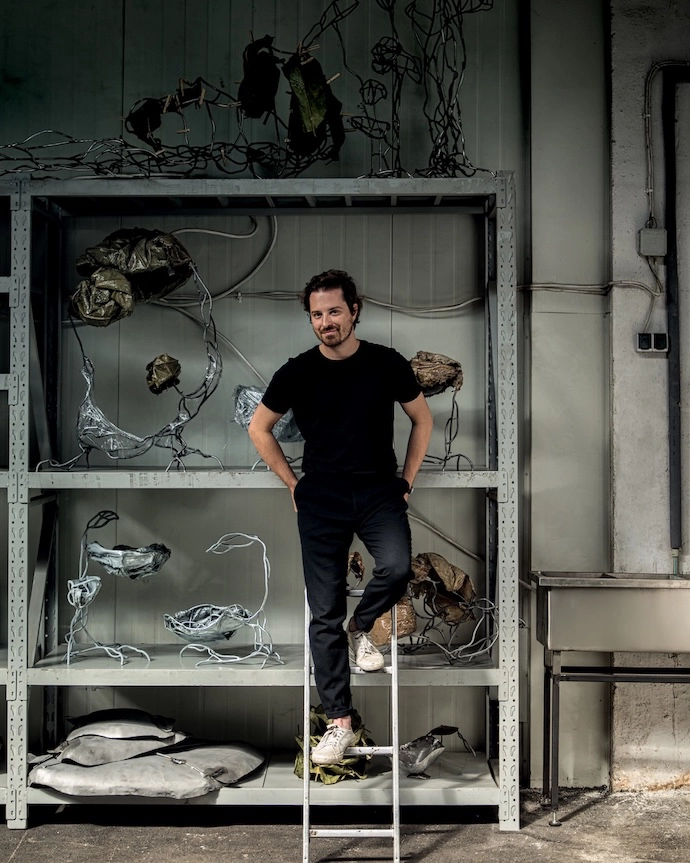
Marcin Rusak describes his Warsaw studio as a laboratory. -

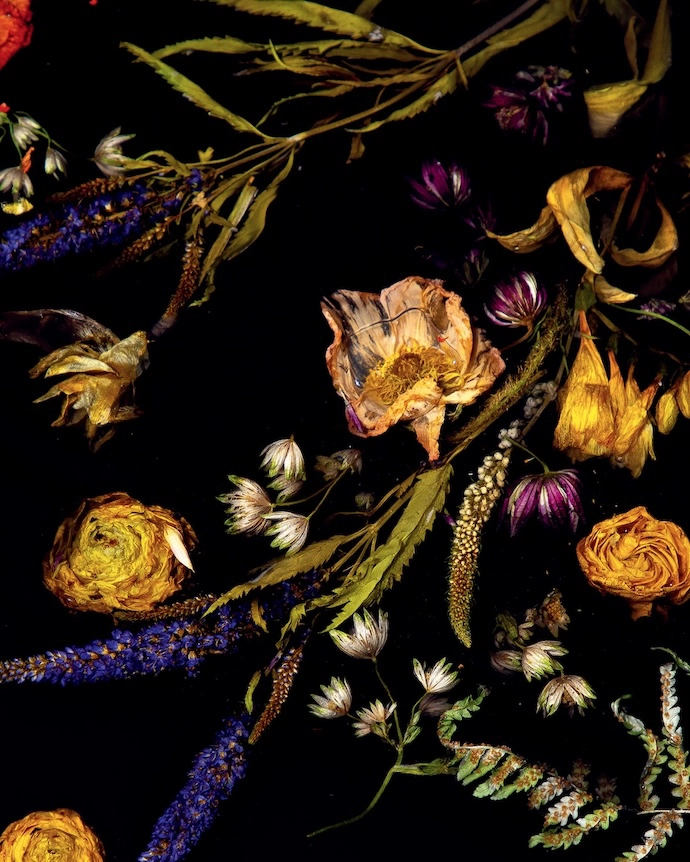
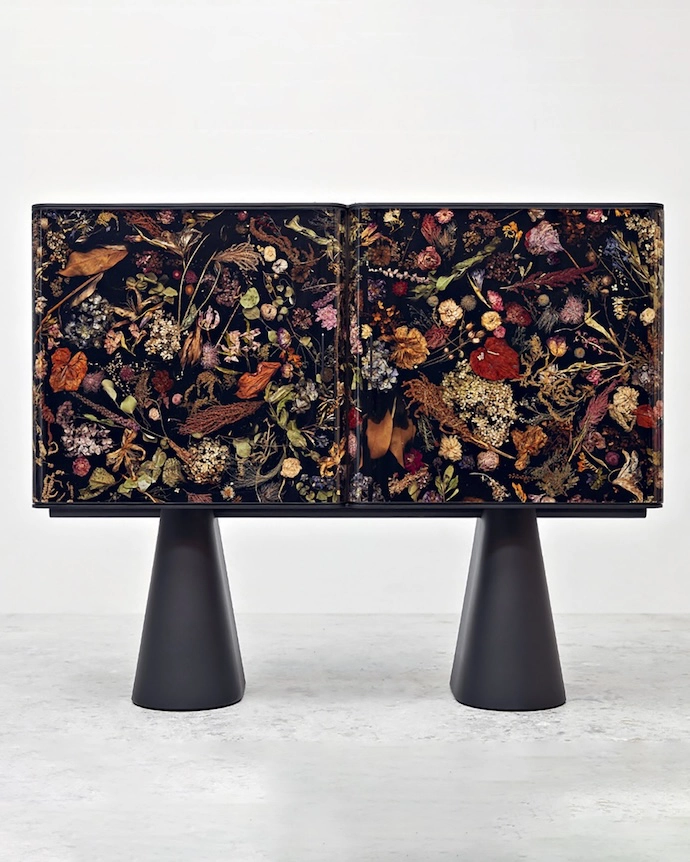
Floral waste is preserved in Flora, the first of several resin materials Marcin pioneered. -
Flora Cabinet 176 in Black. -
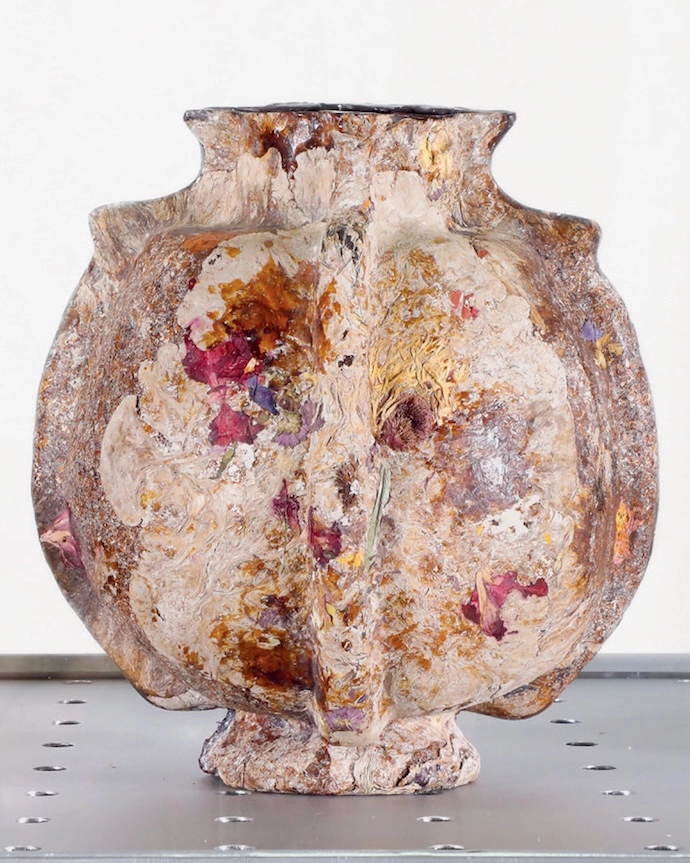
Made from biodegradable materials, this Nature of Things vessel will decompose with time. -
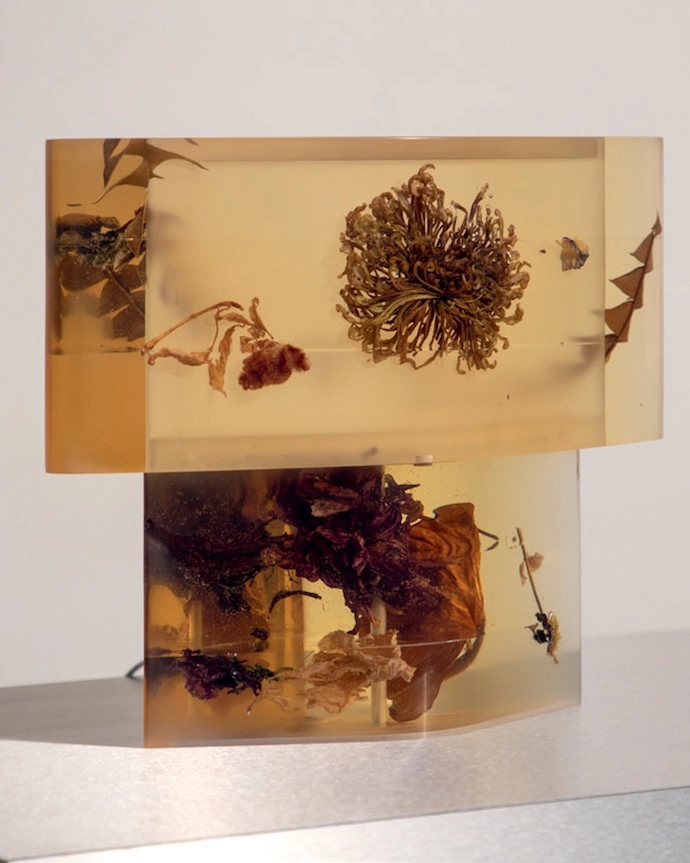
Marcin’s resins come in many colours, like this amber table lamp. -

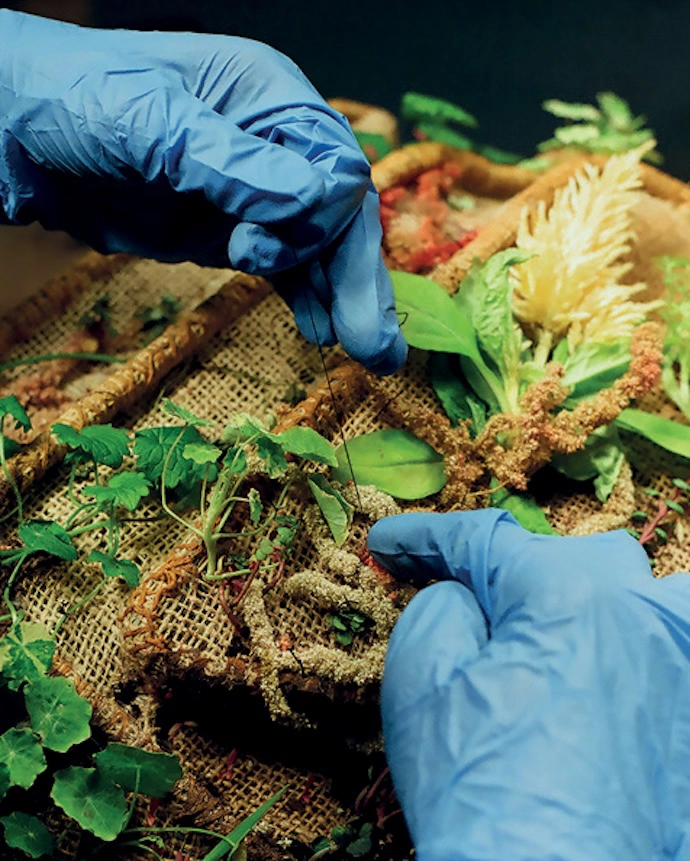
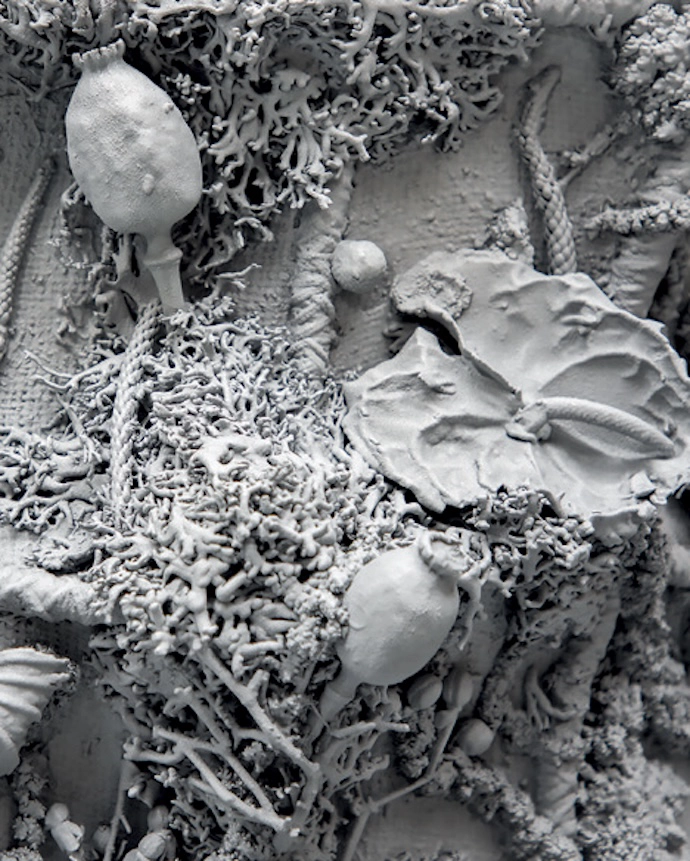
The plants grow on jute. -
Tephra’s metallising process preserves fine detail.
As part of our ongoing series spotlighting international design trailblazers, we explore Polish designer Marcin Rusak’s alchemical material processes, which transform floral waste into collectable works that interrogate preservation, value and consumption.
WORDS Martin Jacobs PHOTOS Mathij S Labadie, Marcin Rusak Studio, Kasia Bielska, Pion Studi
When last did you stop to consider a cut-flower bouquet – impulse-bought from a market, gift ed on an occasion, arranged at a wedding? We admire the easy hit of nature at home, the colour, occasionally the fragrance. But the engineering behind cut flowers – the genetic tweaks for scale and speed of transport, the straightened stems for easier shipping and arrangement in vases, the bolder blooms bred at the expense of scent – rarely crosses the mind. Like most things we live with, flowers have become just another consumable. Except in the hands of Marcin Rusak.
Given the Polish multidisciplinary designer’s lineage, you could argue this was inevitable: that cut flowers, in his hands, would come to carry the weight of consumption, commodification, time, preservation and decay. “When the family history of over a century of flower growers and botanists ended with my birth, I felt there was nothing of a grower in myself,” he says. “What I remember from growing up surrounded by abandoned glass houses is mostly their textured industrial materiality, and the presence of disappearance and decay at every step I took exploring.”
Those glass houses loom large for Marcin. Across interviews and features – from Cabana and Vogue Poland magazines to Financial Times and Dezeen – he returns to them obsessively: their shattered panes, broken glass and scrap metal; their scents of rust and rot. Former sites of cultivation and beauty turned feral, they became his playground – spaces where collecting, assembling and an early fascination with decay laid the formative groundwork for a practice centred on transformation.
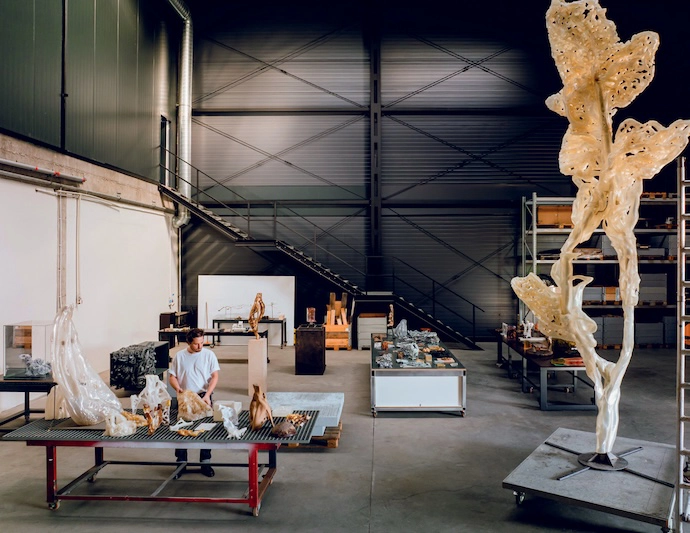
Born in Warsaw, where he lives and works today, and now in his late 30s, Marcin studied conceptual design at Design Academy Eindhoven before continuing his studies at London’s Royal College of Art. It was in London that a second pivotal encounter with flowers would reshape the trajectory of his practice. “I clearly remember the first time I thought of plants as a substance, a raw material,” he says. “It was at one of London’s flower markets that I realised the economics behind it, and the amount of waste it produces. There’s a common rule that what hasn’t sold in the first two days at the market has to be tossed. I’d collect the binned waste – wilted, fragrant, already in decline – and drag heavy garbage bags across the Underground to the eighth floor of the RCA in Kensington. The smell was unforgiving.”
Having explored the possibilities of resin as a material while at Design Academy Eindhoven, many years of experimentation followed – first in London and subsequently in his Polish studio (which he describes as a laboratory), working with discarded floral matter. In bringing these threads together, something akin to alchemy emerged: Flora, a material Marcin regards less as a product than as an ongoing process of transformation. “Flora is the result of years of research driven by my desire to capture and preserve the perishable beauty of flowers, which here float under the shiny surface of resin,” he explains.
“The process of creating each piece is very labour-intensive, as everything from collecting and processing the flowers to finishing the resin is done by hand. Each piece is composed like a painting – I choose flowers for their sculptural qualities, colour and symbolic significance. I make several compositions, and only when the effect is satisfactory do I translate them into the material.”
Much like Flora – available in a spectrum of coloured resins and floral compositions spanning themes such as baroque, tropical, classic and field, arranged either densely or with a more open spatial logic – subsequent materials extend the same inquiry under different conditions. Perma is machine-cut, revealing cross-sections of preserved fl owers, where petal forms and leaf flowers, where petal forms and leaf structures emerge within a more stone- like resin body. Glaes, by contrast, lends itself to solid, monolithic forms, its process deliberately producing light-catching fractures throughout the material, giving it an amber-like depth.
These materials extend the lifespan of what would otherwise be fleeting, and – due in part to their synthetic composition – are intended to endure for thousands of years. They take shape as credenzas and cabinets, tables, screens, lighting and sculptural objects that, while preserving floral waste, also prompt a reassessment of what we consider valuable, and how beauty is consumed and retained. Most are made to commission – an approach that itself resists excess production. Larger works are conceived as future heirlooms, developed in dialogue with each client, often incorporating floral matter that holds personal or emotional significance.
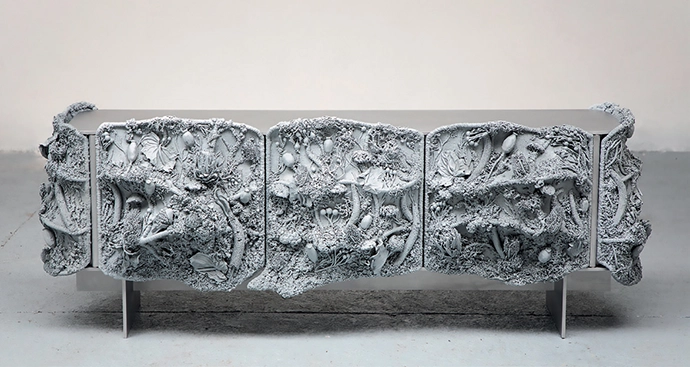
In parallel with his ongoing resin explorations, Marcin has, in recent years, turned to metal. His Tephra series takes its name from the geological term for fragments ejected during a volcanic eruption – a reference that nods to the works’ Pompeiian silhouettes. “These objects are built using specially treated flowers mounted on sculptural forms made of hand-welded steel wire and jute,” he says of the complex process, which allows plant growth to gradually envelop the structures. “They’re then metallised using a thermo-coating technique that covers the dense textures in a layer of molten metal.” Floral matter becomes ornamental within a restrained, monochrome palette. By contrast, in his Protoplasting Nature series, a similar thermo-coating process is applied to foliage rather than flowers, allowing organic growth to assume a more structural role in cabinets that reference 17th-century furniture typologies.
As much as Marcin’s materials and objects engage with preservation, they are equally concerned with decay. In his Nature of Things installations, vessels and domestic forms are composed from biodegradable materials, which include waste flowers, beeswax, sugar, sand and shellac, and are designed to decompose over time. These works embrace impermanence as both a process and an outcome. As Marcin says, “They provide a field for experimentation that takes as its starting point a critical commentary on the ideas of consumerism and planned obsolescence that contribute to the culture of waste.”
Marcin’s philosophical approach ultimately unsettles a broader cultural fixation on permanence. From his Warsaw studio – where, depending on the project, he collaborates with a team of up to 12 specialists with expertise in everything from artisanal production to digital modelling – he interrogates how beauty is consumed and how value is assigned. “Our desire to create, to make, to invent, is not something that we can – or should – suppress. It is fundamental,” he says. “But we can begin to question what needs to be preserved and what can be released. Loss, in this context, isn’t failure – it’s a recalibration. It reveals what matters. It invites reflection. It slows us down. It asks us to listen. What if loss was not an absence, but an alert system? A way of navigating? A reminder that our time with things – objects, people, places – is limited, and therefore precious?” | marcinrusak.com
Don’t forget to sign up to our weekly newsletter for the latest architecture and design news.