-

The crucible : Haemanthus coccineus flowered within one week of the fire. -
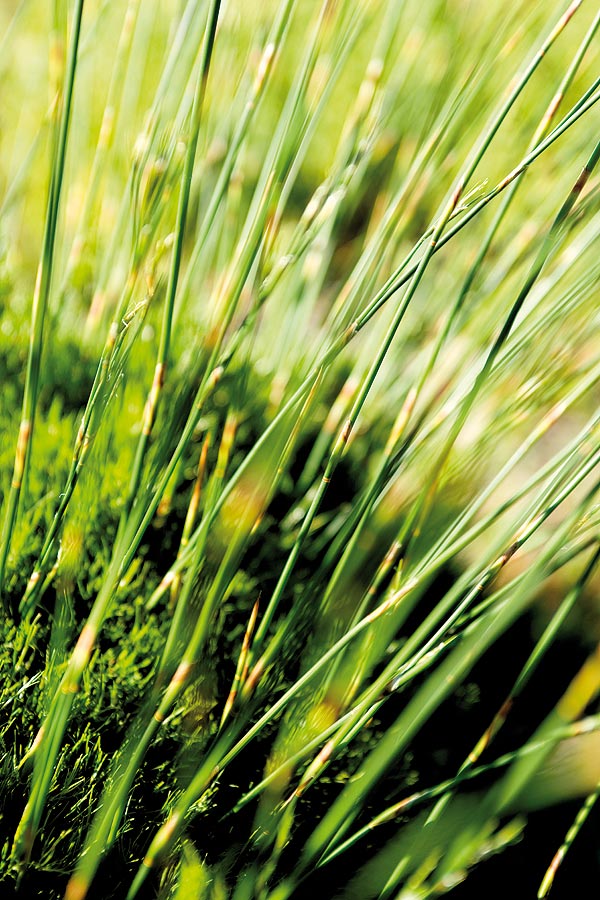
The crucible : Seas of the fine grass, Ehrharta villosa, were a feature of the spring landscape. -
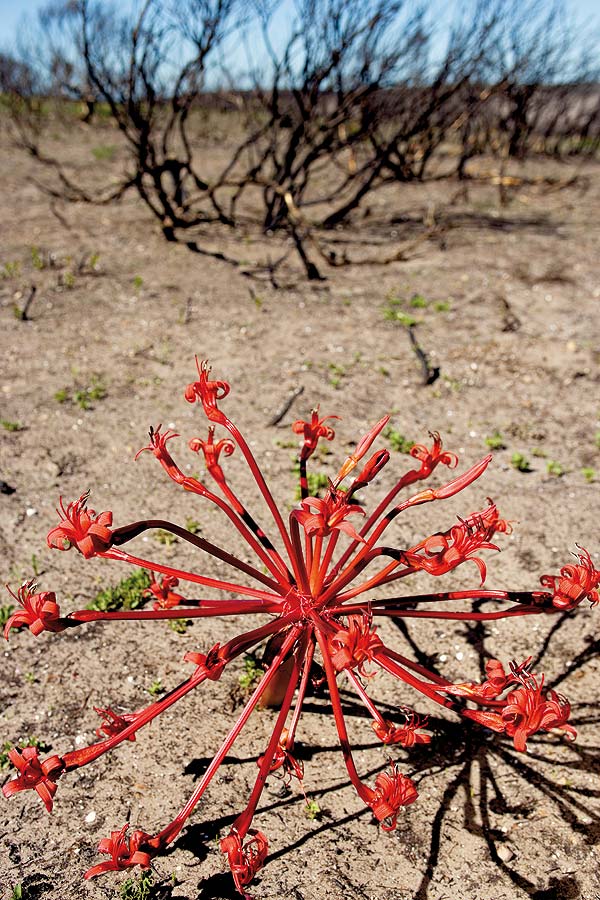
The crucible : Great starbursts of Brunsvigia orientalis appeared in March and April. -
The crucible : Many trees were killed in the fire but many also resprouted from the bases. -
The crucible : Festuca scabra, one the grasses that had flowered over much of the reserve by September.



PHOTOS: Adriaan Oosthuizen | WORDS: Dave Pepler
For veld and fynbos, fire is an enigmatic source of new life. A devastating blaze that swept through Grootbos Nature Reserve has triggered a near- miraculous renewal and reflowering.
‘The changing of bodies into light and light into bodies is very conformable to the course of nature; which seems delighted with transmutations.’
So wrote Sir Isaac Newton in his great scientific work, Opticks, in 1704. Transmutation and the so-called philosopher’s stone had fascinated alchemists of earlier times. For centuries they tried to produce gold from lead, light from darkness and elixirs for eternal youth and life. Their language was obscure and allegorical – either because they feared their precious recipes being stolen or, more probably, that their quackery would be exposed.
In 14th century China, Tisan T’uing Ch’l wrote, ‘One, we know that the white should hold firm to the black. For then divine light will come in due course. The white is the essence of gold and the black is the base of water. One is one in number. In the beginning Yin-Yang, quicksilver, is black with yellow shoots. The master of the five metals and the river chariot of the north.’ Then comes this enchanting line: ‘Hence lead is black on the outside but holds gold concealed in its bosom.’
Fynbos burns – in its pristine state, at 12- to 20-year intervals. However, in areas fragmented by humans, fires usually occur every 10 or fewer years. Patches of burnt veld form an interesting mosaic of texture and colour in landscapes, but when entire landscapes burn, lush hills are reduced to seas of ash scored with the blackened skeletons of dead vegetation. They look lifeless and alien.
Yet something miraculous takes place too. The whole system – plants, animals, soil – is galvanised into new life. The sudden and abundant supply of nutrients in mineral-rich ash quickens all the dormant growth.
And because fynbos has developed special defences against fire, it has stored away a great deal: humble ants, rewarded with nourishing secretions, have carried its seeds underground and far from flames; bulbs have slumbered for as long as 35 years with no sign of life; and leucadendrons and other proteas have locked their seeds into tight capsules, year after year, in the event of a fire. Afterwards, on blackened branches, those capsules unfold to shower rust-red-plumed seeds around the mother plant.
But the bulbs provide the most sublime display. Out of the ash bare, wax-coated stems with spoon-shaped tips emerge. No sign of a leaf. Then, at knee height, breathtaking flowers suddenly unfurl – Amaryllis, Brunsvigia, Haemanthus and Nerine.
Candelabra flower most striking
Of all these jewels Brunsvigia orientalis, the candelabra flower, is the most striking. It’s a red like no other, a perfect globe of flowers, flaming moons around a spherical umbel, with its anthers laden with deep-gold pollen that’s reflected in the petals’ crystalline gleam. A patch of Brunsvigia on an ash-covered slope is an image to dream of, or to recall when your legs can no longer take you into the veld.
The pioneering Swiss chemist Philippus Theophrastus Aureolus Bombastus von Hohenheim, better known as Paracelsus, believed all flammable material contained phlogiston, a colourless, odourless, weightless substance that’s released during combustion. Once burnt, it was ‘the true form, the secret of secrets’. So fire and ash are the true form, the secret, of fynbos. They’re the gold in its bosom.