-

Open Design Q&A: JoAnne Kowalski -

Open Design Q&A: JoAnne Kowalski -

Open Design Q&A: JoAnne Kowalski -

Open Design Q&A: JoAnne Kowalski -

Open Design Q&A: JoAnne Kowalski

INTERVIEWED BY Michaela Stehr
Copenhagen-based JoAnne Kowalski is a textile designer known for her experimentation with wearable technology. Don’t miss her Talk100 Session at Open Design Cape Town at the V&A Waterfront’s Watershed on 21 August 2015 at 1pm.
We got to ask her a few questions about the merging of art and electronics.
How did you get involved with textile design?
After completing a bachelor’s degree in design in France, I entered a masters programme in design, through which I had the opportunity to do an exchange trip. I went to The Swedish School of Textiles at the University of Borås. I had spent a lot of time writing about process, perception and transitions and needed to get my hands on something to apply this heavy thinking. Also, textiles were kind of new to me, so I wanted to position myself as a beginner. It is great for questioning, evaluating and learning.
You work a lot with electronics. How do you incorporate these two very different design styles?
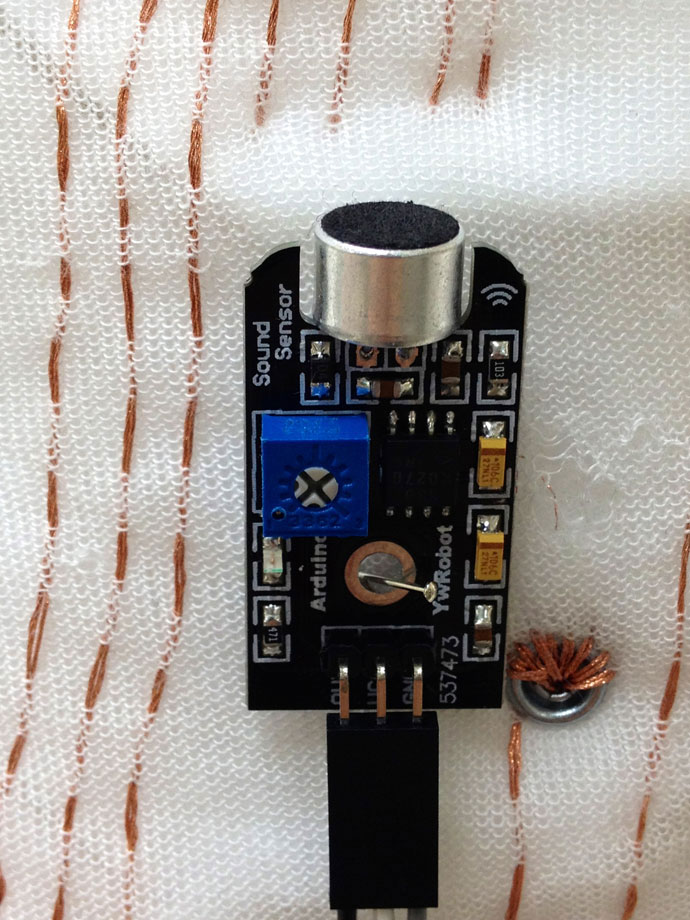
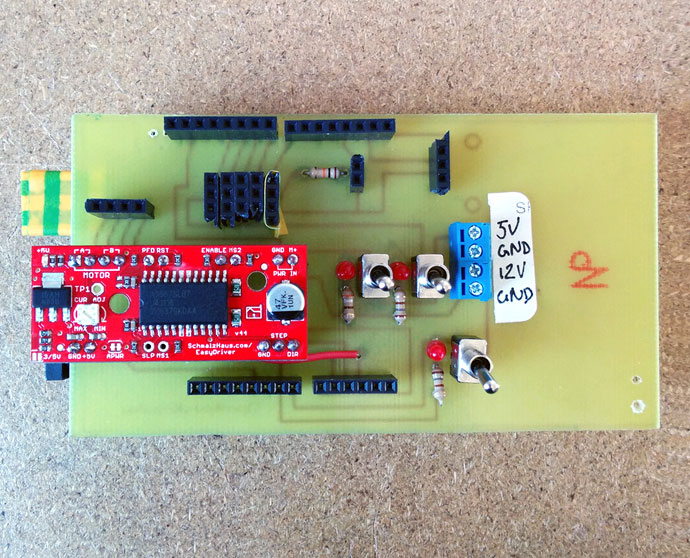
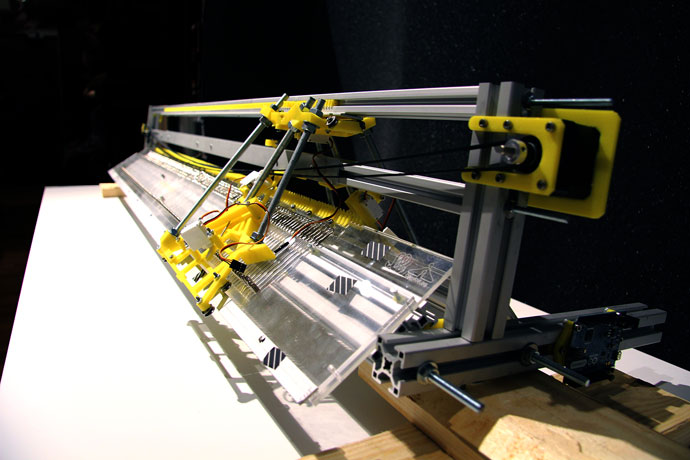
There is actually an emerging field of research and development focusing on textiles and electronics. There is this Sci-Fi futuristic aspect in electronics that is applied into textiles, making it a territory that is waiting to be discovered further. So far, I have focused on very simple, soft-circuit prototyping using micro controllers (electronic circuits made of textile materials), as well as knitting and experimenting with conductive materials. It’s rather abstract and technical so far. It takes time to get a feel for both textiles and electronics before anything actually works, not to mention that there is some coding knowledge you need to grasp as well. I have been testing a lot sensors (sound sensors, pressure sensors, light sensors) that give a very expressive dimension to pieces of traditional electronics.
What are some examples of wearable technology?
What we call wearable technology is actually soft-circuit prototyping onto a fabric or garment. A pair of glasses, or even a watch, are actually forms of wearable technology, something we easily forget about.
Some examples are: a cycling jacket equipped with LEDs embedded directly into the jacket, or a garment equipped with a data gathering sensor (temperature sensor, light sensor, GPS). I participated in a workshop where I could install a little circuit on my T-shirt that allowed me to plug my headphones in on one end and my music player on the other. I have also seen people installing batteries inside belts, so you can always charge your phone and have it with you, or even a drum set directly developed onto the body.
How do you see technology influencing design in the future?
My main concern for the future is that technology doesn’t replace, but rather continues to assist people on a human scale. A machine or a tool should be an extension of the body, rather than a replacement. The situation nowadays is very delicate.
Who are some design names that influence you in this particular field?
I am a big fan of designers in the Netherlands who work with electronics and digital mediums. They are quite advanced and are very flexible in their design thinking. They also work closely with other experts in related fields. Check out the work that Oscar Tomico from Eindhoven is blogging about – it’s a gold mine. I have a crush for the project TexTales by StudioToer, a storytelling system based on augmented reality, where you can scan a woven fabric with a tablet or a phone, and see digital versions of the characters of the story appearing.
Very few companies are focusing only on soft-circuits because it is a very young field, but wait for a couple of years and I am sure we will see some new and consistent work.
Technological design is about functionality. How do you bring visual appeal to these projects and do you find this challenging?
There are different ways: if you work with garments, you can work by customising a piece with a soft circuit or you can design the whole garment according to the actual circuit. More and more attractive electronic components and conductive textile materials are coming onto the market. They are actually quite beautiful – a micro controller no longer looks like an ugly brick with pins all over it. Now you can sew it and use embroidery connections instead of wires.
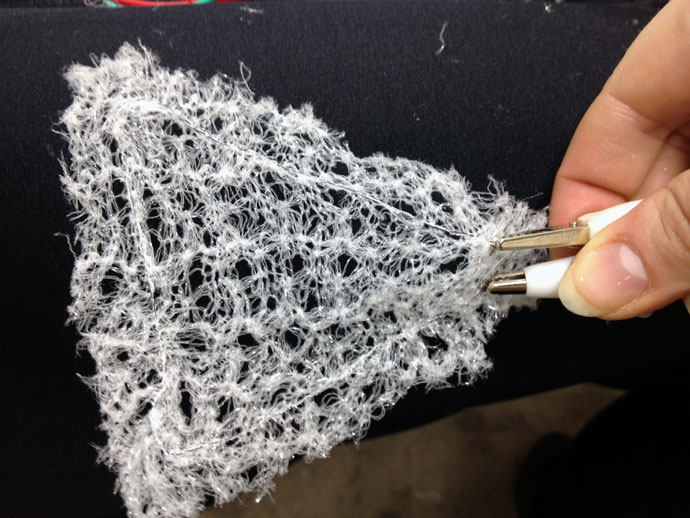
It is definitely challenging in the sense that it is not just about a garment or a piece of fabric, it is also about the circuit itself, so aesthetically, you have to marry textile techniques and electronic constraints to end up with something that does not look bad. Conductive textile materials are surprisingly beautiful: delicate, ultra-thin thread-knitted structures, shiny silver-coated conductive thread, cute little push-buttons, conductive satin ribbons… you can make amazing embroidery work that looks as fine and neat as traditional embroidery. Added to this the fact that you can use all kinds of textile-related things such as fasteners, buttons or zips – all of which are metal and therefore conductive, allowing you to make visually appealing and functional pieces of wearable technology.
To purchase tickets for JoAnne’s TALK100 session, click here.