-

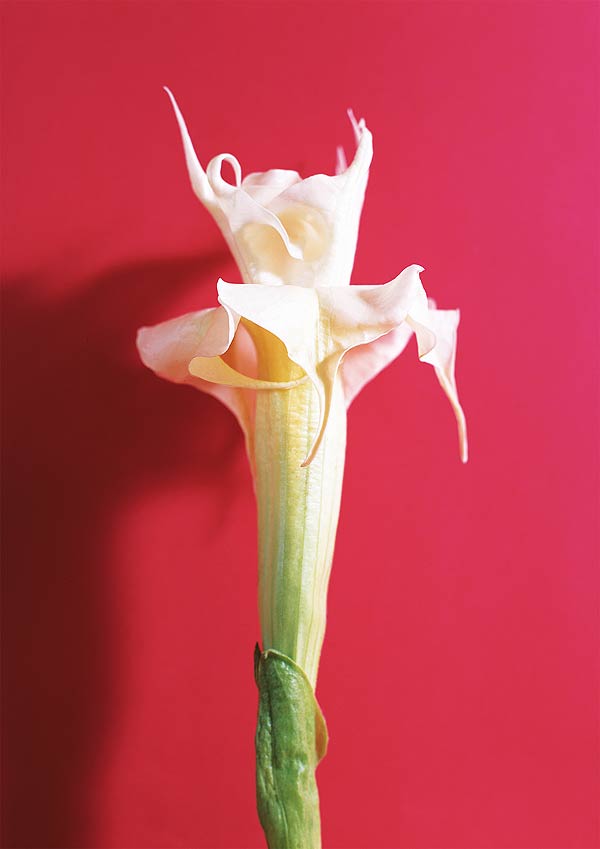
Sylphs of the night : A trumpet within a trumpet: the double forms of moonflowers are perhaps even more beautiful than the single blooms. -

Sylphs of the night : The moonflower structure is rather like an umbrella, with five or more delicate ribs that are wrapped in a spiral in bud, unfurling to release an exquisite perfume. -

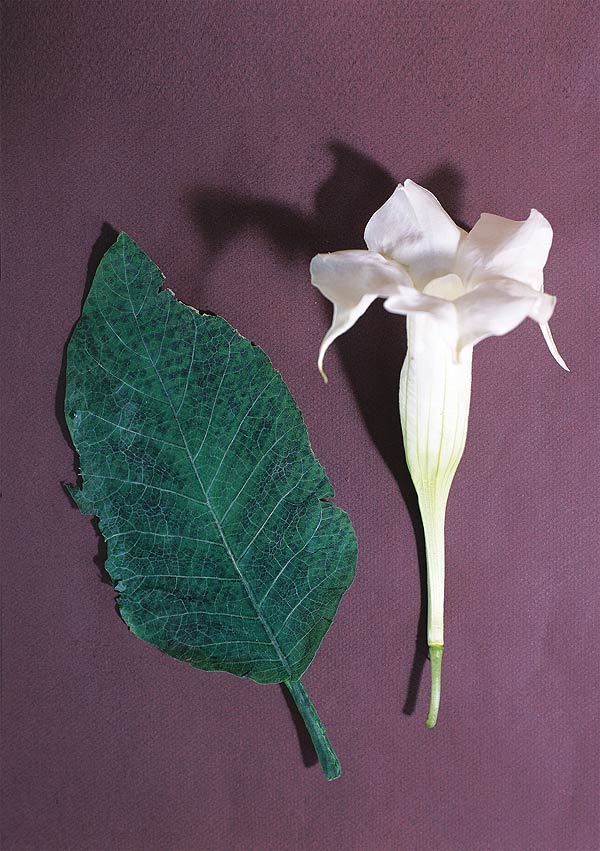
Sylphs of the night : The velvety leaves are a perfect foil for the translucent delicacy of the flower trumpets.

PHOTOS: Lien Botha | WORDS: Dave Pepler & Laurian Brown
Seductive moonflowers may release a heady, sweet perfume into the night air but be careful how far under their spell you fall, for their narcotic and toxic properties are legendary.
Kampala knows no seasons. Lying almost on the equator, the city is like an aquarium – dank, green and oppressive – because Lake Victoria will never allow you to forget her presence. The night air is charged, stifling and full of sounds.
A saffron yellow moon rises above the low hills to shine in at your window; a hawk moth taps against the mosquito gauze. You sleep fitfully. Finally, drenched with perspiration, you get up around midnight and go outside, down the street past the Stanley Hotel and into the city.
Here you need to tread carefully because manhole covers have been stolen, open drains cut across the pavements and there are virtually no streetlights. All around there are frogs calling, unfamiliar insects shrilling and marabou storks scuffling about in their untidy nests.
In the open darkness of a park you walk into a cloud of perfume, sweet, sweet, sweet, with the creamy undertone of clean skin after a bath, hanging in the air like a bank of mist. On the far side a wall of moonflowers gleams – sylphs of the night.
Only then do you realise that Kampala nights have always been perfumed with moonflower, and this is the most likely source of your tropical enchantment and unease.
Is there another plant that blossoms as frequently in art, music and literature?
Literary giants such as Faulkner, Theroux, Thoreau and Steinbeck have used moonflowers in their stories and novels. Léo Delibes’ Lakmé dies after eating moonflower leaves. Tori Amos composed ecstatic and hypnotic rhythms around the plant and, in modern music, especially in the dark sounds of the Goths, moonflowers feature again and again.
The finest work of that troubled Mexican angel, Carlos Castaneda, was written in the shade of the moonflower.
I can gaze for hours at the architecture of the trumpets. The curves of the edges are as delicate as the hem of an Erté dress, the colours ephemeral. Kampala’s blooms are all white, but nowadays there are cultivars of pink, yellow, mauve and even gold.
Garden flowers such as asters, roses and bougainvilleas have fixed colours, unchanging no matter the light. Moonflowers are opalescent because the trumpet is all structure, like a little Modernist building. The ribs are flying buttresses to hold the flower open, bringing the colour to life like a dragonfly’s wing.
Viewed from below it becomes a mandala, as in Georgia O’Keeffe’s Jimson Weed, painted in 1932.
Plant a pure white moonflower in your garden and wait for a perfectly still summer evening. Like a succubus, the trumpets, glowing like those pale Edwardian lamps of ribbed glass, will draw you closer.
The perfume of the flowers reaches you mixed with the rank smell of a crushed leaf. Ponder them late into the night – angel’s trumpets, devil’s trumpets, thorn apples – or malpitte (seeds of madness)?
Moonflowers, Daturas and Brugmansias
The Datura genus is probably native to the Americas, but a long history of medicinal and ritual use has led to its distribution and naturalisation worldwide. The genus embraces an uncertain number of species and originally included both declared weeds and prized garden plants.
All contain powerful tropane alkaloids, which makes them poisonous if eaten. These alkaloids imbue the plants with valuable medicinal properties and rather less useful, even fatal, hallucinogenic ones.
Legend has it that datura seeds or leaves were used by the priestesses of Ancient Greece to induce the trances and fits suggestive of divine power, and the list of more recent recorded fatalities and permanent derangements is a long one – hence the Afrikaans name, malpit. The alkaloids are, however, used commercially to beneficial effect in medications for asthma, Parkinson’s disease, in eye drops and various other external applications.
Most of the weedy species, such as Datura stramonium, are annuals that bear their flowers at various angles on the plant. The garden species and cultivars are tall, woody shrubs with soft velvety leaves and may grow into small trees in favourable positions.
Though often still referred to as Datura, these handsome plants have been reclassified as Brugmansia. Their graceful pendant trumpets, which may be up to 25 cm long, also distinguish them from the annual species.
Fragrance aside, these sumptuous curtains of flowers in white, cream, yellow, gold, apricot, pink and mauve lend brugmansias a gorgeous visual presence. Every garden should find a place for at least one. It’s merely a question of choosing the right colour to suit your style, because the form of this beautiful plant seems to work with all kinds of plantings in all kinds of settings – indigenous, formal, cottage, and tropical, of course.
Most brugmansias available from nurseries are variants of Brugmansia candida. The double white is breathtakingly elegant as well as superbly fragrant. Golden apricot ‘Grand Marnier’ is a dazzling tour de force, while the pink and salmon varieties offer a more delicate enchantment. B. sanguinea is a species with more tubular, red or orange flowers lit with yellow – another tropical whimsy.
Growing moonflowers
• Moonflowers are extremely easy to grow, provided they can be protected from frost and wind.
• All you need is a semi-hardwood heel cutting or a hardwood cutting, best taken in late summer or autumn. Once the cuttings have rooted, plant them out in plenty of compost and water them regularly and well.
• Be sure to plant them where you can enjoy the fragrance of an evening.
• Plants usually grow to 3 m, or to 5 m in favourable conditions, with a spread of 1,5 m-2 m.
• They respond well to cutting back but probably the best procedure is to prune regularly to shape them. Care must be taken to maintain an attractive branch pattern for the plant to look its opulent best.
• Moonflowers also make excellent pot subjects for patios and courtyards but beware of hot dry situations against walls, where they could be prone to red spider mite.