PHOTOS: Greg Cox | PRODUCTION: Etienne Hanekom | WORDS: Alma Viviers
With “artisanal” set to be one of the buzzwords of 2011, VISI spoke to Cape Town carpenter Mario Dieckow.
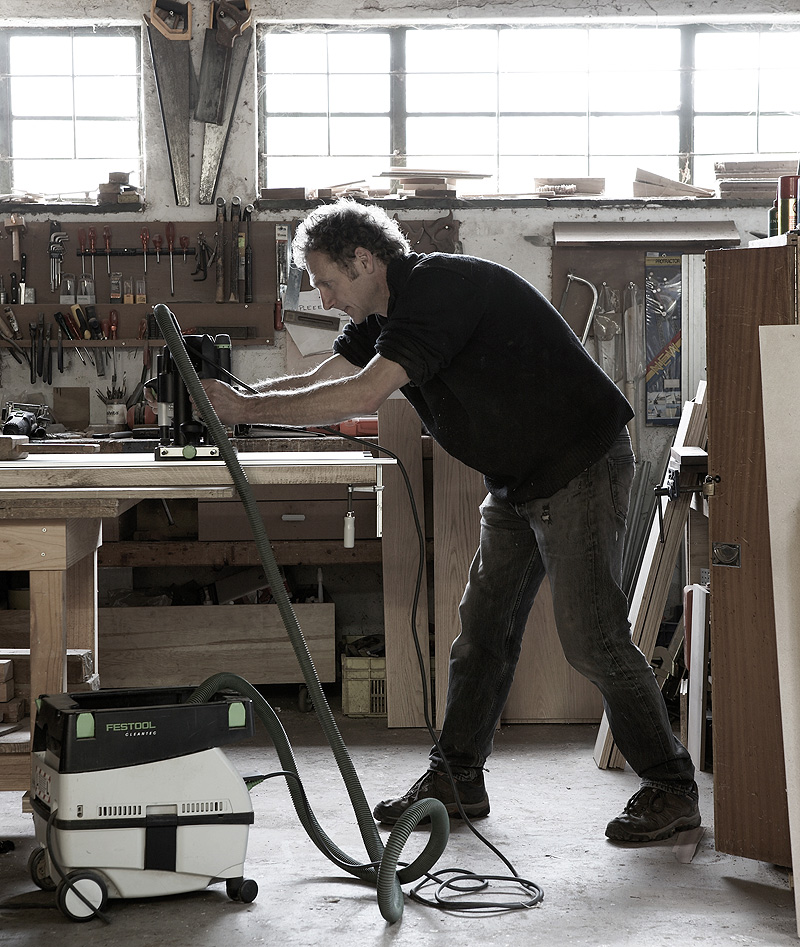
Mario is working on a three-metre-high door when I enter the old farm shed in Noordhoek, Cape Town, that serves as his workshop.
The shed is piled high with planks and the smell of wood is intoxicating. His door is made from wenge, an indigenous African wood, and is part of a large order for a luxury resort in Ghana.
We talk wood: “I generally use wood imported from mostly North America, Canada, and Europe,” he explains. “South Africa does not have the commercial forests for growing good hardwood. Most plantations consist of blue gum or pine and natural forests have been almost completely depleted.”
Lasting design
I ask him about the question of sustainability and Mario confesses that it’s a difficult issue.
“You have to check the source of your wood, and you can recommend an alternative if your client wants a specifically rare wood,” he says. “But my philosophy is to make something that lasts with as little waste as possible – people have been using wood for millennia, and if a piece is made properly, the wood can far outlast the maker.”
He believes the mass-production of cheap wooden furniture is more to blame for the over-consumption of wood than artisanal producers. Wood is cut down too young or not properly dried before use, resulting in inferior furniture that warps and lasts only for a season or two.
“Wood is a ‘living’ material that needs to breathe. It can absorb moisture, and it expands and shrinks,” he says. “You have to consider these properties when you design and make a piece.”
Mario did a carpentry apprenticeship in Germany, and first travelled to South Africa to do an interior fitting for a boat. While here, he got hooked on surfing and decided to set up shop in Noordhoek. Today he runs a successful workshop and has recently completed commissions for the new Tokara Olive Shed and four of the stadiums built for the 2010 FIFA World Cup.
Training tradition
We take a coffee break at the nearby Foodbarn Deli and run into Tim Wolf, another carpenter. “Tim is also from Germany,” explains Mario. “He was what is known as a journeyman.”
He explains that in Germany, trades like carpentry are governed by guilds and steeped in a training tradition where skills are passed down from a master craftsman to an apprentice. When an apprentice completes his training, he can choose to travel for three years to see what he can do with his learned trade. Only after this period as a journeyman can he submit a work to the guild and, if it’s accepted, qualify as a master craftsman. Even today, only master craftsmen may own an independent workshop under the guild.
“This tradition ensures the quality of work,” he says. “Here in South Africa there is very little training for carpenters, and courses are very basic.” Technology is also impacting on the loss of craft skills, with Computer Numerical Control (CNC) and Computer Aided Manufacture (CAM) making it easier for untrained carpenters to produce pieces.
“It is a tricky thing,” says Mario. “There are lots of advancements, and they are not necessarily a bad thing. But it means that younger guys can make things in only one way, and what gets lost is the evidence that a person actually worked on a piece.”
And there’s the rub: it is the knowledge, time and patience of the craftsman that ultimately imbue handmade, artisanal goods with value.
• Mario Dieckow: 021 789 1520, 076 169 2900