-

International Year of Chemistry : Substance: Antoine-Laurent Lavoisier is one of the best known French scientists. He developed theories of combustion, and developed a new system of chemical nomenclature and published the first modern textbook of chemistry. -
International Year of Chemistry : Emission: Marie SkÅ‚odowska Curie was a Polish-born French physicist and chemist famous for her pioneering work on radioactivity. She was the first person honored with two Nobel Prizes – in physics and chemistry. -
International Year of Chemistry : Elements: Dmitri Ivanovich Mendeleev was a Russian chemist and inventor. He made a number of important contributions but is famously credited as being the creator of the first version of the periodic table of elements. -
International Year of Chemistry : Atomise: John Dalton was an English chemist and physicist, a professor of mathematics and natural philosophy. He developed atomic theory. He produced the first table of atomic weights was colourblind and mostly self-taught. -
International Year of Chemistry : Atom: Ernest Rutherford, 1st Baron Rutherford of Nelson OM, FRS was a New Zealand-born British chemist and physicist who became known as the father of nuclear physics. -
International Year of Chemistry : Revolution: Graphene is an allotrope of carbon, whose structure is one-atom-thick planar sheets of sp2-bonded carbon atoms that are densely packed in a honeycomb crystal lattice. -
International Year of Chemistry : H2O: Henry Cavendish FRS was a British scientist noted for his discovery of hydrogen or what he called "inflammable air". He described the density of inflammable air, which formed water on combustion, in a 1766 paper "On Factitious Airs". -
International Year of Chemistry : Stricking: A fullerene is any molecule composed entirely of carbon, in the form of a hollow sphere, ellipsoid, or tube. Spherical fullerenes are called buckyballs, and resemble the balls used in football. -
International Year of Chemistry : Matter: Albert Einstein was a German theoretical physicist and chemist. Einstein's most famous discovery was the theory of general relativity. Einstein’s 3rd paper on Brownian Motion confirmed the atomic theory of matter. -
International Year of Chemistry : Ions: Lorenzo Romano Amedeo Carlo Avogadro di Quaregna e di Cerreto is most noted for his contributions to molecular theory, including what is known as Avogadro's law.
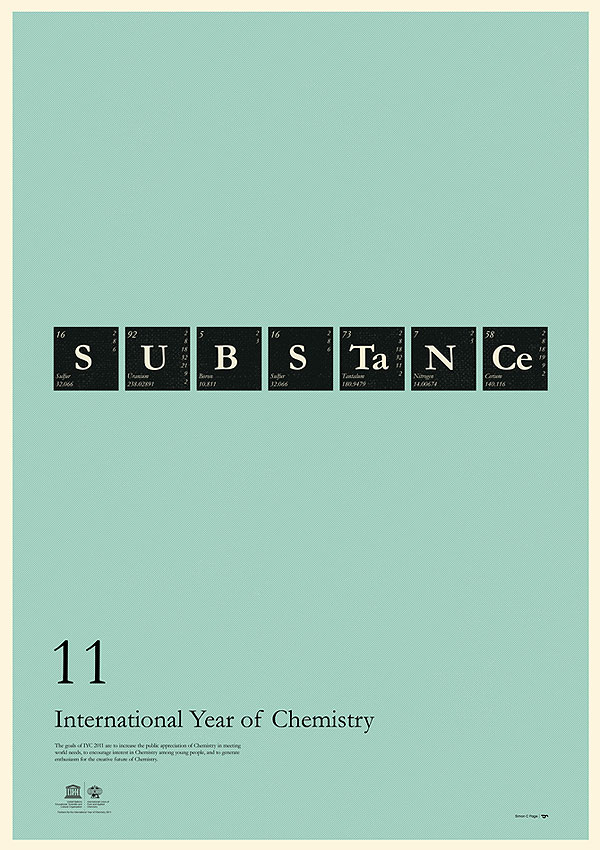


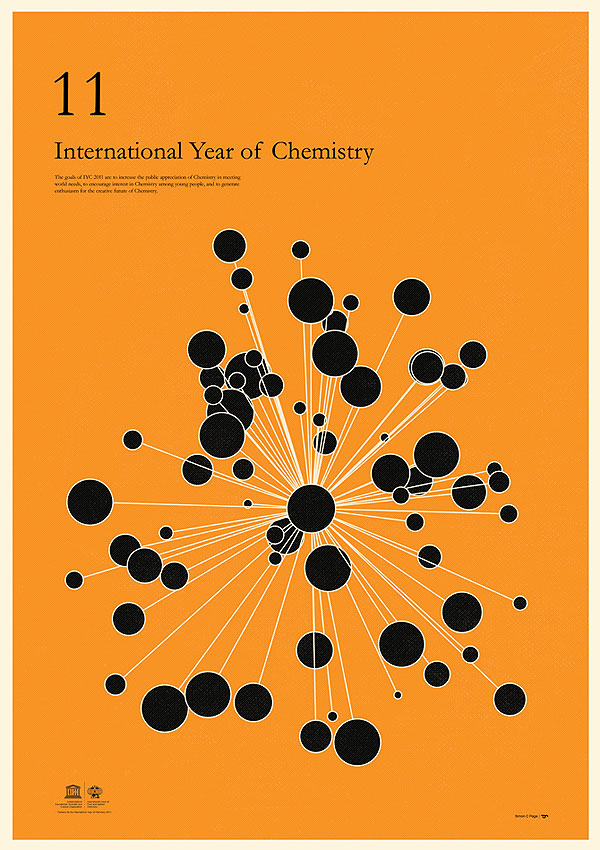

Did you know 2011 is the International Year of Chemistry? We didn’t either… but we were mightily impressed by graphic designer Simon C. Page’s gorgeous prints promoting the initiative.
At the end of 2009 Page executed some prints for the International Year of Astronomy which, unexpectedly, were a massive hit and really helped promote the campaign.
Now in 2011 it is the turn of the International Year of Chemistry (IYC). The goals of IYC are to increase the public appreciation of Chemistry in meeting world needs, to encourage interest in Chemistry among young people, and to generate enthusiasm for the creative future of Chemistry.
The year 2011 will coincide with the 100th anniversary of the Nobel Prize awarded to Madame Marie Curie – an opportunity to celebrate the contributions of women to science. The year will also be the 100th anniversary of the founding of the International Association of Chemical Societies, providing a chance to highlight the benefits of international scientific collaboration.
Simon designed a stack of prints with the help of scientist Noam Prywes. Each print is inspired by a famous chemist or discovery. The prints are available for purchase, and are guaranteed to make you appear smarter if you hang them on your wall. Buddy Holly spectacles and lab coat optional…
More information: http://excites.co.uk/