-

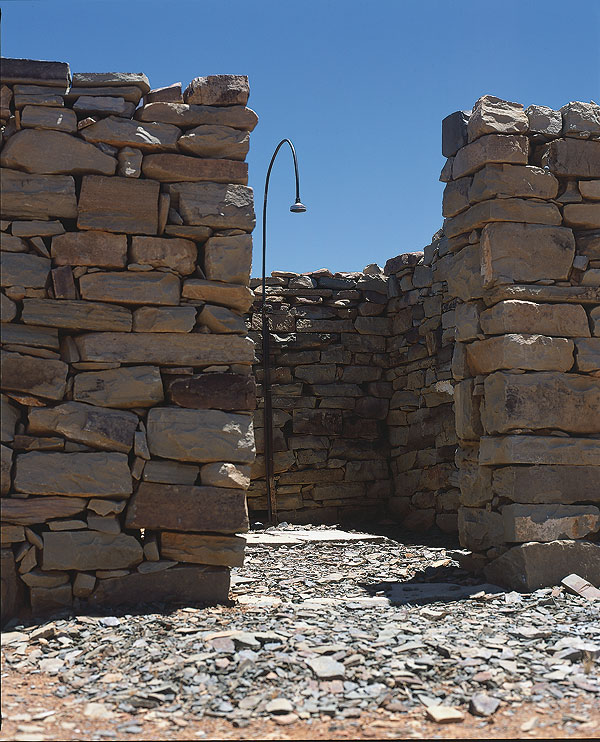
In the Great Karoo : The outdoor shower's walls are built of packed stones collected from a dry riverbed about 500 metres from the house. A windmill supplies the water via a storage tank. -

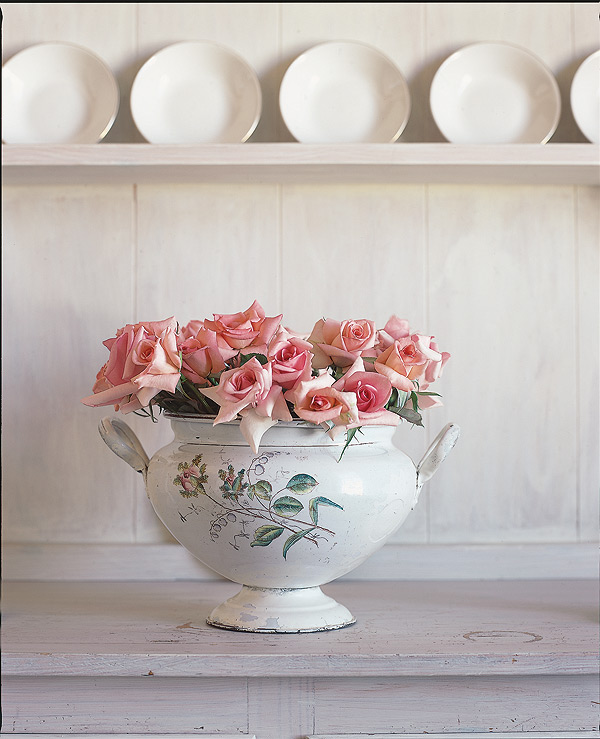
In the Great Karoo : Ouma Lettie's enamel soup tureen is filled with fragrant roses from neighbouring Bethlehem. -

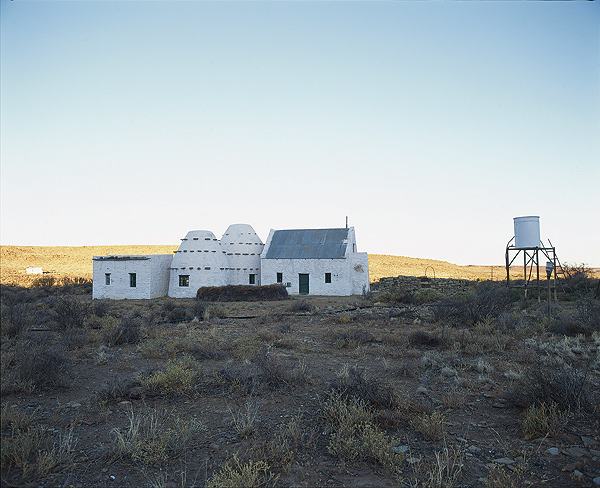
In the Great Karoo : Late afternoon at Stuurmansfontein, with its corbels in the centre and later additions to the sides. -

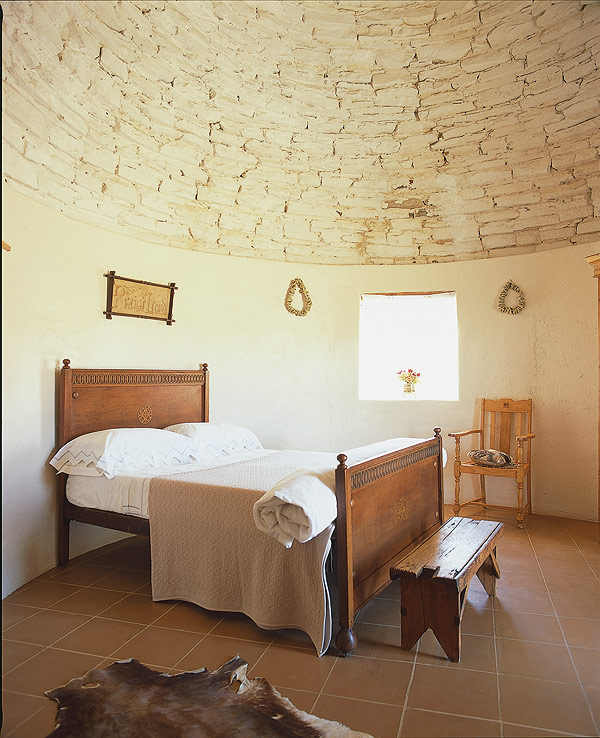
In the Great Karoo : The main bedroom's furnishings are a tranquil mix of heirlooms and odds and ends; a yellowwood bench; a springbok hide on the floor; and wreaths of dried flowers on the whitewashed wall. The deep wedge-shaped window is typical of corbelled buildings. -
In the Great Karoo : More than 200-million years after the dinosaurs, you still sense their presence here. -

In the Great Karoo : An old sideboard is rendered picture-book pretty by owner Charmaine Botha. -

In the Great Karoo : A compact view of the house in its vast setting. -
In the Great Karoo : The classic Welcome Dover coal stove is still in use. -

In the Great Karoo : The corbelled structures, built entirely of stone, with their jutting scaffolding stones. -

In the Great Karoo : Outer stairs lead to the loft, a later addition to the house, where Fanie Bergh stored his fruit - and where his ghost is said to tramp around. -
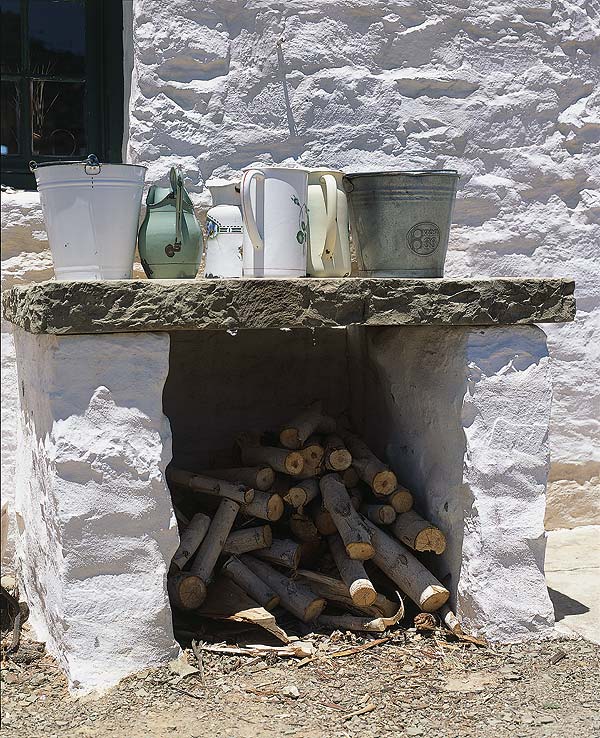
In the Great Karoo : Ouma Lettie's washstand jugs and buckets on an outdoor sandstone worktop. -
In the Great Karoo : The main bedroom's corbelled ceiling with its central keystone.



PHOTOS & PRODUCTION: Lien Botha | WORDS: Raymond Smith
In the dim coolness of this corbelled house, the calls and commitments of the 21st century fade into unreality. The world has passed Stuurmansfontein by. And that’s a good thing.
The road to this unique Karoo farm is a long one. From the N1 you take the R353 to Fraserburg, then on to Loxton on a gravel road where there are few fellow travellers. In Loxton, Gert Spies of Spies Products can bring you up to date on everything that’s happened here over the past 30 years, but don’t linger too long because you still have a long way to go.
Stock up on provisions at Carnarvon: from there on in it’s lone-ranger country as far as the eye can see – and further. Another 30km on, between Carnarvon and Williston (beyond the three rondavels at the railway siding), turn right onto another gravel road. Wind along with it for about 27km, pass an oasis called Bethlehem, and continue through two sheep gates.
Drive on … until you suddenly see a corbelled dome rising out of the flats, as surreal as the mosque in Larabanga.
You’re probably arriving at Stuurmansfontein about 200 years after the nomadic trekboer who grazed his cattle here and erected this little house in this vast landscape. It’s now a national monument and guesthouse.
Enter the house enchanted to find smiling San descendents, Eva Olyn and Pokkie Malan, arranging fresh roses in copper vases. Inside it’s cool and quiet, with a feeling of long ago – as if present owners Piet and Charmaine Botha’s forefathers might suddenly appear for lunch.
You may also hear the ghost of the last tenant, Fanie Bergh, who lived here in the 1960s, moving about in the loft above the dining room. That’s where he stored all sorts of fruit, from grapes to pomegranates, so that they could be enjoyed long after their season – even if many of them had shrivelled to raisins.
The dining room, a later addition to the house, has high wooden ceilings. It’s where Piet’s ouma’s soup tureen, filled with roses, takes centre stage on a white sideboard.
Live harmoniously with nature
To the left of the dining room is a bedroom with an old-fashioned bedstead, a washstand and a wardrobe. The oak smells of wax polish and the linen is crisp and snowy white.
To the right of the dining room is the spacious corbelled sitting room. The thick walls are raised in concentric circles that come together at a keystone in the centre of the roof. At that point, the room is about two metres high.
Despite Stuurmansfontein’s remoteness, Charmaine has succeeded in making the old house beautiful. Using ‘Ouma Lettie’s things and whatever was to hand’ she’s created a shabby-chic interior of simple charm: the scythe and fork hanging in the sitting room were once used to harvest corn; of the two wall cupboards, one held medicines and the other the family Bible; on the windowsill, light shines through a collection of old glass bottles found on the farm; and the books on the trunk are for bird- and wildflower identification.
Piet believes people should live harmoniously with nature, explaining that the plant life here is perfectly adapted to its extreme climate provided it’s not overgrazed. Because when that happens characteristic Karoo herbs such as klappiesbrak, koggelmandervoet, daggapitkaroo and akkedisstert vanish to be replaced by vast tracts of thorn bushes.
Duck when you walk into the last room, the main bedroom, through the yellowwood doorframe. This room’s a smaller corbel than the other but the roof and walls are limewashed to introduce extra light. A black sheepskin warms the alcove and a crocheted curtain flutters in the window.
Place of the past
Next to the dining room is the kitchen with its classic Welcome Dover stove. (But forget about cooking for yourself: no-one can prepare a more tender leg of lamb than Charmaine!) From the kitchen door, look southwest towards the foot of the koppies. There you’ll see the stone shower and the Karoo asbosskerm shelter in which to braai or bake your own pot bread over an open fire.
With luck you’ll also see a flock of swallows whose neat nests of mud are built against an outbuilding that houses a flush toilet – one of two modern facilities on the farm, the other being a gas-run fridge.
As the hot day starts to mellow and the sun goes down, take a seat on the stoep. To the north you’ll see a koppie and a dry riverbed from where the house’s flat-stone bricks were probably collected. A little later, Canopus will appear in the southeastern sky to find you still sitting there, thinking of Fanie Bergh, the wandering !Xam and the lonely trekboers.
Much later than that even, you’ll find your way to bed by the flickering light of a candle and fall asleep with doors and windows wide open, blissfully at peace in a place of the past.
• Charmaine Botha: 053 382 5900, stuurmansfontein@telkomsa.net