-

Crate Man : Serge Alain Nitegeka, the artist behind the installation on the cover of VISI 57. -

Crate Man : Serge Alain Nitegeka, the artist behind the installation on the cover of VISI 57.
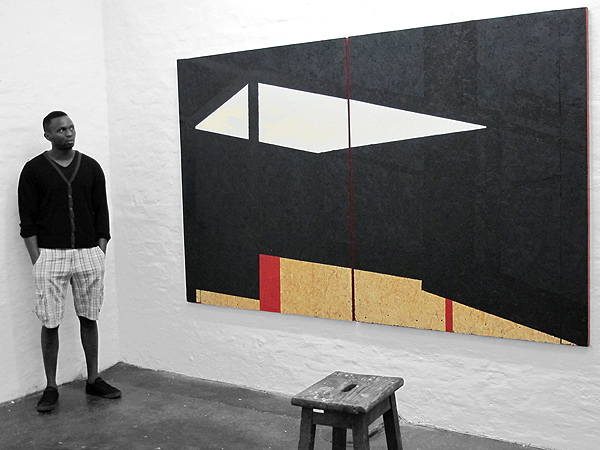
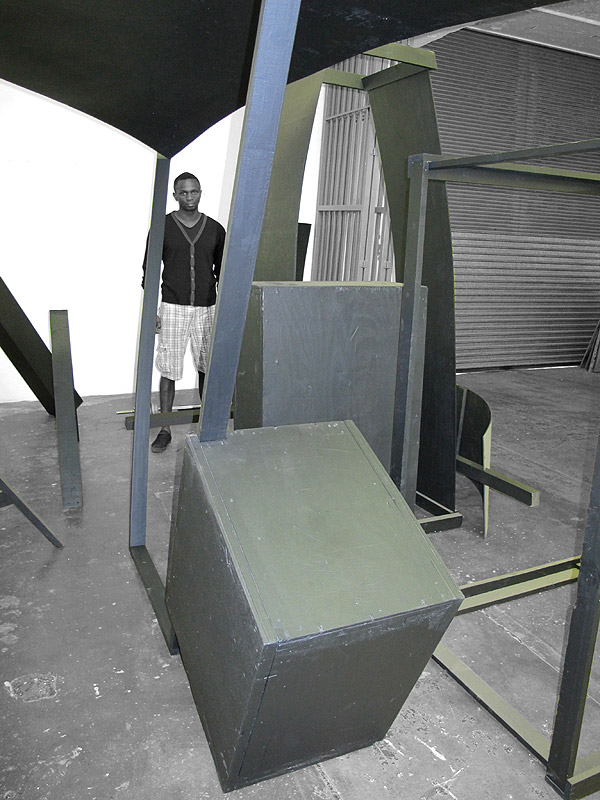
WORDS & PHOTO: Jacquie Myburgh Chemaly
The cover of VISI 57, on shelf during October and November 2011, carries a mysterious image of blackened wood, broken crates and designer Ercol chairs from Tonic. VISI spoke to Serge Alain Nitegeka, the artist behind the installation.
Your name doesn’t sound South African?
I’m from Burundi. I left that country as a refugee, with my family, at age 11 but it took me 13 years to find my way to South Africa. I was at high school in Kenya when I first learnt about Picasso and cubism and at the same time developed a desire to design things.
Tell us about your path to becoming an artist?
The first thing I designed was a car that could fly. It really could fly. So initially I planned to study aeronautical engineering. Fortunately art found me instead and I came to Johannesburg where I studied fine art at Wits. I now design, create and document installations made from crate wood. I’ve lived in Johannesburg for nine years and am now engaged to a fellow artist, Ansie Greyling.
What inspires your work?
My art tells a personal story, of being a refugee. I’m inspired by the concepts of site specificity as well as liminality – that which lies in-between. In my case, liminality refers to uncategorised people such as refugees and asylum seekers and that transitional period when they find themselves between two countries and two identities.
How do you work?
I’ve chosen cargo crates as a medium to tell this story. How refugees carry their possessions is a tangible representation of those things that we carry with us when we move. Once I have built an installation using pieces of crate wood, I paint it black with roof paint to look like charcoal. Next I document different angles of the structure with charcoal and paint drawings on pieces of crate wood. When I feel a sculpture has been adequately documented, I take it down.
What are you working on at the moment?
I’ve just completed this piece called “fragile cargo 2” for the Slow Lounge at OR Tambo International. The piece of bent wood inside the structure of sharp pieces of timber represents the fragile memories that calm us when we find ourselves in a foreign place.
And the cover image on VISI 57?
This installation is still up in my studio in Braamfontein; I’m still working on it. For the Tonic issue of VISI, I was asked to work with pieces of Ercol furniture within my art. It was difficult because there’s too much in this sculpture already and I walked around the pieces for days before I worked out what I wanted to do. I believe strongly in reducing the surplus in life – less is certainly more.
Serge is represented by the Stevenson Gallery in South Africa and is currently working on an exhibition in 2012.
More information: www.stevenson.info/artists/nitegeka.html
VISI 57, our Hidden Issue, explores spaces that have never been published before and reveal the secret collections of some of South Africa’s most interesting creatives. The issue is on sale now.