-

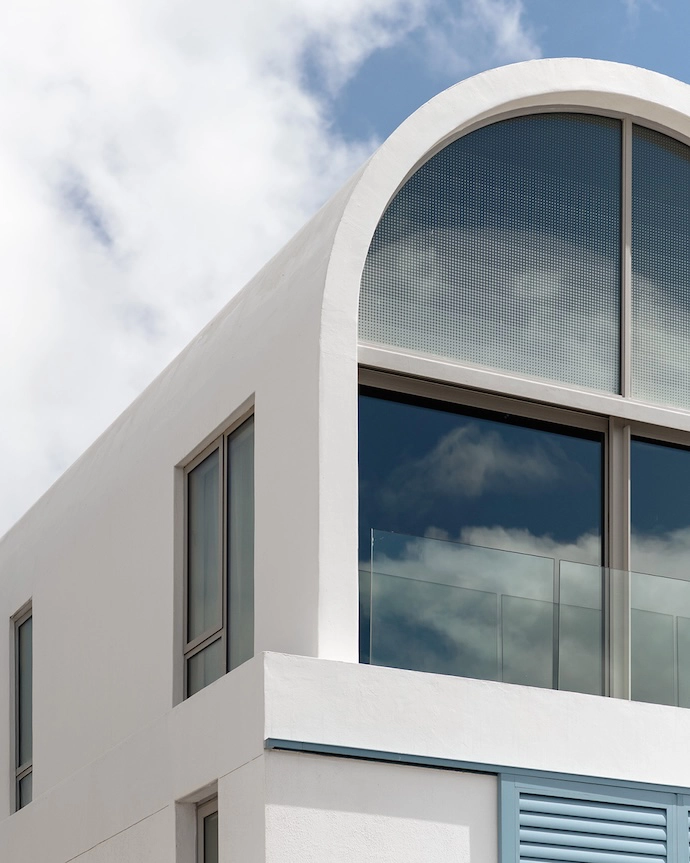
Characterised by two barrel vaults, this striking beach residence pays homage to the architecture of a limewashed chapel in Onrus. The stools are by NØDE. -
The sheltered, spartan balcony. -
Although a busy road separates the house and the beach, the arches’ placement ensures it’s invisible from inside. -
The juxtaposition of curves and right angles is consistent inside and out. -
Thoughtful lighting casts the home’s stonemasonry in sharp relief. -
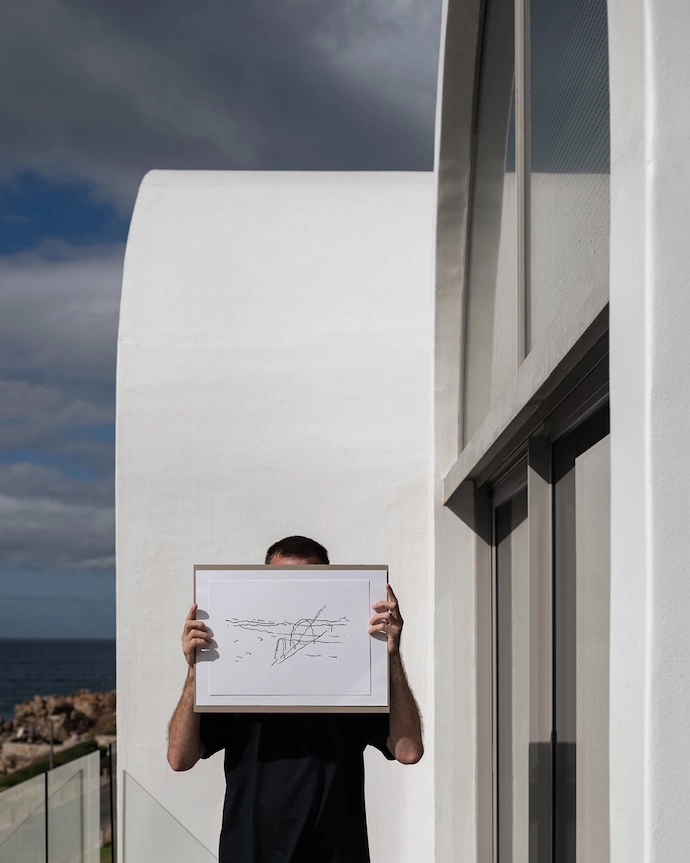
Art imitating life in a drawing by architect Lorenzo Nassimbeni. -
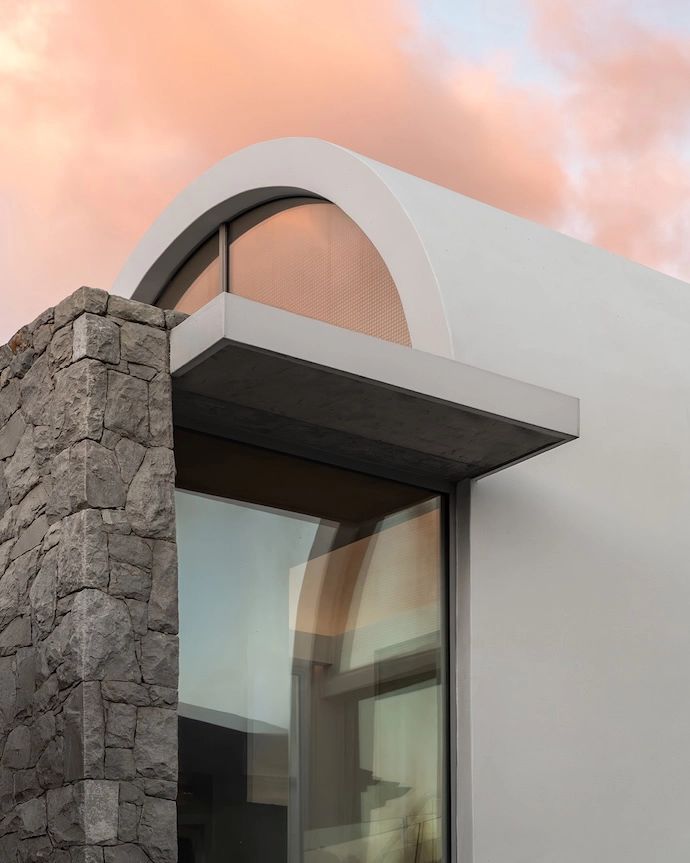
Half-circular windows become their own design feature. -
Walls are clad in locally quarried stone. -
The arched windows feature a ceramic-printed design that cuts 50% of the glare in the mornings. -
St Luke’s Greek Orthodox Chapel by Jack van Rensburg is the clear inspiration behind architect Jankel Nieuwoudt’s design. -
The elemental geometry of the exterior calls for minimal adornment, such as these folding chairs and stool by NØDE. -

Also designed by Jankel, the interior architecture has a timeless anonymity, decorated here with nesting tables, a studio wall light, a coffee table and trays by NØDE, a sculpture by Reticence Studio, and artwork by Tusevo Landu. -
The lounge overlooks the busy Onrus Beach. -

Despite 4m-high vaults, the kitchen feels cosy and intimate, thanks to a bulkhead ceiling, considered lighting, and curated furniture and accessories. -
By day, the open-plan kitchen is illuminated by sunlight filtered through a ceramic-printed arch window. -
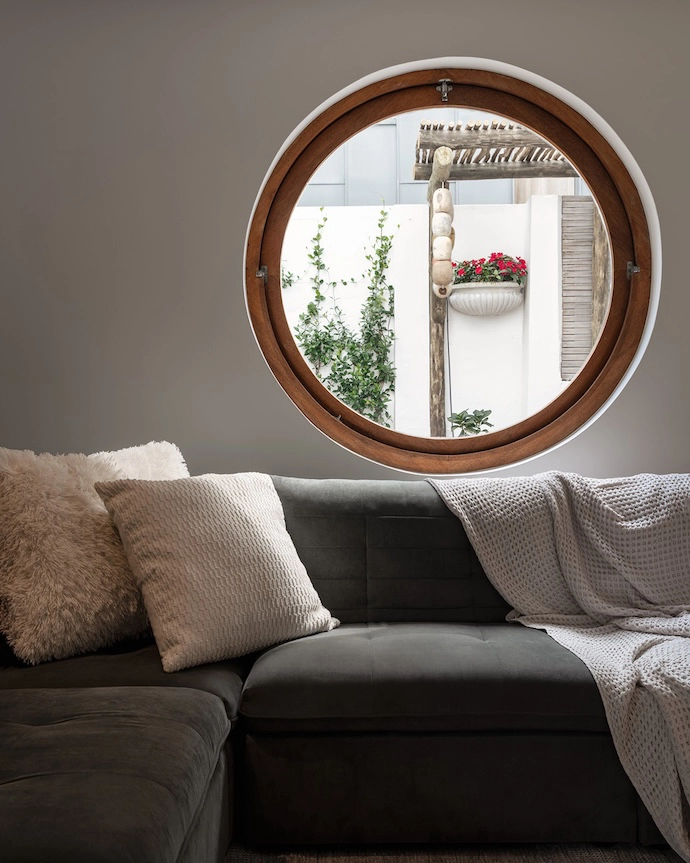
Portal windows make a quirky maritime nod here and there, while form follows function in the clean-lined main and guest bathrooms, with sanitaryware by Duravit and Crestial. -
Portal windows make a quirky maritime nod here and there, while form follows function in the clean-lined main and guest bathrooms, with sanitaryware by Duravit and Crestial. -
Portal windows make a quirky maritime nod here and there, while form follows function in the clean-lined main and guest bathrooms, with sanitaryware by Duravit and Crestial. -
Portal windows make a quirky maritime nod here and there, while form follows function in the clean-lined main and guest bathrooms, with sanitaryware by Duravit and Crestial. -
A bedroom with a sea view, starring an occasional table and stool from NØDE.









Atlantic 91 – an elegant beachfront residence in the Western Cape seaside village of Onrus – breaks the mould of architectural convention while remaining grounded in history.
WORDS Annette Klinger PHOTOS Paris Brummer
When Jankel Nieuwoudt was a young and broke final-year architecture student, he approached a family friend with a proposition: sponsor his outstanding study fees, and Jankel would design him a house one day. Fast-forward 20-odd years, and it’s clear who got the best out of the deal: Jankel’s family friend now owns a striking home on a stretch of prime real estate overlooking the beach in the coastal village of Onrus. “The brief was to build a typical Onrus house, and I thought to myself, ‘What on earth is an Onrus house?’” says Jankel. “Many of the houses were built by farmers as beach getaways, using whatever material was left over from their projects, so the styles are quite… ad hoc.”
That’s not to say there aren’t gems among the area’s idiosyncratic buildings. Perched on a hilltop amid a milkwood grove, a small limewashed chapel with a barrel-vaulted facade captivated Jankel’s imagination – not just with its built form, but with its backstory. St Luke’s Greek Orthodox Chapel was designed by architect Jack van Rensburg on commission from artists Maxie Steytler and Tertia Knaap, who wanted a concrete reminder of their memorable residency in the Mediterranean. Which is how they ended up with an architectural landmark – one in which a former state president was married, no less – on their property.

“It’s a super-interesting story of Onrus’s heritage that not many people know about – so I thought, let’s tell it, but on the main beach,” says Jankel. “I think when you design something that’s perhaps more daring than the local market is used to, a narrative helps to ground the building in its context much better than any ethereal architectural talk and jargon can.”
The resultant residence reads as both a direct translation and a deconstruction of the original source material. Beyond the obvious reference to the barrel vault, Jankel’s contemporary reimagination makes other nods to the original, like the pitched braai chimney that echoes the chapel’s spire, and the irregular white plaster finish evocative of the original’s limewashed walls. The technology used to get to this point, however, is far removed from that used for the 1980s structure. Traditionally, barrel vaults are built from brick, but the external walls that remained after Jankel gutted the site’s existing residence could not carry the weight of the arches. This prompted an idea: “We created a light steel structure, and clad it with Wedi board – an interior waterproof building board that’s very lightweight – which we scored and bent across the shape, before plastering it,” says Jankel. “It was a super-interesting, super-scary process; the product had never been used like that before, and I had to get sign-off from the manufacturer in Germany so that its warranty wouldn’t be voided… It was way more risky than I was willing to admit at the time!”
Equally stressful was the plastering process, which also utilised novel technology to achieve a traditional aesthetic. “In collaboration with plaster specialists Plaster Art, we formulated a mix that contained the traditional lime, but also white fibre and latex reinforcement, which can accommodate some movement of the lightweight vaults caused by the wind,” says Jankel. “As we were finishing our project, the house next door started a big renovation that included cutting bricks, the dust of which blew onto our plasterwork. We had to repaint the entire house.”
Completing the exterior, the bright white, textural finish of the curves is juxtaposed against two rectilinear walls finished in stone cladding, also visible in some areas of the interior.
By day, the interior is bathed in sunlight thanks to arched windows following the curves of the vaults. “The house faces east, which means it really heats up in the mornings,” says Jankel. “We couldn’t exactly put curtains on the barrel vault form, so we worked out a pattern that could cut out 50% of the direct sunlight, and printed it on the glass in ceramic.” By night, the space is illuminated by soft light emanating from the periphery of a bulkhead – which, again, was largely a function of the barrel vaults. “Hanging pendants from a four-metre ceiling would be ridiculous, so we opted to create an ambient circuit of light that not only makes for a relaxed atmosphere at night, but also accentuates the architectural form.”

Also designed by Jankel, the interior architecture speaks to a barefoot modernist sensibility, letting the space and materiality of the fittings and fixtures do the aesthetic heavy lifting. “I like to keep interior architecture almost anonymous, because I want it to be timeless,” says Jankel. “As soon as you bring fads in, it becomes temporary, locking you into a renovation cycle.”
Asked to single out a favourite vantage point of the house, Jankel’s answer is unexpected. “I like observing the house in its background state,” he says. “When it was just finished, I searched Onrus Beach tags on social media to see how it looked in people’s beach photos, out of focus. I really enjoy looking at that perspective, because it’s important to see how a house sits in its context.” It’s a thing – and #onrusbeach is definitely levelling up with the addition of this rising Instagram celeb. @_jankel | @_nieuw
Don’t forget to sign up to our weekly newsletter for the latest architecture and design news.