WORDS: Mandy Allen
James Dyson was recently knighted for his services to business. Though his revolutionary vacuum cleaners have reached iconic status, he’s more concerned with function over form and integrity over celebrity.
‘I don’t have a design mantra; I just want things to work properly,’ says Sir James Dyson. This approach has formed the basis of his career and seen Dyson become the best-selling vacuum cleaner brand in several countries, with more than 10 million sold worldwide.
While his products have worked flawlessly, his path to success was clogged with adversity. That included some early criticism of his design – which is now so lauded, Dyson models are in the permanent displays of several international design museums.
‘There were reservations about the clear bin and bright colours, but I ignored them. There’s energy in the colours and I liked the idea of seeing the dirt,’ says Sir James. Success, he asserts, teaches one nothing: ‘Failures, such as my 5 126 prototypes, teach you everything. Making mistakes is the most important thing you can do.’
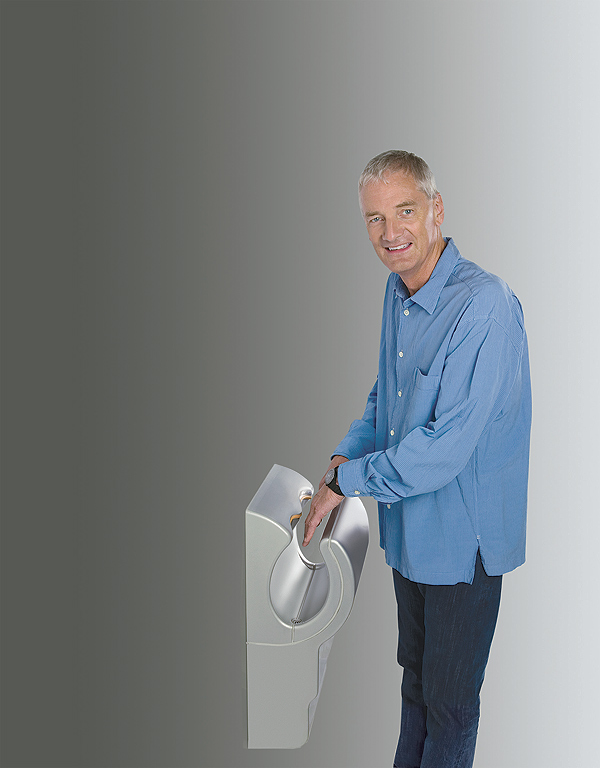
But vacuum cleaners aren’t the only objects to get the Dyson makeover: the company recently launched the Dyson Airblade. ‘It’s a supercharged hand dryer that creates a high-speed sheet of air, the “blade”, that gently squeegees your hands dry,’ says Sir James.
In 10 seconds hands are left dry and, more importantly, clean. The unit also helps to filter and purify the air by removing bacteria and mould. And, true to the Dyson philosophy of making things work properly, the Airblade has a specially developed digital motor that uses up to 83% less energy than a conventional hand dryer.
Sir James, who describes himself as ‘an engineer first and a designer second’, is on an enduring quest to unite technology and creativity. Unsurprisingly every Dyson model from the first is lined up in his office with other favourite design classics, such as Achille Castiglioni’s Toio lamp and Paulo Parigi’s Heron Parigi chair. This reflects his deep appreciation of considered design: ‘I don’t believe design equals style because style easily dates. Good design is about how something works, not just how it looks.’
Sir James’ dedication to making things work properly is such that he’s now setting up the the UK’s first specialist design and engineering school, the Dyson School of Design Innovation, opening next year. ‘Too few people follow careers in engineering. It’s critical for Britain to educate young people in such skills to compete with countries such as China. I imagine the same applies to South Africa.’