PHOTO: Federico Cedrone | WORDS: Johan van Zyl
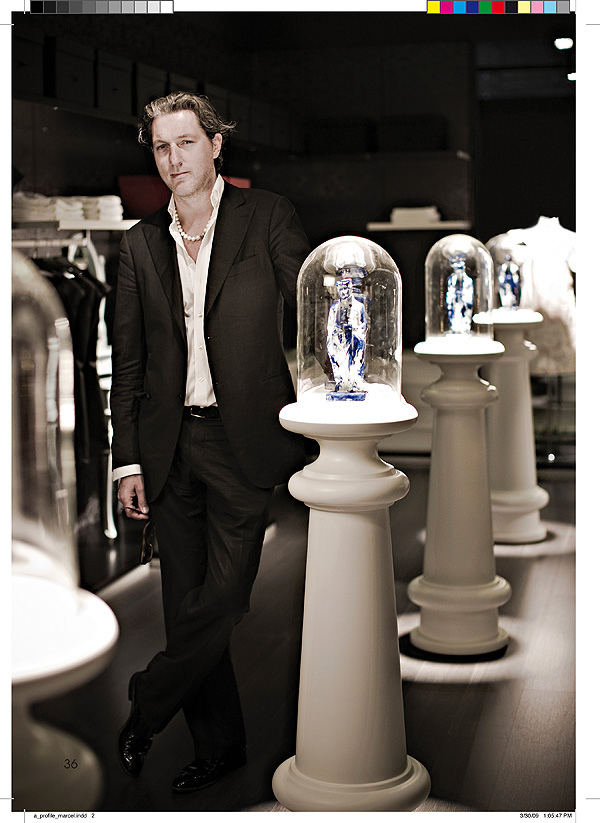
He’s one of the world’s greatest creative raconteurs. Meet the charming Dutch jester who wears a pearl necklace.
You’re not amused when journalists question you about a “recognisable Dutch design identity” or mention the fact that Dutch designers have conquered the world…
The concept of a Dutch design identity has been a problem for me in the past but these days I can live with it. Design is so great because it is an international language that people all over the world can use to try and understand each other and live together in a beautiful way. I seriously don’t know why people, particularly the media, always want to play these nationalist tricks; why we want to make large things small.
So, yes, I was born in Holland and yes, the Dutch have a fabulous culture where creativity is valued and rewarded, where people like myself can make a living by making funny drawings, thinking up a new world, writing poetry. But while in South Africa I don’t like to talk about this too much because, in this context, Dutch doesn’t always have positive connotations.
In your Design Indaba presentation, one of the tips you gave to young designers was to learn to trust yourself. Have you always had this overwhelming confidence that some people confuse with arrogance?
I have been a designer for 20 years and, when I was younger, nine out of 10 of my design projects failed. I thought it would change when I became fabulous and world famous one day – that people would just know I was always right. But it is still exactly the same: Nine out of 10 projects still fail and we should be grateful about that, as sometimes we are indeed wrong.
Design is only meaningful if we can move the world in a certain direction. As a designer, it is critical to take steps that are bold, personal and different. You must have a vision of a better world – of what we need now and in the future, and it should obviously be different to what we have today. It can be difficult and lonesome to believe that you’re right, but you have to believe in yourself and your vision to get the energy of others directed in the direction where you want it to go. People often want to know where my inspiration comes from.
I believe inspiration is a divine fire glowing inside. It is a sense of purpose, of knowing who you are and where you’re going. What’s beautiful about this profession is that it is like walking: Two legs are involved – your personal and professional development – and therefore you cannot become a better designer if you don’t grow as a person.
You also talked about “design for the people” and “representing the public’s dreams”. Who is this “audience” you’re targeting?
Design is about connecting with – and communicating my aspirations to – the people around me. Just as language is a vehicle, I consider design a large vehicle for talking to anyone who wants to listen. Why would you want to exclude anyone? Of course I cannot choose my audience. An audience selects itself because what you give as a designer resonates with a certain group.
Did you know much about South African design before your visit to Cape Town? Were you impressed with what you saw?
I had no idea what South African design was about but I’m really excited about a few things I saw at the Design Indaba Expo. What struck me was the huge number of visitors to the show – the queues of people waiting to get in because they love being in that creative environment. I can honestly say I have never seen anything like this anywhere else in the world.
On your last day at design school you made a list of the 10 companies you wanted to work with – 10 years later you discovered that you’d collaborated with all of them. Do you still have aspirations?
I used to be a plan-driven guy with clear goals, but I started to feel it was stupid and superficial to make one specific plan after the other. If you are a designer, you in fact want to go to a place that doesn’t yet exist. You want to do something completely different and new. Nowadays I simply decide on the direction I want to take – I know where I’m going, but I don’t care about what it will take to get there.
Your work is often extremely decorative – beautiful, I suppose. and you’ve said that the “form follows function” principle can inhibit creativity. Some people say you are more artist than designer…
Oh, I’m sick of people with these beautiful little boxes! You’re an artist or a designer or a craftsman or whatever. Frankly, I’m too tall for your little boxes. I have my own large one and I just fit perfectly well into that.
• Marcel Wanders’ designs for Moooi are available at Créma Design: 021 434 0661