-

Fhatuwani Mukheli -
Blessing Blaai
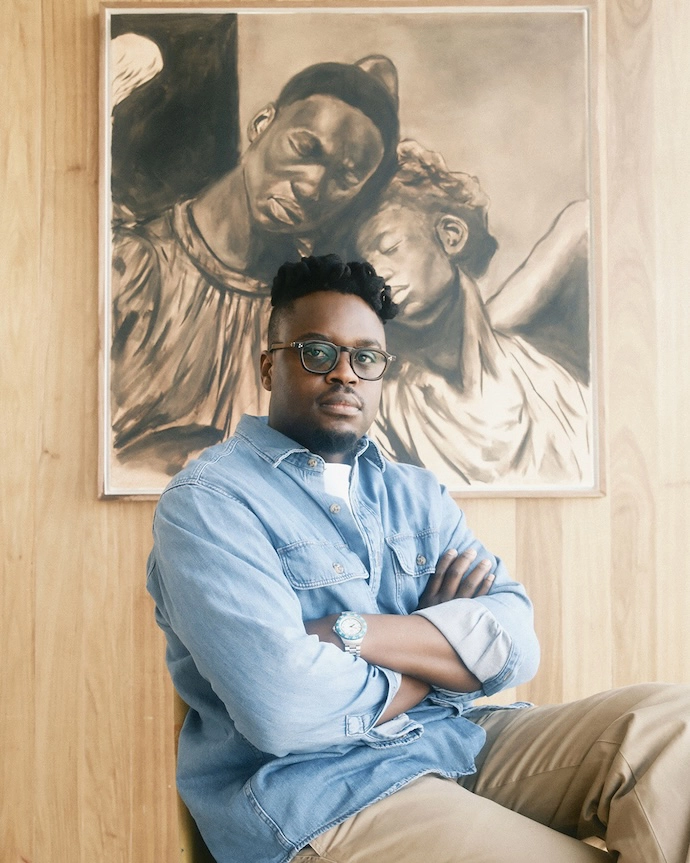
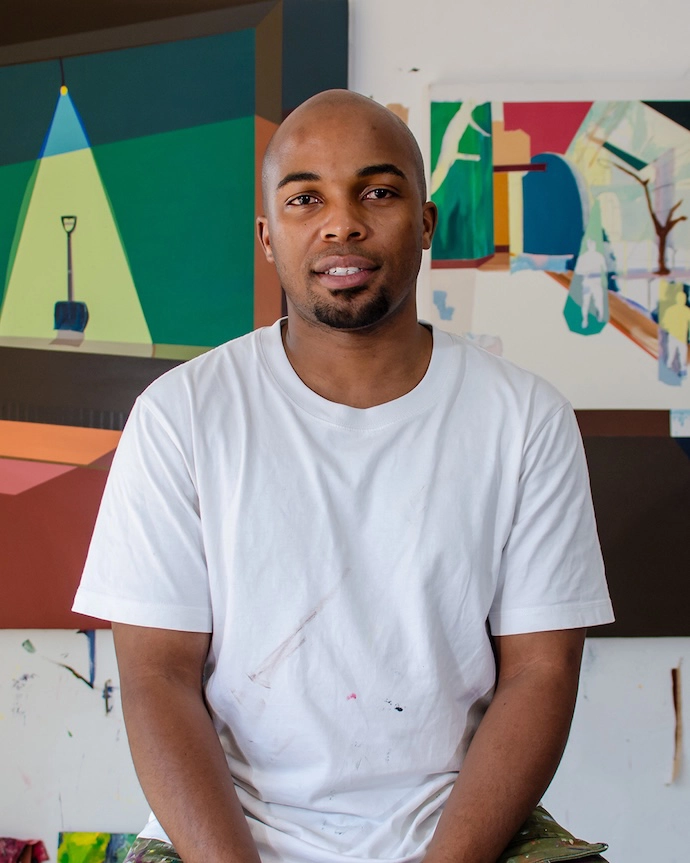
Gallery MOMO, a Johannesburg-based gallery, will be showcasing two local artists – Fhatuwani Mukheli and Blessing Blaai – at the 2026 Atlanta Art Fair.
WORDS Palesa Mohola PHOTOS Courtesy of Gallery MOMO
Gallery MOMO is no stranger to the American art scene. It has exhibited at art fairs such as EXPO CHICAGO since 2019 and at Navy Pier in April 2026, and maintains an artist residency with the School of the Art Institute of Chicago. The Atlanta Art Fair is the next American chapter of that programme and marks Gallery MOMO’s first appearance at the fair.
Representing the gallery are two South African artists whose practices, though distinct in medium and approach, share a deep engagement with identity, memory and heritage.
Fhatuwani Mukheli is a Johannesburg-born multi-disciplinary artist whose work often centres on the relationship between parent and child. Working in acrylic paint, charcoal, fineliner and spray paint, he gravitates towards earthy reds drawn from his Venda heritage.
Blessing Blaai is a Johannesburg-based visual artist and muralist trained in painting, drawing and printmaking. He works across oil, acrylic, watercolour, ink and mixed media.
The works that will be showcased at this year’s fair comprise paintings and mixed-media pieces, including Fhatuwani’s A Study of Freedom, a large four-panel painting, and Blessing’s Surmount, a mixed-media artwork.
We spoke to both artists, who gave us insight into the creative process behind their works for the Atlanta Art Fair:
Can you walk us through your creative process, from planning your piece to the final product, and what was your favourite part of making your exhibition piece?
Fhatuwani Mukheli: “My process is quite layered and can be lengthy because I find inspiration everywhere. I read a lot of art books, Renaissance books and art history, looking at the stories artists were telling at the time and imagining my own life and reality within them. I’m also constantly collecting references, colours, compositions, clothing, poses, light, music and things I see in everyday life.
“From there, I sketch and build compositions, sometimes reimagining historical works and sometimes creating completely new stories rooted in my upbringing and where I come from. My favourite part is when all those different references finally come together and the work begins to feel like my own world.”
Blessing Blaai: “Process starts from a collection of drawings and references (new and old) which basically form my “library”. I take cut-outs I’ve made, drawings and other motifs and combine them to form the base of the artwork, which is done as an underpainting. Once happy, I start the next step where I section each part of the work using masking tape (which has become both tedious but very satisfying at the end), then paint.
“Once dry, I pull off the tape, which has become my favourite part as I get to see the results for the first time.”
What new ways of creating did you experiment with when putting together this piece, and how did they improve the quality of your work?
FM: “I’ve been experimenting more with how I build compositions and how different references can exist within one image. Instead of simply recreating a historical composition, I take elements from different places, Renaissance imagery, photography, contemporary African life, clothing and my own memories, and reconstruct them into something new.
“This has allowed the work to become more layered and intentional. I’m thinking beyond just making a beautiful image and asking what every gesture, object, pose and compositional decision contributes to the story.”
BB: “In my recent works, I’ve approached them as if I’m doing a multicolour linocut, which has allowed me to place elements harmoniously, giving a nice uniform look while creating depth.”
What story do you hope to tell with your art piece?
FM: “I want the work to feel like a reflection of my life, my upbringing and the people and communities that shaped me. At the same time, I’m interrogating art history, particularly Renaissance art, and asking what those images might have looked like if people who looked like me had been given the same dignity, beauty and monumentality.
“In many ways, my work is about deconstructing history and reconstructing it through my own perspective, placing Black people at the centre of stories where we were historically absent.”
You are trained in painting, drawing and printmaking, and work across oil, acrylic, watercolour, ink and mixed media. How did you ensure that your different ways of creating were represented and still balanced in your piece?
BB: “Within the different mediums that I’ve learned to use, each has come with a certain principle that I keep. For example, when working with ink on paper, all works had to be clean even if the process was messy (which is very aesthetically pleasing). This is one of the rules I’ve applied to the final look of my works.”
How does the surrounding environment and natural landscape influence or inspire your work?
FM: “My environment is a huge part of my work. I grew up in Soweto, but my family history and Venda heritage are also deeply connected to how I see the world. I’m inspired by landscapes, homes, family spaces, people, clothing, textures and even the colours around me.
“But environment for me isn’t only physical. It’s also the music I’m listening to, conversations I’m having, things happening around me and memories from my childhood. Inspiration is everywhere; I’m constantly looking.”
What feeling do you hope audiences get when they view your artwork?
FM: “I hope there is an immediate sense of beauty, dignity and presence, but I also want people to stay with the work long enough to question what they are seeing. I want them to recognise something familiar while also seeing history from a different perspective.
“Ultimately, I want the work to feel human. Even though I’m having a conversation with art history, the people in my paintings come from my world. I want audiences to see Black people represented with tenderness, strength, beauty and the same sense of importance that has been given to figures in classical art for centuries.”
BB: “I want the audience to feel an array of emotions (depending on the piece they are looking at), but the overall purpose is for them to feel like they fit into the piece despite the emotions they’re experiencing.”
The Atlanta Art Fair continues to be a platform for cultural enrichment and artistic exchange. Now in its third edition, the fair takes place from 1–4 October 2026 at Pullman Yards in Atlanta, bringing more than 70 galleries from around the world. gallerymomo.com | theatlantaartfair.com
Don’t forget to sign up to our weekly newsletter for the latest architecture and design news.