-

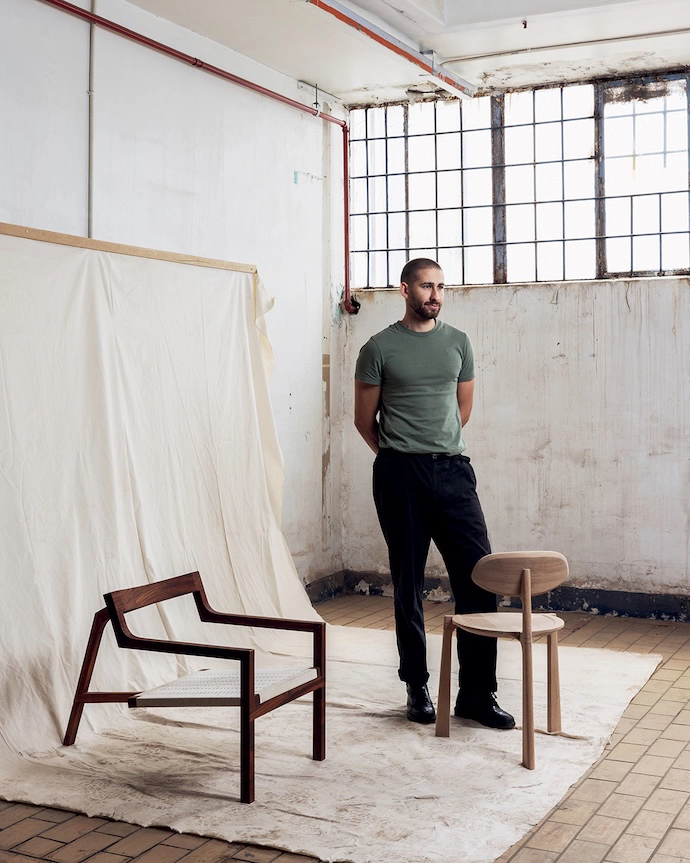
Tom Lead with his Studio chair (left ) and Koppie chair (right). The latter – a collab with Stripped Collective – was the winner of the Cape Town Furniture Week x VISI Design Prize. -
The Studio chair -
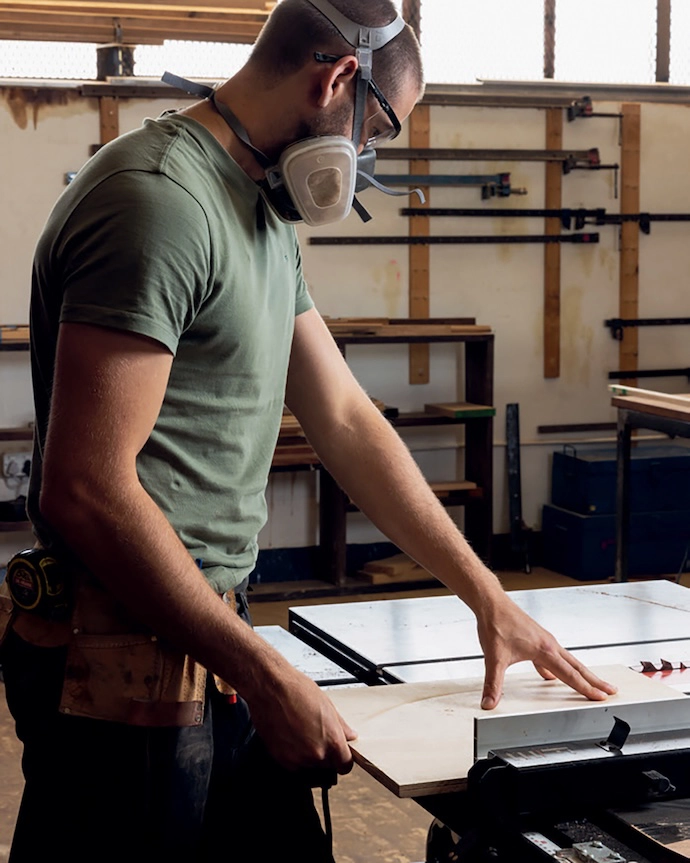
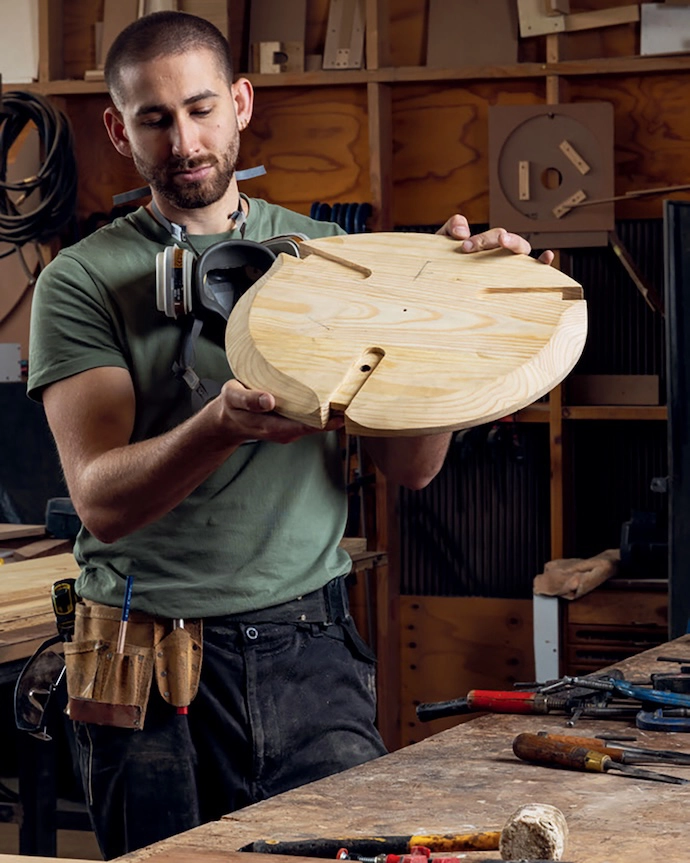
Tom at the Stripped Collective workshop in New Doornfontein. -

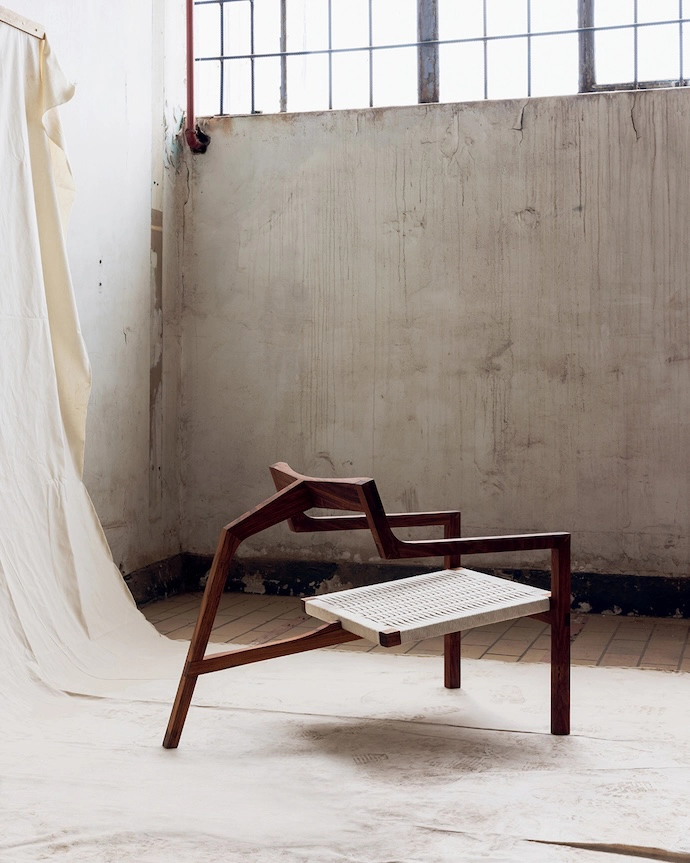
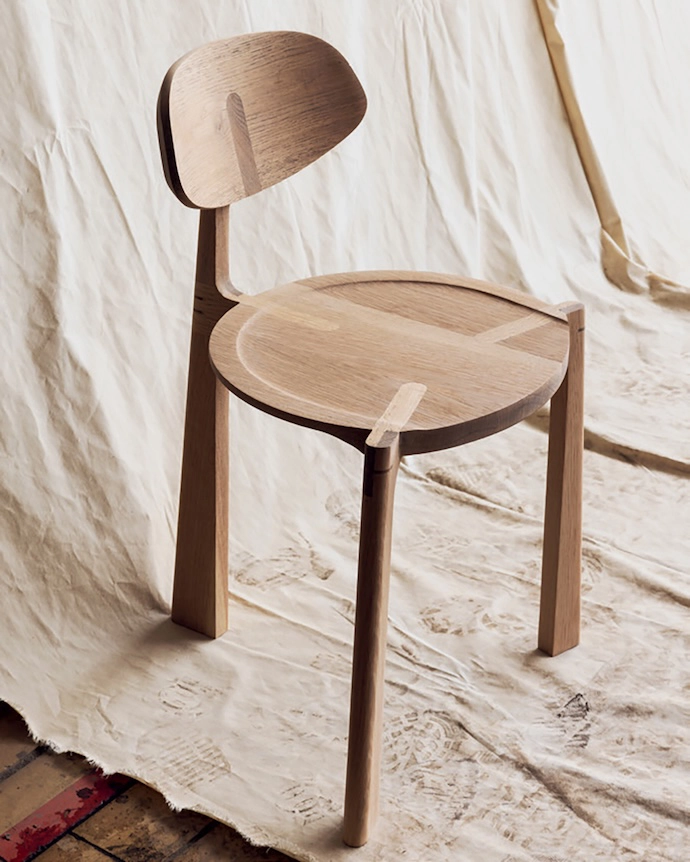
The Koppie chair -
The base of the Koppie chair displays its complex joinery.
After his collab with Stripped Collective – The Koppie Chair – won the CTFW x VISI Design Prize, we definitely needed to find out more about this very talented local designer. And it’s an inspirational story.
WORDS Tom Lead and Steve Smith PHOTOS Sarah de Pina
It’s safe to say most parents would, at best, discourage their kids from becoming an artist. Rather be a lawyer, or a doctor – now there’s a decent career. Young Thomas Lead had the opposite to contend with. “I was brought up in a creative family, so it was inevitable that I’d end up doing something creative,” he says. “I was under pressure to become an artist!”
Studying art in high school led to an art degree at Wits, which is where his passion for furniture sparked. Here’s his story.
That Spark – and The Fight
“I was conflicted about what to do for my final year. The year before, I’d done a series of acrylic paintings of home spaces that addressed lockdown living, and, looking down the daunting barrel of my final year, I was overwhelmed about what the subject of the next series of paintings would be.
“I decided to stick with something I knew – chairs. I had an interest in drawing chairs, mainly because they make for great still lifes. As someone who had little design experience at the time, and no idea of the complexities and depth involved in designing a chair, let alone a unique one, I naively thought, ‘Let me just design my own chair.’
“After six months of working tirelessly in the Wits workshop – and 15 iterations later – I had a newfound appetite for chair design. Each chair was a sculptural puzzle that needed to be solved, often creating more questions than answers. I became obsessed; I practically lived in the Wits workshop. The managers would lock me in during lunch, and chase me out at the end of the day. I was the first person to win the ‘Golden Hammer’ award for dedication in the workshop.
“Since then, my journey has been a bumpy roller-coaster with quite a long drop in the beginning. In 2023, I was diagnosed with a rare type of lymphoma. My whole world got flipped on its head; I went from worrying about what I was going to do for my gap year to worrying about whether I would be alive in a year’s time. Luckily the cancer responded well to treatment, and I went into remission after about four months of chemo. I then spent 18 months in and out of hospital for ongoing treatment. It changed me as a person and as a creative. That level of isolation and feeling of separation is something I’m still recovering from. It felt like someone had stomped out the fire that had erupted a couple of months prior, in my final year at Wits.
“I had to work hard to keep my creative embers glowing. I kept my sketchbook next to my hospital bed and, on the rare occasion that I had an idea for a design, I’d grab my book and get it down. I have memories of waking up in the early hours of the morning, turning on my light, and sketching an idea in my sketchbook. That practice created quite an intimate bond between me and my designs; they were like friends who would distract me from the pain of my reality.
“I was only able to work professionally in 2025, starting with Khyle Strydom and Simon Hough at Stripped Collective, and the design of the Koppie. It’s been an incredible journey. I’m very proud of how far I’ve come under the circumstances, and I’m excited to see where I’ll go next.”
The Story of The Koppie Chair
“I came up with the basic concept for the Koppie in hospital, but it’s evolved significantly since then. I knew I wanted to design a three-legged dining chair that was exciting. I didn’t have the strength or immunity to work in a workshop, so I had to make maquettes of the designs whenever I came home. The mini three- legged chair is lying around my mom’s house somewhere.
“I was first drawn to three-legged chairs in my Wits days. They pose a unique challenge both structurally and aesthetically, and they have strong roots in African history. The process of trying to reimagine that in a modern African context interested me. My brief from Simon and Khyle was to design a chair that is simple, timeless, unique, humble and honest; a chair that represents the company and what it stands for. I was trying to make a chair that was rooted in Stripped’s identity… What I didn’t consider was that I’d become a part of Stripped, and that I would end up capturing a relationship in a chair. As my relationship with Stripped blossomed, the design followed suit.”
His Design Approach
“Because I didn’t have a formal design education – I am an artist – my approach to design is artistic and sculptural. I’m drawn to the structure of things; I like to play with the mechanics of furniture and push the boundaries of materials. I’m drawn to creating objects that are visually illusive yet structurally sound. I love when people have to take a second look at something I’ve made. This interest in structure influences the way my designs are made. Exploring new, interesting joinery techniques is something I strongly consider when designing; often, the joinery system will inform the design.
“It was something that informed the Koppie’s design. I came up with a joint that we named ‘the duck’ (as a result of its duck-like side profile) during the prototyping because I needed a more efficient way to test out different designs. So instead of creating a whole new chair every time I tweaked the design, I could instead make a new leg and slot it in. This system ended up moulding the design into its final form.
“Simplicity – designing something that feels light and that doesn’t demand too much – is something that I strive towards. I generally stay away from heavy design – it doesn’t feel very me. I put a lot of weight on being original. It’s so easy to be influenced by other designers and their work. For this reason, my process is very important. The time I put into drawing, playing and following my intuition without too much influence from other material is what allows me to create pieces that are pieces of ‘me’.
“My design approach has been influenced by the environments I’ve moved through. I’m part of a super-exciting generation of young South African designers who are expressing the country and the cities and the people around them. It’s exciting and encouraging to see. In that respect, my approach is decolonial and New Age South African.”
His Inspiration
“There are many things that spark my creativity. Materiality is a big one. I’ve worked predominantly with wood, and my approach is to think of it as a collaboration in the sense that I’m not using a material, but rather we’re working together – learning its texture, how it cuts and moulds, and where its limits are. It’s an incredible material and there are so many variations that function, feel and smell so different. It’s a strange one, but the smell of the wood I’m working with influences the design.
“Limitations are another big source of inspiration. They’re something I used to fear as an artist, but learnt to love, and now impose. How to work around a limitation and the problem it imposes excites me. It was something I learnt from Prof David Andrew at Wits: ‘Make a painting with only your left hand’ and ‘Use a metre-long paintbrush.’ It’s often where a new idea stems from. Designing a stable chair with three legs is the limitation that created the Koppie.
“People spark my creativity too. Working with other designers influences my process. That’s another limitation – figuring people out. Having people to conceptualise ideas with, to critique and be critiqued by, leads to work I couldn’t do in isolation. Creating a manifestation of a relationship is powerful.
“Music is also a big part of my life. When I went to university, it was either going to be music or art. I’m glad I didn’t choose music; it would have tarnished my relationship with it. I play piano and guitar; I sing. It’s such a different form of creative practice, but I’ve found that my music can inform my design. Rhythm, space, harmony, silence – they have all inspired my work. The overlap between design and music in my practice is a very interesting space.”
The Stripped Collective Bond
“There’s something grounded, humble and genuine about Simon and Khyle and what they have created at Stripped. I was drawn to working with them on a design basis – but on a deeper level, I really liked who they were as people. Our mutual fondness and our shared values have played a huge role in our work together.
“Simon and Khyle believed in me as a designer and gave me the freedom to explore. They allowed my curiosity to wander, and gave me the space I needed without neglecting me. The biggest lesson I learnt was how to partake in constructive conflict – how to put egos aside and come to a decision as a team, because that was best for the design regardless of who was right or wrong. There were some decisions we battled over for days. I found that those points of contention resulted in some of the strongest elements of the design – they transformed us from a professional team into good friends.” strippedcollective.co.za | @tom_lead_design
Don’t forget to sign up to our weekly newsletter for the latest architecture and design news.