-

Ingredients for the fragrances that aren’t grown on site are sourced from a handful of local, ethically managed farms and suppliers. -

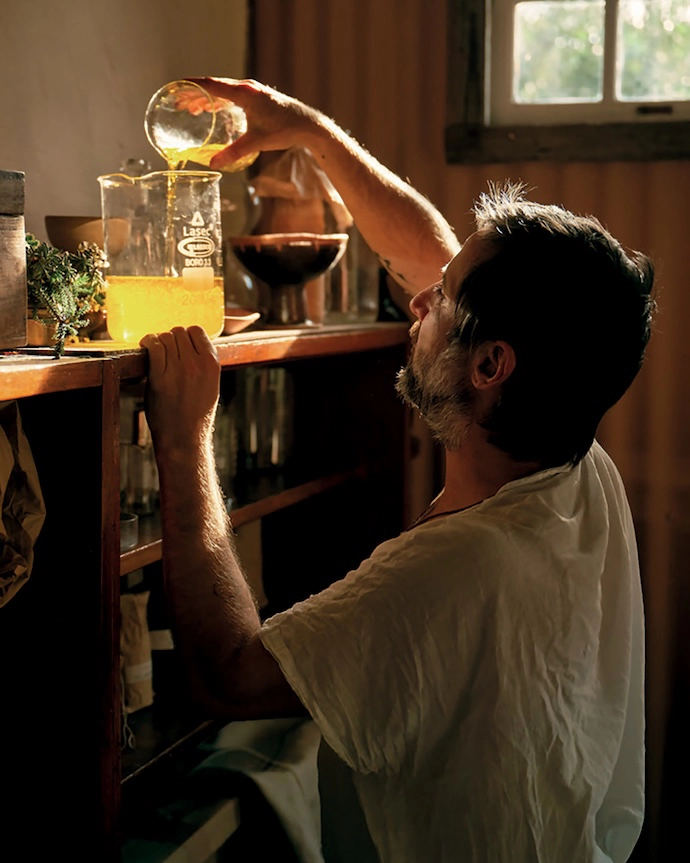
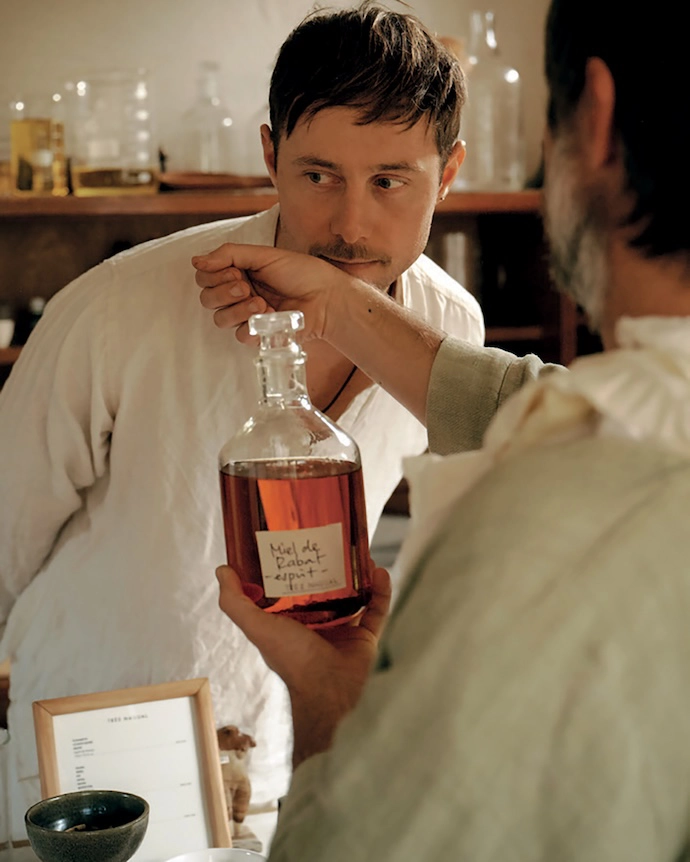
Florian’s culinary studies and background in systems biology are of value when fine-tuning fragrances -
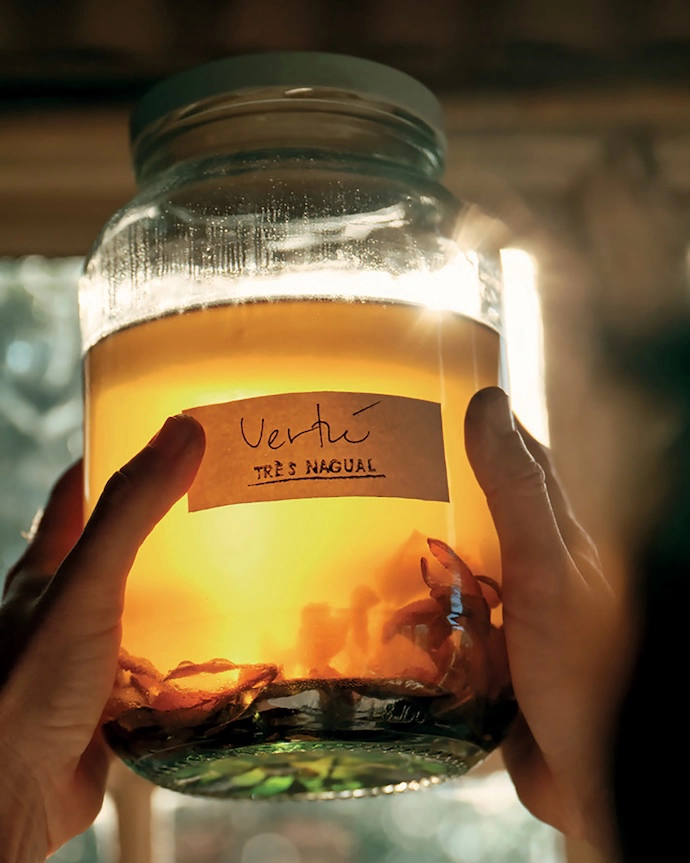
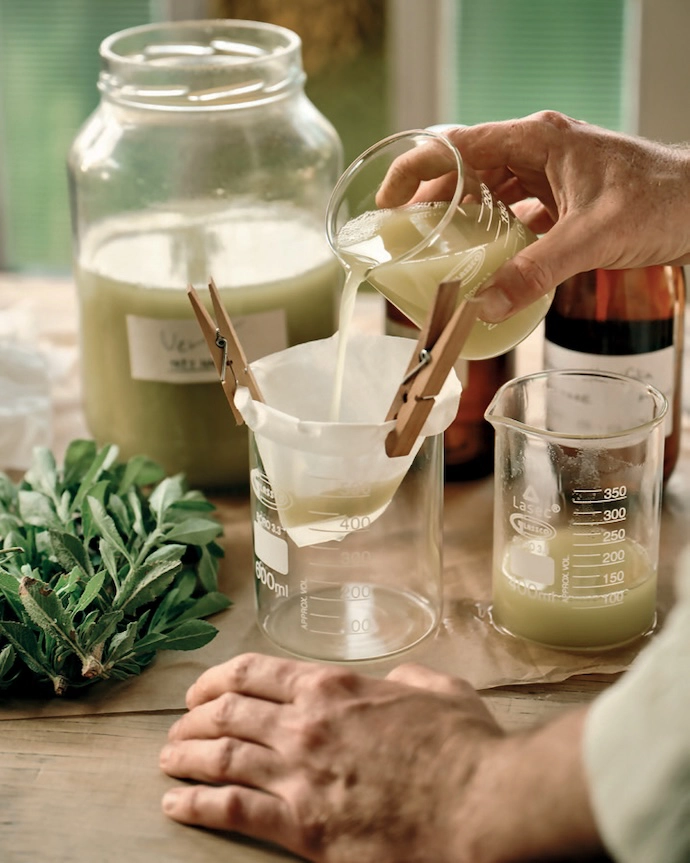
Many of the perfumes distil for as long as a year before being bottled. -
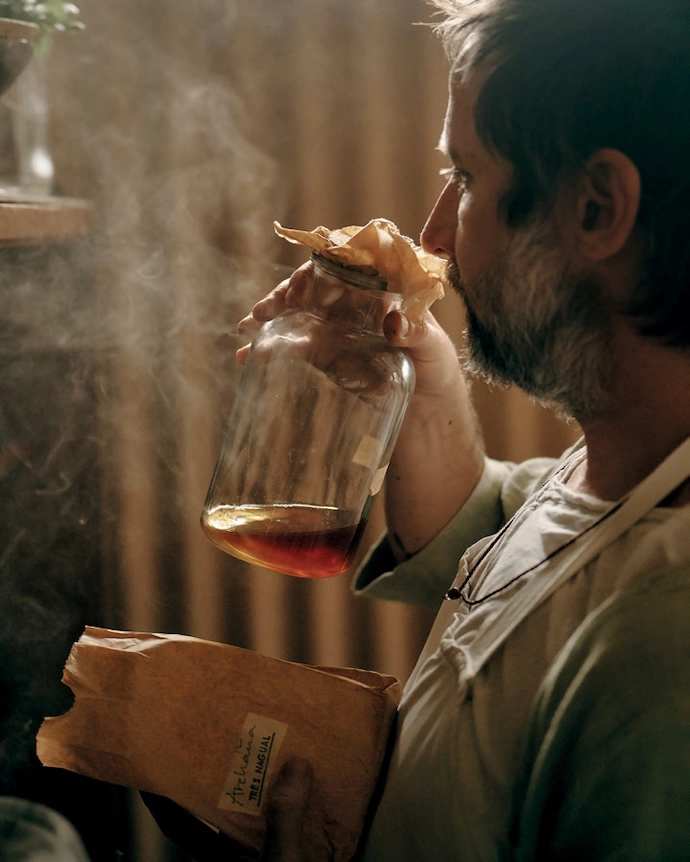
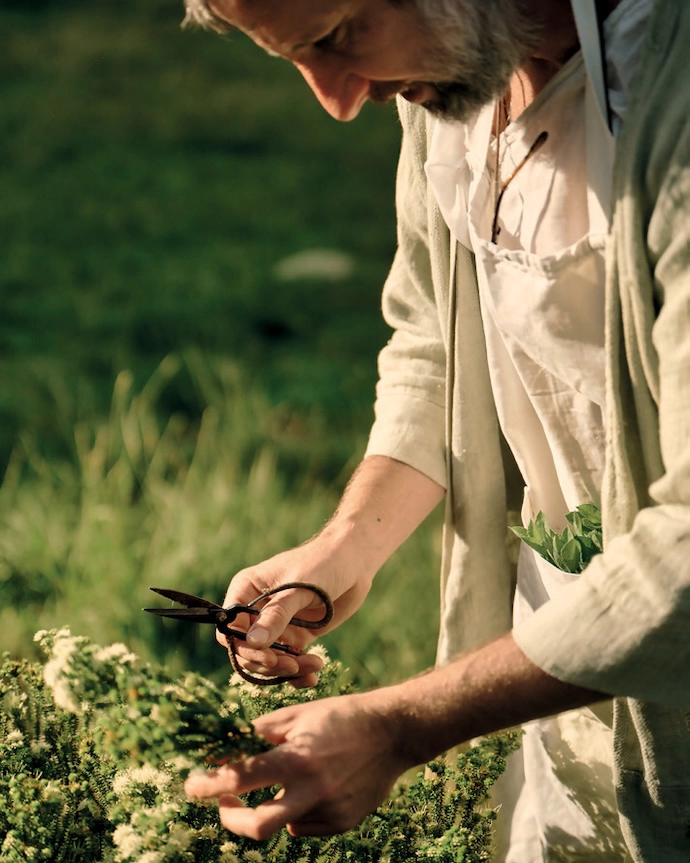
Florian forages for aromatic ingredients. -
David’s eye for visuals is apparent in the curated interior. -
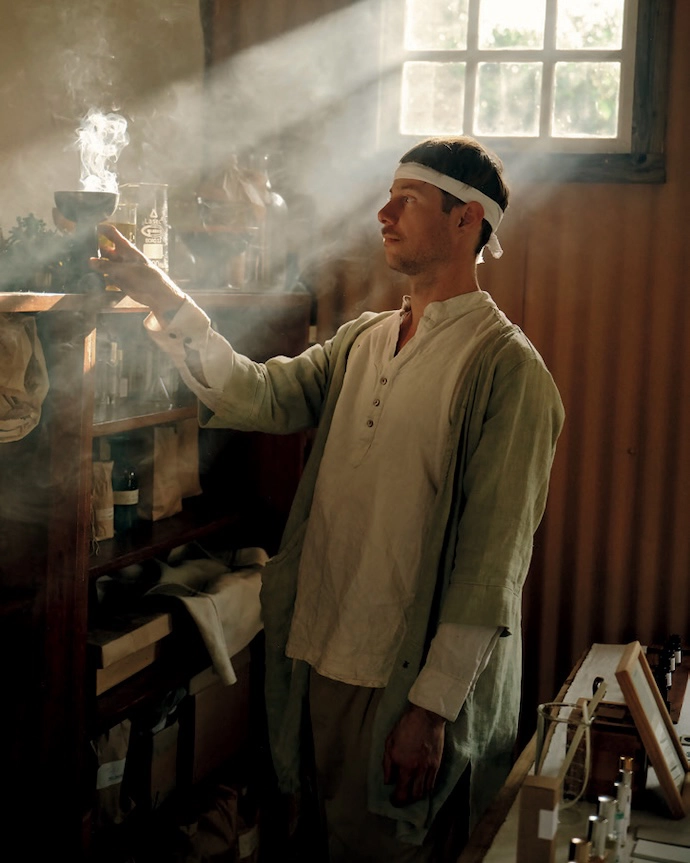
On weekdays, the studio serves as a laboratory in which the perfumes are created. -
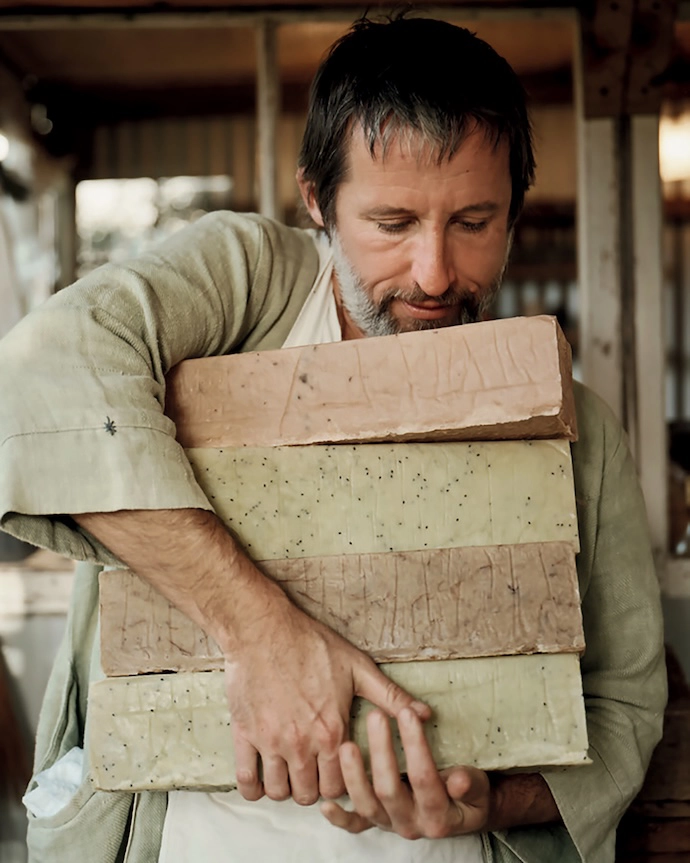
Large bars of handmade soap, made from harvested rainwater and other natural ingredients, are cut to useable size. -
Intentional Scent -
The perfumers consider their signature scents to be earthy and mountainous.
For the founders of Très Nagual natural perfumery, their Cape Point studio represents more than a sanctuary in which to explore the beauty of organic scents – it embodies their way of living.
WORDS Martin Jacobs PHOTOS Nicola Katie Suttle
Camouflaged behind flame-like aloe spires, the dark-green facade of Très Nagual’s Cape Point studio appears, much like the fynbos surrounding it, to grow from the earth. The corrugated-metal-and-wood structure, adjacent to founders Florian Baumann and David Plenderleith’s cosy home, serves as a weekday laboratory, and as a retail space from Fridays to Sundays. As far as workspaces go, with its gentle footprint in the soil, its architecture couldn’t be more aligned with the perfumery; and, once inside, it’s an evocation of all things analogue
Underplaying Très Nagual’s successes, which include global clients and the recent opening of a shared retail space in De Waterkant, Moroccan-born Florian says, “I don’t think of Très as a business, but as an extension of our being.”
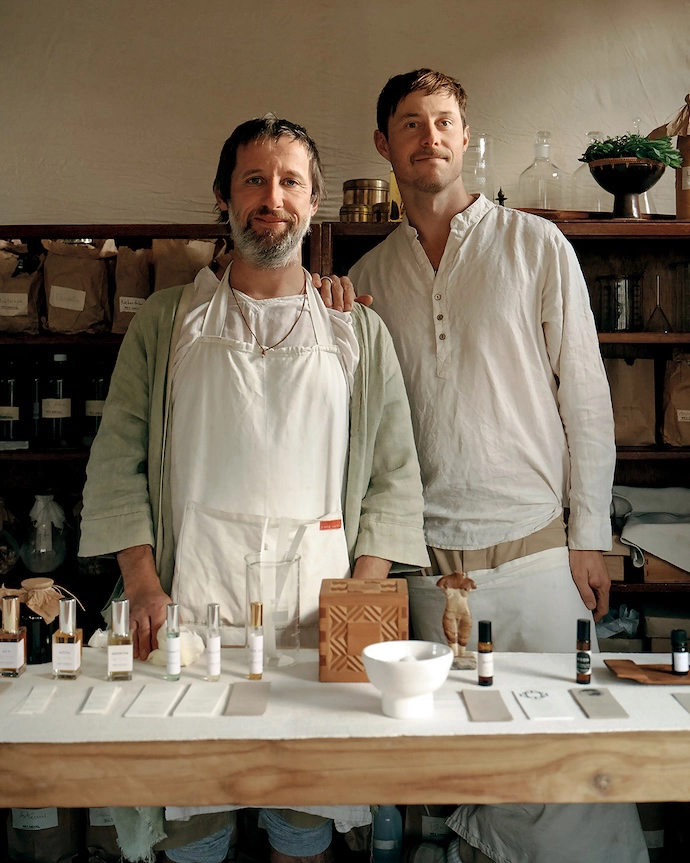
“And a way of living,” adds his partner David, a Zimbabwean, as he individually packages perfumes destined for Europe. “This is a lifestyle we wake up for – being in the shop, pouring the soap, really taking pride in doing things ourselves. It comes with slowing down, where every action is contemplative, and embodied by wrapping it with mindfulness and sending it out with love.”
Addressing this ritualism within their craft, he adds, “Part of our approach is to keep things small and intentional. I would rather make less and fi ll it with that intentionality and integrity, than dilute, mass produce and lose the essence of it.”
The couple, who met on a nearby beach in 2016, and who individually and together have travelled the world, share not only spirituality and a passion for the olfactory art, but an appreciation of the bounty of their remote surroundings.
Their choice of ingredients speaks to this. In addition to harvesting rainwater for use in Très Nagual’s handmade soaps, Florian – with his background in both cooking and systems biology – tends to their garden, both wild and cultivated, which yields many of the botanicals that form the base of their perfumes.
“This is how it all began, with whatever was immediately around us,” he says, pointing out wild rosemary, buchu (anise, lemon and garlic varietals), Artemisia, sage, geranium and fynbos, all thriving within metres of their studio. Looking towards a line of eucalyptus trees from which scent is extracted for soap bars, he adds, “The moringa and baobab oils come from Zimbabwe, David’s mom sends them down. She also sends down the elephant dung…”
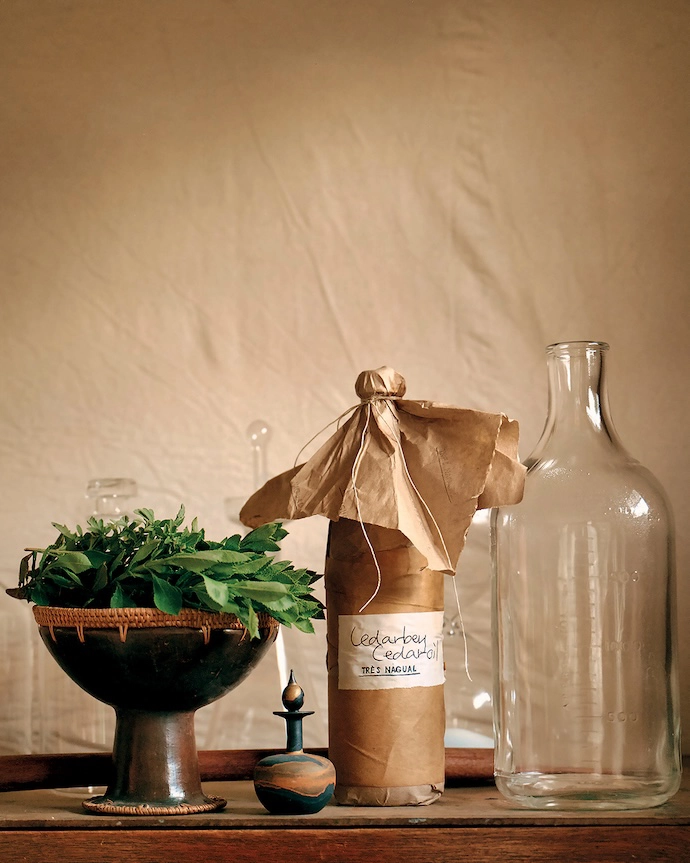
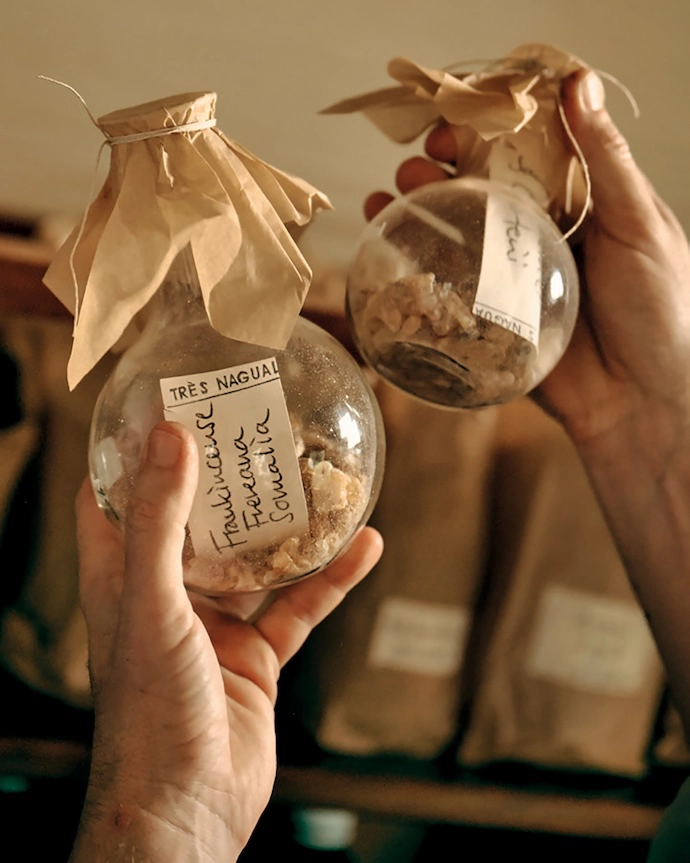
Back inside, the list of unusual ingredients continues. Glass jars, wrapped in brown paper bags to protect them from the light, contain frankincense, myrrh, fragrant woods, Tahitian vanilla pods, resins and more.
Enigmatic as many of these ingredients may be to those browsing Très Nagual’s shelves, so too are their fragrance names esoteric. Like the scents themselves, some – like Kå – manifest to the couple in dreams. Others, like Arthemis and Hildegard, are inspired by David’s interest in the mystical. Of Nefertum – an Amyris, lime and blue lotus scent – he says, “Nefertum is the god of perfume in Egyptian mythology. Blue lotus grows in the Nile, and there’s myrrh that’s associated with Cleopatra, so the name shows itself with the notes, formulation and energy of the scent.”
“Some clients aren’t ready for Nefertum, so they shy away – ‘No, I’m softer,’ they say – eventually returning, ready for the scent,” adds Florian. “Because Nefertum is quite erotic, it requires a little bit of commitment.”
The couple consider many of their fragrances to have a gender (Nefertum is male), as well as a personality. With notes of rose absolute and African chamomile, Elisabeth is female, a gentler scent evocative of antiquity. David describes her as very social, but equally a reader appreciative of her solitude. “Whereas Kå is like, ‘You guys are so boring, where are the high heels?’” Florian says, laughing, of the sexier patchouli, black pepper and West Indian sandalwood scent.
Given that the intensity of their materials varies with shift s in season and climate, no two releases of Très Nagual’s unconventional fragrances are identical – something the perfumers have had to explain to repeat clients, with differing reactions. Regardless of these subtle shift s from batch to batch, they consider the Très Nagual signature to be earthy, mountainous and wild. If that tends towards the masculine, well, consider that the scents are crafted by two men.
That’s not to suggest that the couple are so geographically removed from developments in the fragrance world as to be unaware of its constant evolution. Far from it. “I’m inspired to see what others are doing,” says Florian. “Secretly, I admire Diptyque and Aesop; I admire the vision, and the artistry behind it all. We’re in the same boat here. But I paint with my own colours. To niche further and to become more different is what this allows me to do – not to become more similar.”
And Très Nagual’s growing following is proof that their clients agree. | tresnagual.com
Don’t forget to sign up to our weekly newsletter for the latest architecture and design news.